
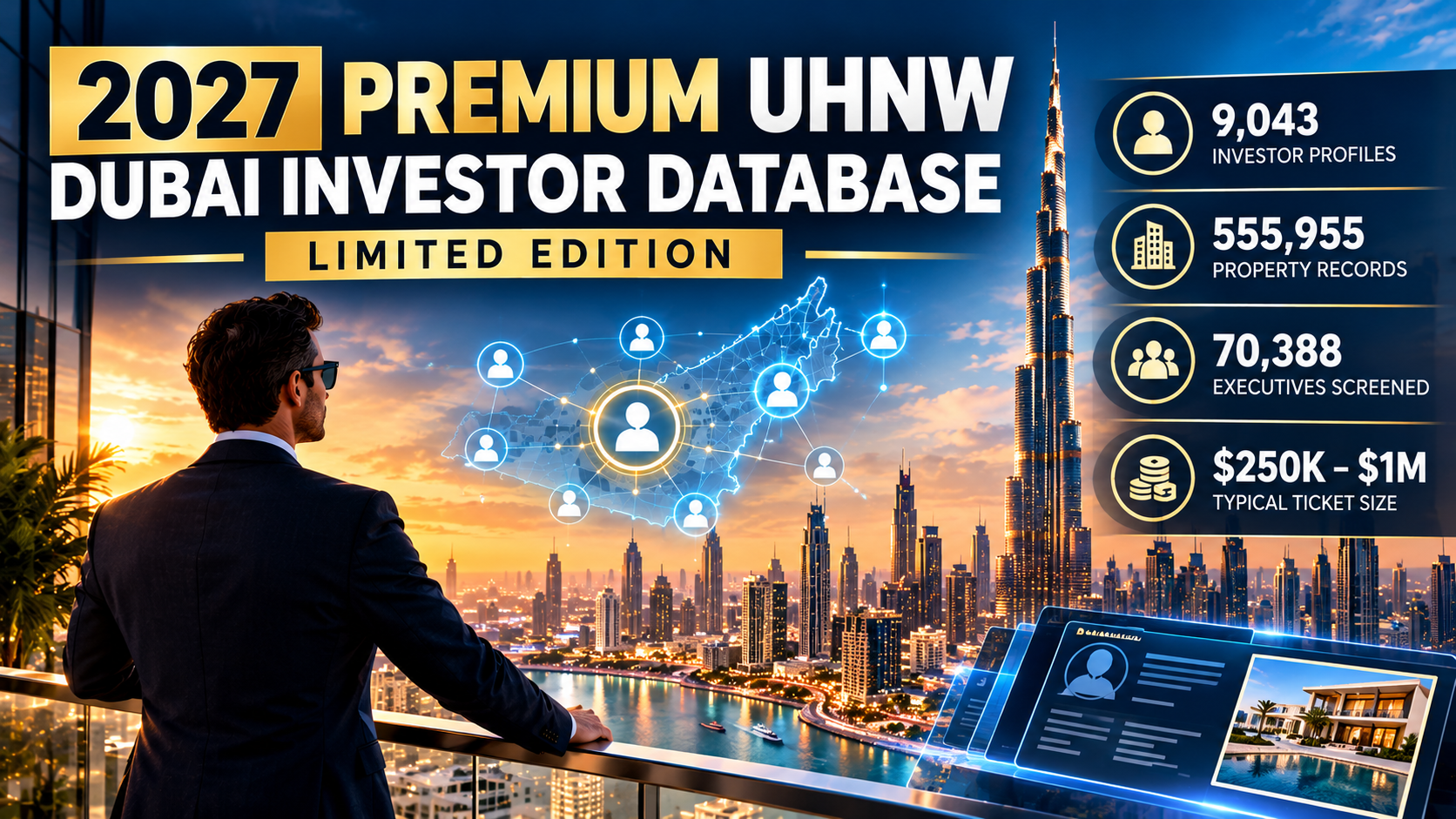
The 2027 UAE Investor Intelligence Database
From Executive Contacts to Property-Matched Investor Intelligence
Four independently sourced databases. More than 555,000 property records. One institutional-grade investor intelligence asset.
In capital raising, identifying a decision-maker is only the beginning. Knowing someone’s title, company and contact details can help establish who they are professionally, but it does not necessarily tell you whether they have a demonstrated history of property investment, what transaction evidence is associated with them, or whether they warrant further consideration for a particular fundraising mandate.
The 2027 UAE Investor Intelligence Database was developed to address that gap.
DubaiInvestorsList.com began with a substantial database of UAE senior executives and cross-referenced those profiles against multiple property transaction and ownership datasets covering Dubai and Abu Dhabi. The objective was to create something more useful than a conventional executive directory: a research asset that combines professional information with property-record evidence, identity-confidence assessments and a structured investment-prioritisation model.
The result is a database of 9,043 distinct profiles classified as verified or well-evidenced property-investor profiles under the project’s methodology. Each profile brings together executive information and matched property evidence, with an Investment Rating from A to D and a separate indicator for potential retail-investor capacity at the $250,000 threshold.
This is not simply a matter of adding more contacts to an existing list. The distinction lies in the process used to identify, match, assess, filter and consolidate the records.
The database is designed for professional organisations raising approximately $10 million to $50 million, particularly those seeking individual investment tickets in the $250,000 to $1 million range. Its intended users include private equity real estate funds, real estate sponsors, investment banks, capital-introduction teams, developers and professional advisers who require a more evidence-led starting point for investor research.
This page explains the thinking behind the database, the four source datasets, the matching and filtering methodology, the Investment Rating model, and how the resulting intelligence can support a professional capital-raising process.
1. The Problem: A Contact List Is Not an Investor List
Executive databases serve an important purpose. They help organisations identify senior professionals, map companies, locate decision-makers and build contact strategies. A well-maintained executive directory can be valuable for business development, sales, relationship mapping and market research.
But investor research presents a different challenge.
A person’s title may establish that they are a chairman, founder, owner, partner or C-suite executive. Their company profile may indicate the scale of the organisation they lead. Their professional background may suggest experience in business or investment.
None of those details, on their own, establishes a personal history of property transactions.
That distinction matters when a fundraising team is trying to identify potential investors rather than simply compile a list of influential people.
A conventional executive database generally focuses on fields such as:
- Name and professional title.
- Company and industry.
- Seniority and department.
- Email address and telephone number.
- Company website and professional profile.
- Geographic location.
These details provide useful professional context. However, without additional evidence, the database may not help distinguish a senior executive with a demonstrated property-record history from another executive whose title and company profile look equally impressive.
The problem is not that executive databases have no value. It is that their purpose is different from the purpose of investor intelligence.
For a firm raising capital, the initial question is not only, “Who is this person?” It is also, “What evidence makes this person relevant to the investor profile we are trying to identify?”
That second question requires a different research approach.
The cost of incomplete investor research
When the underlying list is based primarily on professional titles and company information, the fundraising team must do more work after acquiring it.
Researchers may need to verify identities, investigate backgrounds, establish whether property-related evidence exists, distinguish individuals from corporate entities, remove duplicate records and determine which contacts deserve priority.
That work consumes time and resources before the team has even begun qualifying genuine interest.
For a capital raise with a defined target, timetable and ticket size, an unprioritised list can also create an operational problem. A team may have thousands of contacts but limited capacity to research, approach and follow up with each one.
The question becomes how to focus that capacity.
The 2027 UAE Investor Intelligence Database was built around the idea that executive information becomes more useful for investor research when it is assessed alongside relevant property-record evidence.
Why a name match is not automatically proof
There is another problem that is easy to overlook: matching records incorrectly.
A name may be written differently across datasets. A telephone number may be shared. A registered transaction may identify a bank, developer or company rather than the individual a researcher intends to investigate.
If a database accepts every apparent match without checking the context, it risks attributing a transaction to the wrong person.
Real estate introduces an additional complication. Brokers and developers may appear in transaction records because they facilitated deals, not because they personally purchased every property associated with their details.
A large cumulative transaction value can therefore represent professional activity rather than personal wealth.
These are not minor technical issues. They affect how the resulting information should be interpreted.
The database was designed with these challenges in mind. Its methodology includes confidence tiering, screening for a known class of institutional false positives, adjustments for real-estate-industry activity and consolidation at the individual-profile level.
The objective is to produce a more structured and transparent research resource—not to suggest that any database can eliminate the need for further investor qualification.
2. Built for a Specific Capital-Raising Requirement
The database has a defined purpose. It is designed around capital raises of approximately $10 million to $50 million, where individual investment tickets may fall in the $250,000 to $1 million range.
This is a different requirement from identifying institutional limited partners for a very large fund, sourcing a single $20 million commitment or building a retail crowdfunding audience.
For the target segment, the number of individual decisions required can be material.
Consider the arithmetic:
| Illustrative raise | Average individual ticket | Number of investments required |
|---|---|---|
| $10 million | $250,000 | 40 |
| $50 million | $1 million | 50 |
These are illustrations rather than predictions. Actual raises can involve a wider distribution of investment sizes, and the number of prospects needed to secure commitments will generally exceed the number of investors ultimately participating.
The presentation estimates that many raises in this range require approximately 15 to 100 qualified individual checks, depending on the raise target and ticket sizes.
That makes prioritisation important. The fundraising team needs to identify a sufficiently broad prospect universe, determine which contacts merit attention first, and then establish whether individual prospects meet the offering’s actual requirements.
The database provides a structured starting point for that work.
Who is the database designed for?
Private equity real estate funds and sponsors
Funds and sponsors can use the database to research potential UAE-based individual investors for live raises, property funds and club deals. The property-record evidence and rating framework can help organise initial prospect research before the sponsor begins its own qualification process.
Investment banks and capital-introduction teams
Intermediaries may use the database as a research resource when mapping potential individual counterparties for structured, off-market or cross-border transactions. It is designed to support research and prioritisation, not to replace an intermediary’s own relationships, suitability process or introduction work.
Real estate developers
Developers can use the property-related information as an initial signal when researching potential buyers. A record does not establish that a person is actively seeking a property, has available funds or will be interested in a particular development. Those questions require further qualification.
Family offices and private banks
Family offices and private banks may find the database useful as one component of relationship mapping, particularly where executive profiles and property-record evidence can help inform their research. It should be integrated with their own onboarding, privacy, source-of-wealth and compliance procedures.
Who is it not designed for?
The stated focus is the individual retail and high-net-worth investor segment, with typical tickets of $250,000 to $1 million.
It is not presented as a replacement for institutional limited-partner research when a mandate specifically requires institutional LP allocations. Nor is it specifically designed for sub-$10 million micro-raises or opportunities requiring individual tickets materially above $1 million.
The most appropriate use depends on the investment strategy, target investor, jurisdiction, minimum commitment and qualification requirements of the actual mandate.
3. The Database at a Glance
The headline figures illustrate the scale of the source material and the result of the matching process.
| Measure | Figure |
|---|---|
| UAE executives screened | 70,388 |
| Property records cross-referenced | 555,955 |
| Distinct final investor profiles | 9,043 |
| Matched transaction value | AED 97.6 billion |
| Potential $250,000-plus profiles | 6,229 |
| A-tier Priority Targets | 212 |
| B-tier Strong Prospects | 3,375 |
| C-tier Qualified Leads | 3,975 |
| D-tier Developing Leads | 1,481 |
| Real-estate-industry profiles flagged | 1,332 |
These figures describe different aspects of the database and should not be treated as interchangeable.
The 70,388 figure represents the executive pool screened. The 555,955 figure represents the property records cross-referenced. The 9,043 figure represents the distinct profiles in the final database. The AED 97.6 billion figure represents matched transaction value associated with the assembled research records.
Matched transaction value is not the same as personal net worth. It does not establish current liquid assets, present equity, beneficial ownership of every associated record or available investment capital.
Likewise, the potential $250,000-plus indicator and the A-to-D Investment Rating are research and prioritisation measures. They do not guarantee that an individual can or will invest in a particular offering.
The purpose of the methodology is to make the available evidence more useful, while retaining appropriate distinctions between what the records show and what still requires verification.
4. Four Independent Databases. One Consolidated Research Asset.
The foundation of the 2027 UAE Investor Intelligence Database consists of four source datasets: one executive database and three property-related databases.
Each contributes a different kind of information. The executive database provides professional identity and company context. The property datasets provide historical transaction records and more recent ownership or buyer-contact information.
Combining these sources allows the research process to consider multiple types of evidence rather than relying on a job title or a single record in isolation.
Source One: UAE C-Suite Master Database
The executive foundation contains 70,388 senior UAE professionals assembled from two independently compiled pools.
The first is an Elite database containing 17,779 senior and C-suite executives, enriched with investor-relevance scoring and VVIP flags.
The second is a Standard database containing 52,610 broader UAE senior executives.
According to the project’s source review, the two pools were merged and deduplicated. Email and name-plus-company matching confirmed that they were independent pools, with only one duplicate identified across both.
Fields captured per executive include:
- Name, job title and seniority.
- Company, industry and department.
- Company size.
- Email, mobile and corporate telephone details.
- Personal and company LinkedIn information.
- Website.
- City, state and country.
The precise fields available may vary by record, so users should rely on the supplied file rather than assume that every field is populated for every person.
The executive database is the starting population, not the final investor list. A senior title does not automatically qualify someone as a property-matched investor. The subsequent matching, filtering and scoring processes determine which profiles are carried forward and how the available evidence is classified.
Source Two: UAE Master Property Database
The historical property source contains 445,882 individually registered transactions covering January 2, 2018, to July 1, 2024.
The presentation reports AED 1.71 trillion in total registered transaction value across this period and approximately 102,000 distinct registered parties.
The source fields include:
- Registered party name.
- Mobile number.
- Property type.
- Project or building.
- Unit and area.
- Procedure or sale type.
- Transaction value.
- Registration date.
These records provide transaction-level evidence against which executive candidates can be tested.
The historical register is important because it provides a record-based signal rather than relying exclusively on a person’s professional title or self-described interest in investment.
However, a registered transaction is not automatically proof of an individual’s present ownership or personal financial capacity. A record may involve a corporate party or another entity, and identity matching still needs to be assessed.
For that reason, the methodology does not simply accept every apparent name or telephone association. It applies confidence tiers and specific screening for institutional false positives.
Source Three: Dubai 2025 Sales Database
The Dubai 2025 source is a current ownership and buyer-contact roll-up consolidated from building-level broker sheets.
The presentation describes 61 source sheets and 88,237 owner or contact records after cleaning and deduplication, covering 621 distinct buildings and projects across Dubai.
Its role differs from that of the historical transaction register. It captures current-holding-related information and contact details, including names, mobile numbers, secondary mobile numbers, email addresses, projects or buildings, units, areas, sizes and an unverified list price.
This source helps surface property-related records that may not appear in the historical transaction register.
The list-price field is specifically described as unverified. It should not be treated automatically as a confirmed market valuation, a completed sale price or a measure of the owner’s equity.
Similarly, an owner/contact record should be interpreted in the context of its source. Where current ownership status is material to a decision, further verification may be required.
Source Four: Abu Dhabi 2025 Property Buyers Database
The Abu Dhabi source extends the research beyond Dubai into the UAE’s second-largest property market.
The presentation describes 21,836 owner records consolidated from 88 separate building-level broker worksheets into a single register.
Consolidation makes fragmented records easier to search and cross-reference consistently. Instead of working across numerous worksheets with potentially different layouts and field conventions, the research process can assess the records within a unified structure.
The Abu Dhabi dataset adds another property-market perspective to the combined database. As with the Dubai ownership roll-up, the records provide research evidence; they do not guarantee that every linked property remains owned by the named individual at the time of use.
Why use four sources?
Each dataset has a different purpose and coverage.
The historical register provides transaction information across a defined period. The Dubai 2025 dataset adds a current ownership and contact perspective. The Abu Dhabi dataset extends the geographic coverage. The executive database supplies the professional identities against which those property-related records are assessed.
The value lies in how these sources are brought together.
Combining records alone does not automatically make them reliable. Identity resolution, data cleaning, confidence assessment and appropriate interpretation are necessary to make the resulting research asset more useful.
5. The Matching Engine: Testing Executives Against Property Records
The matching engine tests 70,388 executives against 555,955 property records.
Its purpose is to identify candidate relationships between executive profiles and property-related records, while recognising that names and contact details can be recorded differently across source datasets.
Positional and fuzzy name matching
The system uses first-token and last-token anchors with fuzzy matching rather than relying solely on exact string matching.
Exact-string matching can miss potential matches when names have different spellings, ordering or transliteration. These differences can be especially relevant when names are represented across Arabic and English records.
Fuzzy matching helps identify candidate relationships that may deserve further assessment even when the text is not identical.
It does not mean that every similar name is accepted as the same person. It provides a way to identify candidates for the next stages of evaluation.
Independent phone corroboration
Normalised mobile numbers are cross-checked as a second signal.
A name match and a phone match are not automatically assumed to confirm each other. The system evaluates candidate matches and assigns confidence before they reach the final database.
This distinction matters because telephone numbers can be shared, reused or associated with corporate entities. A phone match may provide useful corroboration, but its meaning depends on the record context.
Candidates are assessed, not simply accepted
The matching engine is one stage in a larger process.
Once candidate relationships have been identified, the database applies confidence tiering and additional filters to address ambiguity, institutional false positives and real-estate-industry distortion.
The objective is not merely to find as many apparent matches as possible. It is to distinguish stronger evidence from uncertain associations and retain the relevant context in the final research asset.
6. Filter One: Confidence Tiering
Not all matches provide the same level of identity confidence. The database separates candidate matches into four categories.
| Confidence tier | Definition | Treatment |
|---|---|---|
| Verified | Name and phone both match | Carried forward as a high-confidence match |
| High | Unique name match with no ambiguity | Carried forward |
| Medium | Phone-only unique match, fuzzy name or common-name ambiguity | Flagged for review; reviewed Medium-tier matches may be carried forward |
| Low | Shared or generic phone number appearing across five or more unrelated names | Excluded |
Only Verified and High-confidence matches, together with reviewed Medium-tier matches, are carried into the final database.
Low-confidence matches are excluded.
This framework recognises that a match can be plausible without being conclusive. Instead of treating every association as equally reliable, the database records the confidence category and uses it to guide the filtering process.
A confidence tier refers to the strength of the match between records. It is not a rating of a person’s wealth, character, investment sophistication or suitability for a particular investment opportunity.
Those are separate questions requiring separate evidence and due diligence.
7. Filter Two: Removing Institutions Mistaken for People
The project’s quality review identified a specific false-positive pattern: an apparent phone-only match could resolve to a bank, developer or another institution rather than to an individual.
For example, a mortgage registration may list a lender bank as a party. A registered contact number associated with that bank could coincidentally match a corporate phone number listed against an executive.
If the record were accepted without checking the entity context, the transaction could be incorrectly attributed to the individual.
A targeted institutional-entity filter
To address this issue, the project developed a pattern-based entity filter for unverified, phone-only matches.
The filter looks for institutional or legal-entity patterns such as bank, PJSC, LLC, municipality, developer and similar terms. It is applied specifically to the unverified phone-only match category rather than indiscriminately to every name.
This is important because filtering rules can create errors of their own. A word that appears in an institutional name can also occur as a genuine human surname.
The project tested the filter against real human surnames, including “Banks”, to check for false exclusions before rollout.
The presentation reports that 27% of an earlier internal cross-reference’s headline value—AED 14.1 billion of AED 52.4 billion—was traced to this defect and corrected before delivery.
That figure relates to the earlier internal cross-reference, not the final database’s AED 97.6 billion matched transaction value.
The example demonstrates why the methodology includes a dedicated screening step. A large aggregate number is not sufficient on its own; the underlying matches must be examined to establish whether the evidence has been attributed appropriately.
8. Filter Three: Correcting for Real-Estate Industry Volume
Real-estate professionals present a particular challenge when property transactions are used as a research signal.
A broker or developer may be associated with many transactions because they facilitated, marketed or managed the deals. Their name and telephone number may appear repeatedly, even though they did not personally purchase each property.
If all associated transaction values were added together and interpreted as personal investment activity, the resulting figure could be seriously misleading.
Why raw transaction totals can distort the picture
The presentation gives the example of a contact associated with more than 1,500 brokered transactions worth billions of dirhams.
A raw total of that scale could appear to indicate an exceptionally large personal property position. But if the transactions reflect the individual’s professional role, the total does not establish personal wealth.
The database addresses this by scoring flagged real-estate-industry contacts using average single-deal size rather than relying on a raw cumulative transaction total.
In the example, the adjusted typical deal is approximately $730,000 rather than a fictitious nine-figure personal position.
The purpose is to use a more defensible measure of typical transaction size while acknowledging that the professional context may affect how the evidence should be interpreted.
Transparent flags rather than automatic exclusion
The final database flags 1,332 contacts—14.7% of the final profiles—as belonging to the real-estate industry.
These profiles are not automatically removed. They remain visible with a manual-review note so that users can determine whether the individual appears to be acting as a principal investor, a broker, a developer or another industry professional whose role requires further qualification.
This approach avoids two extremes: assuming that all brokered volume is personal wealth, or silently excluding every person who works in real estate.
The flag makes the potential distortion visible and gives the user a reason to review the record before deciding how to prioritise it.
9. Filter Four: One Person, One Profile
An individual can legitimately appear in more than one of the source datasets.
For example, a person may have historical Dubai transactions, appear in the Dubai 2025 ownership roll-up and also appear in the Abu Dhabi buyer register.
If every match were left as a separate row, the same individual could appear multiple times, and their evidence could be scattered across different records.
That would create unnecessary complexity for the client and could inflate the apparent number of distinct prospects.
Person-level consolidation
The database groups matches by normalised name and company, then consolidates them into one profile per individual.
Property counts, matched transaction value, average deal size and holdings-related information are combined rather than left scattered across separate records.
The result is intended to be a clean, deduplicated profile—not a cross-reference table that the user must manually sort through before beginning research.
Consolidation improves usability and helps reduce the risk of treating multiple appearances of the same person as separate investor prospects.
It remains important to recognise that identity resolution can be complex. Similar names, employment changes, different corporate associations and source-specific variations may require care. The confidence and review framework should therefore be treated as part of the database’s value, not as a replacement for further verification where a particular contact becomes important to a live mandate.
10. The Investor Scoring Model
After matching, filtering and consolidation, the database assigns an Investment Rating using three inputs:
- Role or seniority rank.
- Company-size rank.
- Verified single-property average.
Each factor is scored using the project’s defined framework, and the resulting Composite Rank Score maps to an Investment Rating from A to D.
Input One: Role and seniority
The role or seniority rank gives higher scores to positions such as Chairman, Founder and Owner, while entry-level titles rank lower.
Seniority provides professional context for evaluating a profile. It is not, by itself, evidence of personal investment capacity. That is why the model combines it with other inputs rather than relying on title alone.
Input Two: Company size
The company-size rank uses verified employee-count bands.
Company size can help contextualise a person’s professional position, but it is not a direct measurement of that individual’s personal wealth or liquidity. It is one component of the defined scoring framework.
Input Three: Verified single-property average
The third input uses the average matched property transaction value: total matched value divided by the number of transactions.
The intention is to consider a typical deal size rather than a cumulative total that may be distorted by repeated transaction appearances, particularly for real-estate professionals.
The presentation also states that the basis for each rating is recorded on the profile: either a verified average deal size or an estimate based on role and company size alone.
That distinction matters. A rating based on a verified transaction average has a different evidentiary basis from an estimate derived from professional context.
Two outputs for practical research
The model produces two main outputs.
The first is an Investment Rating:
- A — Priority Target
- B — Strong Prospect
- C — Qualified Lead
- D — Developing Lead
The second is a direct Yes/No qualifier for potential retail-investor status: whether the available evidence suggests that the person may clear a $250,000 minimum check.
These outputs help organise research and determine where a team may want to focus its initial attention.
They do not certify that a person has $250,000 in available liquid assets, guarantee suitability for an offering, or predict that an individual will invest. A rating reflects the defined inputs and evidence recorded in the database.
The user’s own qualification process remains essential.
11. The Final Distribution: From Executive Pool to Investor Profiles
The presentation describes the funnel from the original executive pool to the final database as follows.
| Stage or category | Number of profiles |
|---|---|
| Executives in the source pool | 70,388 |
| Reliable matches found | 11,154 |
| Distinct profiles in the final database | 9,043 |
| Potential $250,000-plus investors | 6,229 |
| A — Priority Target | 212 |
| B — Strong Prospect | 3,375 |
| C — Qualified Lead | 3,975 |
| D — Developing Lead | 1,481 |
| Real-estate-industry flags | 1,332 |
The four Investment Rating categories total 9,043 profiles.
The 212 A-tier profiles form the highest-rated group under the model. The 3,375 B-tier profiles sit in the Strong Prospect category. Together, A and B account for 3,587 profiles that can form an initial research segment for teams that want to start with the highest-rated categories.
The 3,975 C-tier profiles are classified as Qualified Leads, while the 1,481 D-tier profiles are Developing Leads.
These classifications are intended to provide structure, not to replace the user’s own criteria. A particular mandate may require a specific jurisdiction, investment experience, sector preference, minimum commitment, investor classification or other conditions.
The database can help organise the initial research. The user must establish whether an individual meets the actual requirements of the offering before proceeding.
12. Why This Is Different from a Typical C-Suite Database
A typical C-suite database provides names, titles, companies and contact details. These are useful professional facts, but they do not necessarily establish a property transaction history.
The UAE Investor Intelligence Database adds a property-record cross-reference layer.
Every final profile has been assessed through the project’s matching and filtering methodology against a source universe of 555,955 property records. The process includes confidence tiering, screening for a specific class of institutional false positives, adjustments for real-estate-industry transaction-volume distortion and person-level consolidation.
The resulting profile carries an Investment Rating and a potential $250,000-plus qualifier.
The difference is not simply the size of the contact list. It is the process used to build and interpret the records.
| Typical C-suite database | UAE Investor Intelligence Database |
|---|---|
| Name, title, company and contact information | Executive information combined with matched property-record evidence |
| No inherent property-transaction verification | Cross-referenced against 555,955 property records |
| Limited ability to prioritise using property evidence | Investment Rating from A to D |
| Potential ambiguity around repeated contacts and shared identifiers | Confidence tiering and person-level consolidation |
| Transaction volume may be misinterpreted if industry roles are not considered | Real-estate-industry profiles are flagged for manual review and adjusted scoring treatment |
| Requires further work to establish the relevance of each contact | Provides a structured starting point for evidence-led prospect research |
The aim is to reduce the distance between identifying a senior professional and developing a reasoned view about whether that person merits further investor research.
Rather than treating every senior executive as an equal prospect, a fundraising team can begin with the highest-rated profiles, examine the recorded evidence, review flagged contacts and apply its own qualification standards before deciding whom to approach.
The database does not eliminate the need for relationship development, a credible investment proposition, compliant communications or investor due diligence. It is designed to support those activities by providing a more structured initial research resource.
13. Tested in the Field, Not Just on Paper
The presentation reports that the database was used in live, blind outreach without warm introductions or prior relationships.
Internal campaign tracking showed an average open rate of 68%, compared with a 28%–35% range presented for generic high-net-worth investment databases.
The comparison is intended to provide an operational signal: the database has been used in outreach rather than existing solely as a theoretical scoring model.
However, open-rate data must be interpreted carefully.
Email performance can be affected by the audience, subject line, sender reputation, deliverability, timing, campaign design and email-client privacy features. The comparison in the presentation is framed against published category-level cold-email benchmarks, not a claim that a specific named third-party database was tested under identical conditions.
An email open is also not a reply, a qualified meeting, an investment commitment or a completed transaction.
The 68% figure is an internal campaign indicator, not a guarantee of future performance. Results will vary by user, audience, message, delivery infrastructure and outreach strategy.
For an institutional client, the relevant point is that the database has been put into operational use. Its performance should still be assessed within the client’s own campaign, audience and compliance framework.
14. Applications for Professional Capital Raising
The database can support several stages of investor research, depending on the client’s strategy and internal capabilities.
Private equity real estate funds and sponsors
For a sponsor preparing a $10 million to $50 million raise, the database provides a pool of UAE executive profiles with property-record evidence.
A team can begin by reviewing A- and B-tier profiles, assess the basis for the ratings, identify potential fit with the investment strategy and determine which contacts warrant additional qualification.
The data does not establish investment interest. It helps structure the research process before that interest is assessed.
Investment banks and capital-introduction teams
Intermediaries can use the database as a research layer when mapping potential individual counterparties for structured, off-market or cross-border transactions.
The database does not replace a firm’s relationships, introductions, suitability procedures or due diligence. It can help organise prospect research alongside those activities.
Real estate developers
Developers researching potential buyers can use property-record evidence as an initial signal.
A matched profile does not establish that the individual is currently seeking property, has funds available or will be interested in a particular project. Those questions require further checks and direct qualification.
Family offices and private banks
Family offices and private banks may use the database as one component of relationship mapping, particularly where they want to examine how executive profiles intersect with property-related records.
The resource should be integrated with the institution’s existing onboarding, privacy, source-of-wealth, suitability and compliance procedures. It is a research input, not a replacement for institutional controls.
15. The Cost of the Traditional Route
The presentation compares the database with a traditional placement-agent or investment-bank route.
It describes non-contingent retainers in the range of $150,000 to $350,000 before investor outreach begins, and a funnel in which a broad network of approximately 150,000 institutional-grade relationships may narrow to around 300–400 highly qualified introductions over the course of an engagement.
These figures are presented as market-level reference points, not as universal quotes for every intermediary or mandate. Actual fees, network size, deliverables and introduction volumes vary according to the firm, geography, strategy, exclusivity and scope of engagement. Prospective clients should verify terms directly with any intermediary they consider appointing.
The comparison is intended to highlight the difference between paying for an intermediary engagement and purchasing a research asset.
A placement agent may provide fundraising strategy, investor relationships, introductions, process management and other services beyond data. The database provides a licensed research file of 9,043 property-matched profiles, including 3,587 rated A or B, available for review from the outset.
These offerings are different and should not be treated as interchangeable.
| Comparison | Traditional PA / IB route, as described in the presentation | UAE Investor Intelligence Database |
|---|---|---|
| Upfront cost | $150,000–$350,000 non-contingent retainer | $25,000 one-time licence |
| Starting pool | Approximately 150,000 institutional-grade relationships | 9,043 property-matched profiles |
| Qualified names or profiles | Approximately 300–400 introductions over the engagement | 3,587 profiles rated A or B available for research from day one |
| Access | Onboarding and staged outreach | File available for review after purchase and delivery |
The database is not a promise of introductions, meetings, commitments or capital raised. It is designed to help the buyer conduct its own research and outreach, or to support the work of a professional intermediary.
A client should assess whether the licence fits its internal capabilities, outreach strategy, compliance requirements and intended use.
16. The Investment: A One-Time Enterprise Licence
The presentation prices the Premium 2027 UAE Investor Intelligence Database at $25,000 for a single-enterprise licence, on a one-time, non-resale basis.
The stated offer is not a recurring subscription and does not require annual renewal under the proposed terms.
The presentation also benchmarks the offer against several alternative approaches:
- Bulk contact lists sold online for approximately $200–$500.
- Institutional-grade fundraising databases described in the $35,000–$60,000-per-year range.
- A build-it-yourself approach estimated at $50,000–$120,000 or more in year one.
These figures are indicative market comparisons supplied in the presentation, not universal prices for every provider or project.
Comparing like with like
A low-cost bulk list and a purpose-built investor intelligence database serve different purposes.
The relevant comparison is not price alone. It is what evidence the buyer requires, how much work remains after purchase, what internal resources are available and whether the data’s coverage aligns with the intended fundraising mandate.
Building a comparable resource independently may involve property-data subscriptions, contact-data subscriptions, specialist matching and scoring work, data cleaning and review. The database’s value proposition is that the source datasets and processing steps have already been assembled into one research product.
Prospective buyers should still evaluate the available fields, sample records, methodology and licence terms before relying on the resource for a live mandate.
The offer is positioned for professional organisations that value evidence-led research and have a clear plan for using the data. It is not intended as a resale product or a general-purpose consumer contact list.
Premium 2027 UAE Investor Intelligence Database
$25,000 — single-enterprise licence. One-time. Non-resale.
17. What the Database Can—and Cannot—Tell You
A useful investor intelligence resource should be clear about both its evidence and its limitations.
The database can show that an executive profile was matched to property-related records under a defined methodology. It can present the confidence tier assigned to the match, available transaction or ownership context, the Investment Rating and whether the profile meets the project’s potential $250,000-plus threshold.
It cannot, from those fields alone, establish an individual’s current net worth, liquid assets, beneficial ownership in every associated record, present appetite for investment, suitability for a specific offering or legal eligibility to participate.
Transaction value is not equivalent to personal wealth. A current holding-related record may need verification. A rating is a prioritisation aid, not an investment recommendation.
Before acting on a profile, users should:
- Review the available evidence and match context.
- Confirm the individual’s current professional role and contact details.
- Examine the basis recorded for the Investment Rating.
- Review real-estate-industry flags and any Medium-confidence match notes.
- Apply the mandate’s own investor qualification criteria.
- Independently verify any fact material to an investment or fundraising decision.
Users should also determine the lawful basis for their intended use of contact information, comply with applicable privacy and direct-marketing rules, and observe relevant securities laws and investor-eligibility requirements.
The database supports research. It does not replace legal advice, compliance review, investor qualification or due diligence.
18. A More Evidence-Led Starting Point for UAE Investor Research
The 2027 UAE Investor Intelligence Database was built around a straightforward premise: a professional title provides useful context, but it is not proof of investment activity.
By testing a source pool of 70,388 UAE executives against 555,955 property records, the project sought to create a more meaningful starting point for investor identification and prioritisation.
The resulting database contains 9,043 distinct profiles classified as verified or well-evidenced property-investor profiles under the project’s methodology. It identifies 6,229 profiles meeting the potential $250,000-plus threshold and 3,587 profiles rated A or B.
The methodology includes name and phone matching, identity-confidence tiering, screening for a known class of institutional false positives, adjustments for real-estate-industry transaction-volume distortion and person-level consolidation.
The final profiles carry an Investment Rating designed to help users organise their research and decide where to focus their initial attention.
For firms raising $10 million to $50 million, this provides a structured research resource for identifying potential individual prospects in the UAE. It is intended to help teams prioritise where to look first, not to replace the work required to qualify an investor, develop a relationship or secure a commitment.
The database is offered as the Premium 2027 UAE Investor Intelligence Database at $25,000 for a single-enterprise licence, one-time and non-resale.
Institutions considering the resource should assess its coverage, methodology, available fields and licence terms against their own requirements before purchase.
DubaiInvestorsList.com provides institutional investor intelligence, fund research and customised market research for capital-raising and investment organisations.
The 2027 UAE Investor Intelligence Database extends that focus into a more evidence-led approach to researching potential individual investors across Dubai and Abu Dhabi.
Enquire About the Premium 2027 Database
For professional organisations seeking a more structured approach to UAE investor research, contact DubaiInvestorsList.com to discuss the database, its methodology, intended use and licence terms.
Premium 2027 UAE Investor Intelligence Database
One-time licence: $25,000
Frequently Asked Questions
What is the 2027 UAE Investor Intelligence Database?
It is a research database combining a UAE executive pool with three property-related datasets covering historical Dubai transactions and 2025 Dubai and Abu Dhabi owner or buyer-contact records. Profiles are matched, filtered, consolidated and assigned an Investment Rating.
How many profiles are included?
The final database contains 9,043 distinct profiles classified as verified or well-evidenced under the project methodology.
What does the $250,000-plus indicator mean?
It is a potential retail-investor qualifier based on the database’s defined scoring approach and available transaction evidence. It does not guarantee current liquidity, net worth or willingness to invest.
What do the A-to-D ratings mean?
The ratings organise profiles into A — Priority Target, B — Strong Prospect, C — Qualified Lead and D — Developing Lead. They reflect the model’s inputs and recorded evidence and are intended to support research prioritisation.
Does the database guarantee introductions or capital raised?
No. It is a licensed research asset. It does not guarantee that a profile will respond, meet a fund’s requirements, accept an introduction or invest.
Why are some contacts flagged as real-estate-industry profiles?
A broker or developer may be associated with transactions because of their professional role rather than personal ownership. These profiles are flagged for manual review, and the relevant scoring treatment uses average single-deal size rather than relying on raw cumulative volume.
Who is the database designed for?
Its stated focus is professional firms raising approximately $10 million to $50 million and seeking individual tickets of $250,000 to $1 million. Potential users include real estate sponsors, private equity funds, investment banks, capital-introduction teams and professional advisers.
What is the price of this Database?
This Database is US$25,000 . Prospective buyers should confirm the final scope and licence terms before purchase.
Interested in the Premium 2027 UAE Investor Intelligence Database?
The Premium 2027 UAE Investor Intelligence Database is available exclusively to institutional and corporate-grade buyers. Access is restricted to qualifying organisations in the following regions:
- United States and Canada
- United Kingdom and Europe
- Asia: Hong Kong and Singapore
- Middle East
No purchases will be accepted from any other regions. No exceptions.
This database is intended for professional investment organisations, real estate funds and sponsors, investment banks, capital-raising teams and established corporate buyers. It is not offered as a general-purpose contact list or for individual, personal or resale use.
How to Enquire
Please visit the contact form on the DubaiInvestorsList.com homepage and provide the following information:
- Your firm: Company name, website and business location.
- Your role: Your position and responsibilities within the organisation.
- Your organisation: A brief description of your firm and its investment or business activities.
- Your intended use: Explain why you are interested in the database and how you expect to use it.
- Your investment mandate: Where relevant, outline your fundraising, investment, real estate or investor-research requirements.
All enquiries will be reviewed to assess the prospective buyer’s organisation, intended use and eligibility under the database’s regional restrictions.
Institutional and corporate-grade buyers only. All prospective purchasers are subject to review. No exceptions to the geographic eligibility requirements.

