
Discover Which Investors Are Most Likely To Invest In Your Opportunity
June 2026
Raising capital is not just about finding investors.
It is about finding the right investors.
Many fund managers, real estate sponsors, developers and alternative investment managers spend months approaching investors who were never likely to invest in the first place.
My Capital Raise Investor Screening Service helps solve this problem.
Using my proprietary investor databases, I analyze your opportunity and identify the investor categories, geographies and investor profiles most likely to align with your offering.
Whether you are raising capital for a real estate fund, private credit strategy, infrastructure project, mining opportunity, energy platform or alternative investment vehicle, my screening process helps identify where the strongest investor fit may exist.
What I Analyze
My investor databases include thousands of:
- Family Offices
- Investment Funds
- Institutional Investors
- Registered Investment Advisors (RIAs)
- Wealth Managers
- Sovereign Investors
- Endowments
- Foundations
Each opportunity is reviewed against investor mandates, sector preferences, geographic focus, investment themes and other relevant criteria.
What You Receive
Each Capital Raise Investor Screening includes:
- Executive Summary
- Investor Suitability Assessment
- Investor Category Analysis
- Geographic Recommendations
- Key Findings
- Strategic Observations
- Supporting Excel-Based Screening Output
Investor Screening Lab
The following case studies demonstrate how I analyze capital raising opportunities using my proprietary investor databases. All opportunities have been anonymized for confidentiality purposes.
Why I Created This Service
Over the years I have built and maintained proprietary databases covering family offices, investment funds, institutional investors, wealth managers and other capital sources globally.
One of the most common questions I receive is:
“Which investors should I be targeting?”
The reality is that not every investor is suitable for every opportunity.
A mining company should not necessarily be approaching the same investors as a real estate fund.
A private credit strategy may require a completely different investor universe than an infrastructure project.
This service was created to help identify where the highest probability sources of capital may exist before significant time and resources are spent on investor outreach.
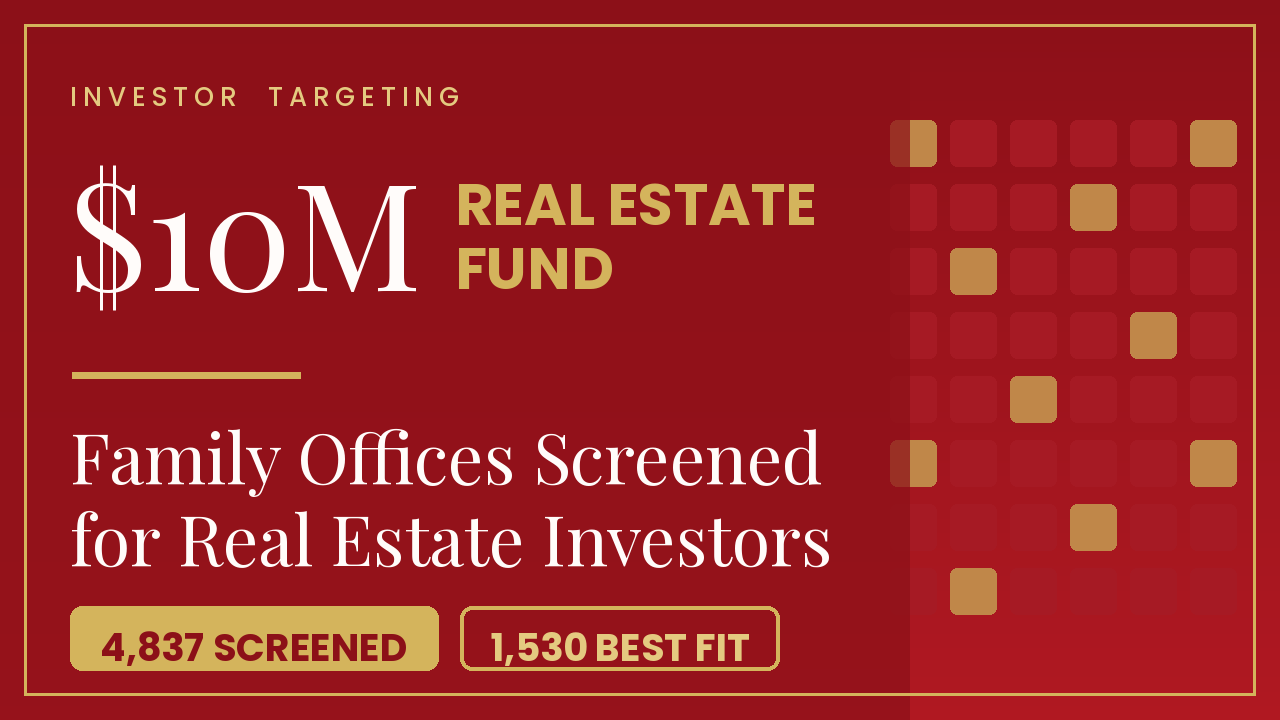
CASE STUDY – $10m Real Estate Fund
CONFIDENTIAL REAL ESTATE FUND
Net-Zero Real Estate Fund
Capital Raise
US$10 Million Preferred Equity Raise
Sector
Real Estate
Structure
Build-for-Rent / Value-Add Residential Strategy
Screening Universe
4,837 Global Family Offices
Objective
Identify family offices actively investing in:
- Direct Real Estate
- Joint Venture Real Estate
- Value-Add Real Estate
- Distressed Real Estate
- Sustainable Development
- Net-Zero Infrastructure
Key Findings
The analysis identified 1,530 Tier 1 family offices actively participating in direct, private or joint venture real estate strategies. Approximately 480 of these investors demonstrated a specific value-add, opportunistic or distressed real estate focus, representing the closest strategic alignment to the opportunity. Additionally, 227 investors displayed ESG or sustainability alignment consistent with the fund’s net-zero positioning.
Strategic Observation
The strongest investor fit was not driven by sustainability alone.
Instead, the highest-conviction targets were family offices already active in value-add and distressed real estate, with sustainability acting as a secondary differentiator rather than the primary investment thesis.
Screening Result
✓ 4,837 Family Offices Screened
✓ 1,530 Tier 1 Targets Identified
✓ 480 Value-Add / Distressed Real Estate Investors
✓ 227 ESG-Aligned Investors
✓ 962 Named Decision Makers Identified
Watch The Full Case Study Video Below
This video walks through:
- The original opportunity
- The screening methodology
- The database analysis
- AI-assisted review process
- Key findings
- Investor recommendations
See the Detailed Video of this Existing Screening
Need A Screening For Your Opportunity?
Optimize your capital raise by targeting the right investors. Submit your executive summary or pitch deck to receive a tailored analysis of your ideal investor categories. Custom screening ranges from $95 to $150, scaling with the number of global databases analyzed.
For this service contact me via the Contact Form on the Home Page
June 2026
CASE STUDY – $200m Real Estate Fund
Investor Targeting Case Study: A $200M US Multifamily Real Estate Fund
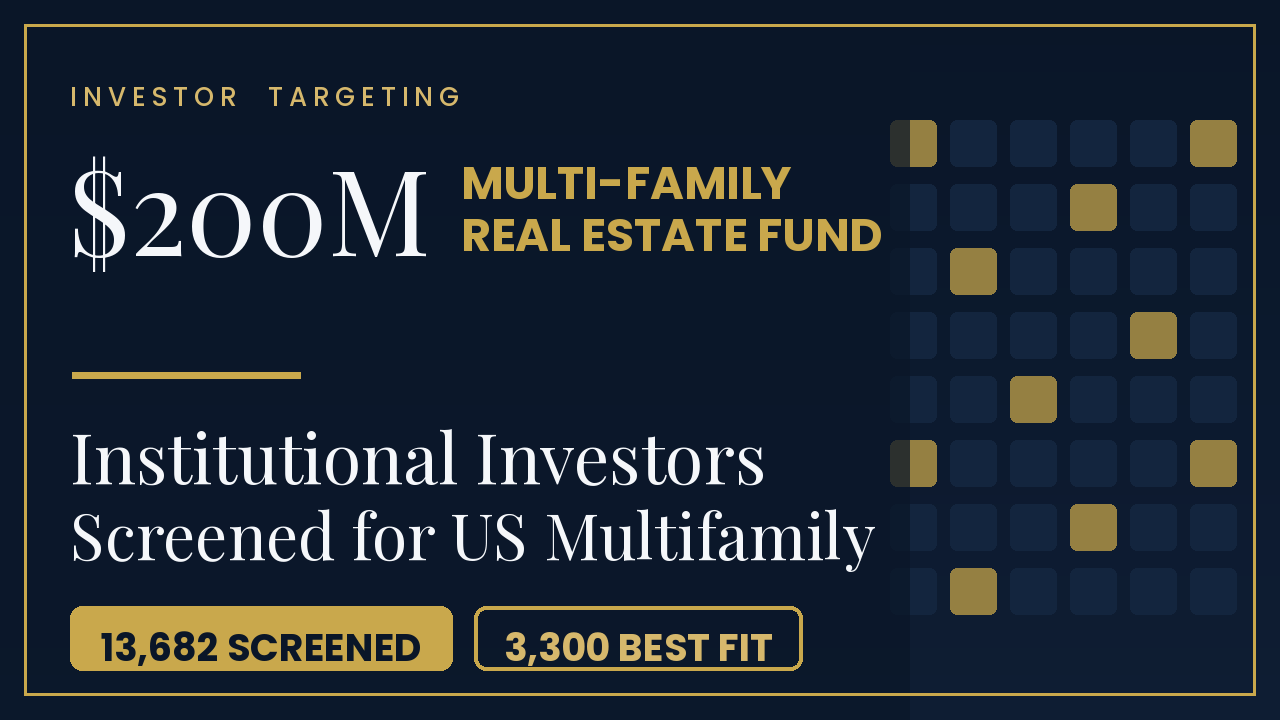
How I screened 13,682 institutional investors to find the ones genuinely suited to back a $200M multifamily raise – and how the same process works for any capital raise.
The Brief
A sponsor comes to market with a $200M US multifamily private equity fund. The strategy is a Core-Plus / Value-Add play: acquiring Class A and B apartment assets in high-growth Sunbelt and secondary markets, built 1990 or newer, at a basis advantage created by repriced asset values, distressed sellers, and a wave of floating-rate debt maturities.
On paper, the thesis is strong. The economics are institutional-grade – a 14–18% target gross IRR, a 1.5–2.5x equity multiple, a 4–6 year hold, 6–8% blended cash-on-cash, at 65–70% leverage. Deals run $50–120M each, building a portfolio of 5–7 assets diversified across multiple MSAs.
But a good thesis doesn’t raise capital on its own. The question every sponsor and placement agent actually has to answer is simpler and harder: who do we call first?
That is the work this case study walks through.
The Problem With “Blasting the List”
Most capital-raising campaigns start with a generic contact list and a mail-merge. The result is predictable: low response rates, wasted senior time chasing investors who were never a fit, and a campaign that drifts for 24–30 months without a clean first close.
The better approach is to treat investor targeting as a screening problem, not a volume problem. Instead of contacting everyone, you build a ranked, evidence-based shortlist that answers three things up front:
- Which investors fit the specific mandate.
- Why they fit – on strategy, sector, geography, and how they actually deploy.
- Who to contact first, with a named decision-maker rather than a generic inbox.
That is exactly what I built here.
The Universe: 13,682 Institutional Real-Estate Investors
I started from a database of 13,682 institutional real-estate investors – pension funds, foundations, endowments, insurance companies, sovereign wealth funds, family offices, wealth managers, and real-estate-focused asset managers – each carrying detailed mandate data: real-estate allocation, strategy preferences, geographic focus, typical ticket size, access route (private funds, direct, co-invest, joint ventures), and whether they back first-time funds.
That depth is what makes a precise screen possible. Rather than guessing who might be interested, I could match each investor directly against the fund’s actual profile.
The Methodology: Matched to the Fund Profile
I scored every investor on four dimensions, weighted to reflect what actually matters for this specific deal:
Strategy and sector. The fund is roughly 50% Core-Plus and 50% Value-Add, in multifamily residential. Investors whose declared real-estate strategy includes Core-Plus or Value-Add scored highest, with multifamily / residential focus adding further weight. Core and Opportunistic strategies counted as adjacencies.
Geography. The fund targets US Sunbelt and secondary growth markets, so a US / North American geographic preference was a core requirement, not a nice-to-have.
Access route. A fund commitment comes through specific channels – private real-estate funds, direct investment, co-investment, and joint ventures. Investors set up to deploy this way scored higher than those limited to listed or fund-of-fund exposure.
Quality and readiness. Ticket-size fit, AUM scale, and – importantly for a newly-marketed vehicle — whether the investor will back a first-time fund.
Investors that matched on all of strategy, sector, and geography formed the best-fit tier. The whole universe was retained and tiered, so no reachable investor was discarded on a data gap – a blank field reflects what a data vendor has catalogued, not the absence of appetite.
The Results
The screen produced a clear, ranked picture:
- 3,300 Tier 1 best-fit investors – Core-Plus / Value-Add strategy, US markets, the exact mandate match for this fund.
- 177 investors name multifamily / residential explicitly, with a further 251 that will back a first-time fund.
- 1,714 Tier 1 investors resolve to a named decision-maker with a verified email – not a generic contact.
The best-fit tier is institution-heavy and exactly the buyer base a $200M multifamily fund should be calling: roughly 1,400 pension funds, hundreds of foundations and endowments, insurers, plus real-estate-focused managers and family offices — all with declared Core-Plus / Value-Add appetite in US markets.
Who To Approach First
The shortlist sorts into a clear order of priority:
Pension funds, endowments, and foundations form the core institutional base – public and private pension systems, university endowments, and community foundations with active US real-estate allocations.
Real-estate specialists and family offices with direct US multifamily and co-investment appetite are natural fits, often able to move faster than larger institutions.
International and Gulf / MENA capital is the differentiator. In comparable campaigns, the placement firms involved are strong in the US but have minimal Middle East penetration. That makes international institutional capital an underserved, high-differentiation channel – one most US-centric raises overlook entirely.
The final piece is tailoring the pitch. A pension fund’s investment committee, a family office principal, and a sovereign allocator each weigh a multifamily fund differently. Knowing which investor you’re talking to – and leading with the dimension that matters most to them – is what turns a targeted list into actual meetings.
Why This Matters
A $200M raise lives or dies on the quality of the first 100 conversations. Spending those conversations on the right investors – matched on strategy, sector, geography, and deployment route, with a named decision-maker on the other end – is the difference between a clean first close and a campaign that drifts for two years.
This is the work I do for sponsors, fund managers, and placement agents: turning a broad universe into a ranked, evidence-based targeting plan that shows exactly who fits, why, and who to call first.
See the Detailed Video of this Existing Screening below:
Work With Me
Initial targeting reports start at US$95–$150 depending on scope. This case study is part of my ongoing Investor Targeting series, where I break down how professional capital-raising targeting actually works – one deal at a time.
For this service contact me via the Contact Form on the Home Page
CASE STUDY – $20m Clean Energy JV
Investor Targeting Case Study: A Clean-Energy Capital Raise
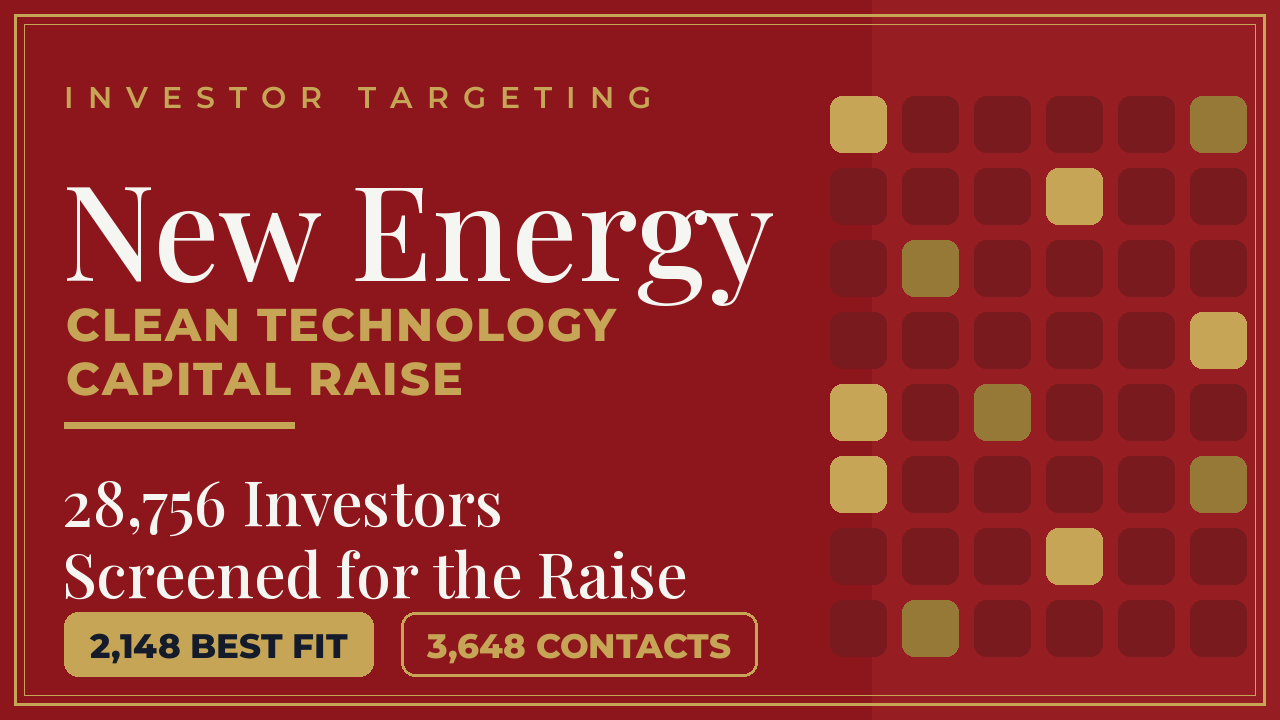
How I screened 28,000 institutional investors to find the ones genuinely suited to back a new clean-energy technology – and how the same process works for any capital raise.
The Brief
A clean-energy infrastructure client comes to market raising capital to commercialise a new power technology – one that delivers firm, dispatchable clean power and bypasses the multi-year grid-interconnection queues that now stall energy projects across most major markets.
On paper, the thesis is strong. The technology addresses a real and growing bottleneck: surging demand from data centres, electrification, and remote industry, set against a grid that can’t connect new supply fast enough. The opportunity is structured to contain risk – capital sits against a single, measurable proof point rather than a long-dated business plan, with a clear path to scale-up on success.
But a good thesis doesn’t raise capital on its own. The question every founder and capital raiser actually has to answer is simpler and harder: who do we call first?
That is the work this case study walks through.
The Problem With “Blasting the List”
Most capital-raising campaigns start with a generic contact list and a mail-merge. The result is predictable: low response rates, wasted senior time chasing investors who were never a fit, and a campaign that drifts for months without a clean first close.
The better approach is to treat investor targeting as a screening problem, not a volume problem. Instead of contacting everyone, you build a ranked, evidence-based shortlist that answers three things up front:
- Which investors fit the specific mandate.
- Why they fit – on strategy, sector, geography, and how they actually deploy.
- Who to contact first, with a named decision-maker rather than a generic inbox.
That is exactly what I built here.
The Universe: 28,000 Institutional Investors
I started from a database of roughly 28,000 institutional investors – energy and infrastructure funds, climate and impact investors, pension funds, foundations, endowments, insurers, sovereign wealth funds, family offices, and strategic energy players – each carrying detailed mandate data: sector allocation, strategy preferences, geographic focus, typical ticket size, access route (private funds, direct, co-invest, joint ventures), and whether they back early-stage or first-time vehicles.
That depth is what makes a precise screen possible. Rather than guessing who might be interested, I could match each investor directly against the opportunity’s actual profile.
The Methodology: Matched to the Profile
I scored every investor on four dimensions, weighted to reflect what actually matters for this specific deal:
Strategy and sector. The raise is a clean-energy infrastructure play. Investors whose declared mandate includes energy, infrastructure, or the energy transition scored highest, with an explicit clean-power or new-energy-technology focus adding further weight. Broader climate and impact strategies counted as adjacencies.
Geography. The opportunity has a clear primary market, so a matching geographic preference was a core requirement, not a nice-to-have – while genuinely global allocators were retained for their cross-border appetite.
Access route. A commitment of this kind comes through specific channels – private funds, direct investment, co-investment, and joint ventures. Investors set up to deploy this way scored higher than those limited to listed or fund-of-fund exposure.
Quality and readiness. Ticket-size fit, AUM scale, and – importantly for a newly-marketed, early-stage opportunity – whether the investor has appetite for project-stage or first-time positions.
Investors that matched on all of strategy, sector, and geography formed the best-fit tier. The whole universe was retained and tiered, so no reachable investor was discarded on a data gap – a blank field reflects what a data vendor has catalogued, not the absence of appetite.
The Results
The screen produced a clear, ranked picture:
- 6,800 Tier 1 best-fit investors – energy, infrastructure, or climate mandate with early-stage or project appetite, the exact match for this opportunity.
- 240 investors name geothermal, clean power, or the energy transition explicitly as an active focus area.
- 1,950 Tier 1 investors resolve to a named decision-maker with contact details on file – not a generic inbox.
The best-fit tier is exactly the buyer base a new clean-energy raise should be calling: energy and infrastructure funds with direct mandates in power and the transition, climate and impact investors, and strategic players seeking exposure to firm, off-grid clean power.
Who To Approach First
The shortlist sorts into a clear order of priority:
Energy and infrastructure funds form the core institutional base – managers with direct mandates in power, infrastructure, and the energy transition, already deploying into exactly this space.
Climate and strategic capital – impact-driven investors and strategic energy players – are natural fits, often able to move faster than larger institutions and motivated by more than financial return alone.
International and Gulf / MENA capital is the differentiator. Gulf and broader MENA allocators carry strong appetite for energy and infrastructure opportunities, yet most US- or Europe-centric raises overlook them entirely. That makes international institutional capital an underserved, high-differentiation channel.
The final piece is tailoring the pitch. An infrastructure fund’s investment committee, a family office principal, and a sovereign allocator each weigh a clean-energy opportunity differently. Knowing which investor you’re talking to – and leading with the dimension that matters most to them – is what turns a targeted list into actual meetings.
Why This Matters
A capital raise lives or dies on the quality of the first 100 conversations. Spending those conversations on the right investors – matched on strategy, sector, geography, and deployment route, with a named decision-maker on the other end – is the difference between a clean first close and a campaign that drifts.
See the Detailed Video of this Existing Screening below:
Work With Me
Initial targeting reports start at US$95–$150 depending on scope. This case study is part of my ongoing Investor Targeting series, where I break down how professional capital-raising targeting actually works – one deal at a time.
For this service contact me via the Contact Form on the Home Page
 DUBAI INVESTORS LIST