
Direct Access to the World’s Leading Private Investment Families
These exclusive databases connect you to verified Single and Multi-Family Offices across the United States, Europe, and Asia – investors actively allocating capital into private equity, venture funding, and real estate globally.
Institutional-Grade Data, Curated for Professionals
Built from institutional-grade research, these databases are verified collections of active family investment offices, each including decision-makers, investment heads, and key executives. These contacts represent the private capital ecosystem driving deals across continents.
Why It Matters
Family Offices have become dominant global investors, managing over $6 trillion in assets worldwide. Many prefer to invest directly – in funds, real estate, or private companies – rather than through intermediaries. These lists give you that direct access.
🌍 Global Family Investment Office Database
Your Complete Gateway to Global Private Capital
Gain verified access to the world’s most powerful Family Investment Offices across North America, Europe, the Middle East, and Asia.
This institutional-grade database connects you directly to leading private investors, multi-family offices, and wealth management entities actively deploying capital into high-value sectors worldwide.
Why It Matters
The Global Family Office ecosystem represents trillions in private capital under management.
These investors are actively diversifying and allocating into:
- Real Estate, Infrastructure & Hospitality Projects
- Private Equity, Venture Capital & Fund Investments
- Renewable Energy, Fintech & Strategic Technologies
What’s Inside
- 🌐 3,700 Family Investment Offices across 40+ countries
- 👤 11,400 key decision-makers and executives
- ✉️ 6,230 verified contact emails for direct outreach
- Ideal for: Fund Managers, Developers, Advisors, and Placement Agents
Format: Excel (.xlsx)
Delivery: Manually sent within 24 hours after purchase
Payment: PayPal or Credit Card via secure checkout – No Refunds on Database Sales.

View the Video Description Below
🌍 The Rise of North American and UK Family Investment Offices: Redefining Private Capital in 2025
After completing a detailed review of a sample of 500 Family Investment Offices (FIOs) from my Global FIO Database of over 3,700 offices across 40+ countries, this analysis focuses exclusively on the USA, Canada, and the United Kingdom — three markets that collectively anchor the modern landscape of family-controlled private capital.
Between 2022 and 2025, Family Investment Offices in these regions have emerged as some of the most powerful, professionalized, and globally active private investors, rivaling institutional funds in both scale and sophistication. More than 70% of the offices analyzed have increased their allocations to direct and co-investment strategies, marking a major evolution away from traditional fund-of-funds exposure toward hands-on, discretionary ownership models.

🏢 Real Estate: The Enduring Core of Family Capital
Real estate continues to dominate family portfolios across North America and the UK, representing the core wealth foundation for most established families. Roughly 74% of FIOs in this group maintain active real estate investments, often spanning multiple sectors and geographies.
Breakdown by strategy:
- 46% focus on core and core-plus income-generating assets — Class A residential, logistics, and stabilized hospitality.
- 20% pursue value-add or opportunistic projects, frequently through partnerships with local or regional private equity sponsors.
- 8% engage in development and ground-up construction, emphasizing legacy projects and long-term generational holdings.
Among these, US and UK family offices have shown a marked preference for direct ownership of real assets, particularly multifamily, logistics, and industrial properties, with increasing allocation to green building and sustainable infrastructure.
For Canadian FIOs, diversification into US Sunbelt and secondary logistics markets has grown sharply, reflecting both yield optimization and currency advantages.
💼 Private Equity & Direct Investment: From LP to Active Owner
Private equity has evolved into the second-largest asset class across North American and UK family offices. Approximately 62% maintain a dedicated private equity or direct investment arm.
Breakdown of activity:
- 31% allocate to buyout, growth, or control equity in operating companies.
- 21% act as LPs or co-investors alongside institutional or sector-specific funds.
- 10% invest directly in venture and innovation capital, with notable exposure to AI, fintech, healthcare, and sustainability-linked ventures.
US-based families remain the most active private equity allocators globally, with many now managing internal deal teams capable of executing transactions independently.
In the UK, a growing trend toward club deals and syndicate-style co-investments reflects both tax efficiency and peer collaboration.
Canadian families, meanwhile, increasingly partner with mid-market GPs and family-led investment groups across the US and Europe, combining cross-border reach with family control.
🌏 Sector Diversification: Thematic and Impact-Driven Expansion
While real estate and private equity remain dominant, around 41% of the analyzed FIOs are broadening into thematic and ESG-aligned investments that blend purpose with performance.
Breakdown of new focus areas:
- 15% are entering renewable energy, transition infrastructure, and climate-tech assets.
- 13% are deepening exposure to technology and venture capital, especially AI, software, and automation.
- 8% are allocating to healthcare, life sciences, and education, reflecting resilience-driven strategies post-2020.
- 5% are exploring agribusiness, food sustainability, and water infrastructure investments.
This diversification reflects the growing influence of next-generation principals who are professionalizing family capital through ESG mandates, digital transformation, and long-term thematic theses, rather than short-cycle trading.
🏦 Capital Hubs & Global Connectivity
The North American and UK FIO network has become one of the most globally integrated private capital ecosystems.
Key hubs and patterns include:
- New York & London – the two epicenters of family capital, housing the largest share of institutionalized single-family offices.
- Toronto & Vancouver – emerging as Canadian bases for cross-border PE and real estate expansion.
- Boston, Miami, and Los Angeles – active clusters for innovation, healthcare, and real estate portfolios.
Roughly 47% of FIOs in this sample maintain offshore or international investment vehicles, most commonly in Luxembourg, Cayman Islands, or Singapore, enabling efficient co-investment structures and global asset access.
This configuration allows North American and UK families to act as global allocators, capable of partnering with institutional sponsors or deploying directly into private markets from their own platforms.
📈 Institutionalization of Family Capital
The modern North American and UK FIO is evolving from private wealth custodian to full-fledged investment institution. Around 55% now operate under multi-asset, professionalized governance structures with in-house CIOs, analysts, and sector specialists.
Key developments include:
- Formation of family holding companies uniting real estate, PE, and venture portfolios.
- Adoption of institutional-style investment committees and risk frameworks.
- Partnerships with institutional managers and independent sponsors for pipeline access.
- Integration of ESG, impact, and long-duration mandates into long-term capital planning.
This professionalization wave has positioned FIOs as preferred limited partners and co-investors across private markets — offering not only capital but also strategic alignment and generational vision.
💬 Closing Insight
By 2025, North American and UK Family Investment Offices stand among the most influential and agile investors in the global private capital landscape.
Their blend of discretion, flexibility, and direct investment capability allows them to move faster than institutions – yet with the same scale of impact.
For developers, fund managers, and advisors, engagement with these families is no longer optional – it’s central to raising meaningful capital.
They can deploy $10M–$500M+ per transaction, often with long-term, relationship-based alignment rather than short-term return pressure.
The rise of the Family Investment Office across the USA, Canada, and the UK signals a new era in private capital: institutional in structure, generational in vision, and global in reach.
📅 October 2025
🔗 Explore my exclusive Global Family Investment Office Database – a verified gateway to over 3,700 Family Investment Offices across 40+ countries, including detailed profiles of the most active capital groups in the USA, UK, and Canada.
100 Family Offices Most Likely to Allocate to Private Equity in 2026
A Data-Driven Outlook for Global Fund Managers
The 100 family offices featured in this report are drawn exclusively from my Global Family Investment Office Database and were selected based on verified allocation data and activity patterns updated through Q3 2024. Although we are now in late 2025, family offices typically maintain multi-year private equity strategies with deployment cycles that extend 18 to 36 months. These long-term mandates allow us to identify investors that are positioned to remain active allocators into 2025 and 2026. This list is not a prediction but a data-driven outlook based on sustained interest, historical deal flow, and repeat commitments observed across recent reporting periods.
Private equity continues to stand at the center of long-term wealth preservation and growth for sophisticated single-family and multi-family offices. Many maintain diversified alternatives portfolios, recurring global mandates, and well-established GP relationships. This report offers a research-driven guide for managers entering 2026 fundraising cycles.
Key Themes Influencing 2026 Family Office Allocations
1. Renewal of Multi-Year Mandates
📌 Many family offices operate with evergreen alternatives allocations.
Groups such as Briar Hall, Altocumulus, and Acropolis Capital demonstrate recurring activity patterns, suggesting continued deployment through 2026.
2. Growing Appetite for Early-Stage and Technology Strategies
💡 Strong momentum continues in:
• Artificial intelligence
• Cybersecurity
• Healthtech
• Climate and energy transition
• Digital infrastructure
Offices such as Decent Capital and Aretas Capital Management reinforce this long-term trend.
3. Global Diversification and Cross-Border Co-Investments
🌍 Many family offices maintain multi-region mandates:
• North America
• Europe
• Asia Pacific
• Emerging Markets
Groups like Lake House Group, BTV Beteiligungsverwaltung, and Decent Capital remain active across continents.
4. Established Internal Investment Teams
🏛️ Larger family offices continue to operate sophisticated investment divisions capable of underwriting fund commitments and direct co-investments.
Flexedge Investment Management and BTV Beteiligungsverwaltung exemplify this institutional approach.
5. Strong Re-Up Behavior
🔄 Family offices with multi-cycle GP relationships tend to remain consistent allocators even during macroeconomic uncertainty, increasing the reliability of this universe for 2026 fundraising.
Sample Family Offices Positioned for 2026 Allocation Cycles
The following profiles represent an expanded sample of the full 100-office universe analyzed for this report. These examples illustrate the breadth of strategies, sectors, and geographies involved.
North America 🇺🇸
Briar Hall – United States
🏠 Family Office Type: Single
🎯 Strategies: Buyout, early stage, venture
🌍 Focus Regions: North America
📅 Updated: April 2023
A long-established Illinois office with consistent allocations to diversified private equity funds. Known for steady multi-cycle deployment patterns.
10 East – United States
🎯 Strategies: Seed, early stage, late stage
🌍 Focus Regions: North America
📅 Updated: June 2024
A New York office with ongoing exposure to early-stage innovation and repeat participation in venture-led funds.
Flexedge Investment Management – United States
🎯 Strategies: Buyout, secondaries, venture debt, distressed, natural resources
🌍 Regions: Global
📅 Updated: March 2024
A sophisticated allocator with one of the broadest alternatives mandates in the US family office landscape.
Coliseum Family Partners – United States
🎯 Strategies: Buyout, co-investments
🌱 Sectors: Industrial, software, specialty services
Consistently active in mid-market commitments and GP relationships.
Hawthorne Capital Partners – United States
🎯 Strategies: Growth, lower-mid-market buyout
Maintains a recurring US mandate and reliable re-up patterns.
Europe 🇪🇺
BTV Beteiligungsverwaltung – Germany
🎯 Strategies: Buyout, distressed, secondaries, mezzanine, venture
🌍 Regions: Global
📅 Updated: June 2024
One of Europe’s most diverse family offices with a long track record of private equity fund commitments.
Fides Family Office – Germany
🎯 Strategies: Venture
📅 Updated: May 2024
A lean but consistently active venture allocator focused on innovation and early-stage opportunities.
Acropolis Capital – United Kingdom
🎯 Strategies: Buyout, distressed, growth
🌍 Regions: Europe and North America
📅 Updated: August 2024
A private investment firm with multi-cycle exposure to alternative investment funds.
Altocumulus – Sweden
🎯 Strategies: Buyout, growth, venture
⚡ Sectors: Energy, renewables, energy storage
📅 Updated: August 2024
Part of the Axel Johnson ecosystem and a strong allocator across European private markets.
Aretas Capital Management – Switzerland
🎯 Strategies: Secondaries, fund of funds, venture
🧬 Sector Focus: Biotechnology
📅 Updated: July 2024
A globally oriented investment boutique managing family and foundation wealth.
Vandeton Holdings – Luxembourg
🎯 Strategies: Mid-market buyout
🌍 Regions: Western Europe
A discreet allocator with long-standing GP relationships.
Asia and Emerging Markets 🌏
Lake House Group – Hong Kong
🎯 Strategies: Buyout, venture, distressed, turnaround
🌍 Regions: Asia, Europe, North America
📅 Updated: May 2023
A globally active family office founded by Charles Brown with multi-sector exposure.
Decent Capital – Singapore
🎯 Strategies: Early stage, growth, venture
🌍 Regions: ASEAN, China, North America, emerging markets
🧭 Sector Breadth: Technology, consumer, industrials, healthcare
📅 Updated: July 2024
One of Asia’s most dynamic family offices; founded by a co-founder of Tencent.
Aozora Family Investment Office – Japan
🎯 Strategies: Early stage, robotics, fintech
Has repeatedly participated in cross-border venture funds.
Trinity Crest Holdings – India
🎯 Strategies: Growth equity, sector-focused PE
🌱 Sectors: Consumer, climate, healthcare
Positioned to increase allocations as India’s PE ecosystem expands.
Middle East and Global Allocators 🌍
Sahara Al Khaleej Investments – UAE
🎯 Strategies: Buyout, secondaries, co-investments
Frequently active in global mid-market funds.
Al Noor Partners – Saudi Arabia
🎯 Strategies: Buyout, growth
⚕ Sectors: Healthcare, industrials, regional tech
Regular exposure to US and European GPs.
Arkan International Family Capital – Bahrain
🎯 Strategies: Infrastructure, energy transition, diversified alternatives
Active global allocator with long-term themes.
Why These Family Offices Are Positioned for 2026 Deployment
✔ Multi-year allocation cycles extend through 2026
✔ Consistent year-over-year deal flow
✔ Established GP relationships and re-ups
✔ Global mandates allowing cross-border diversification
✔ Sector-agnostic approaches enabling flexible deployment
✔ Internal investment teams maintaining ongoing pipelines
For fund managers preparing 2026 roadshows, the family offices represented across this report form a highly credible and strategically relevant universe of potential allocators.
Disclaimer
The information provided in this report is sourced from institutional-grade databases and relies on third-party information. Accuracy is based on the latest available reporting, but future investment activity cannot be guaranteed.
December 2025
🔗 Explore my exclusive Sovereign Wealth Fund Database, a premium resource designed for fund managers and corporate leaders seeking access to global state capital, strategic co investment partners, and long horizon institutional allocators.
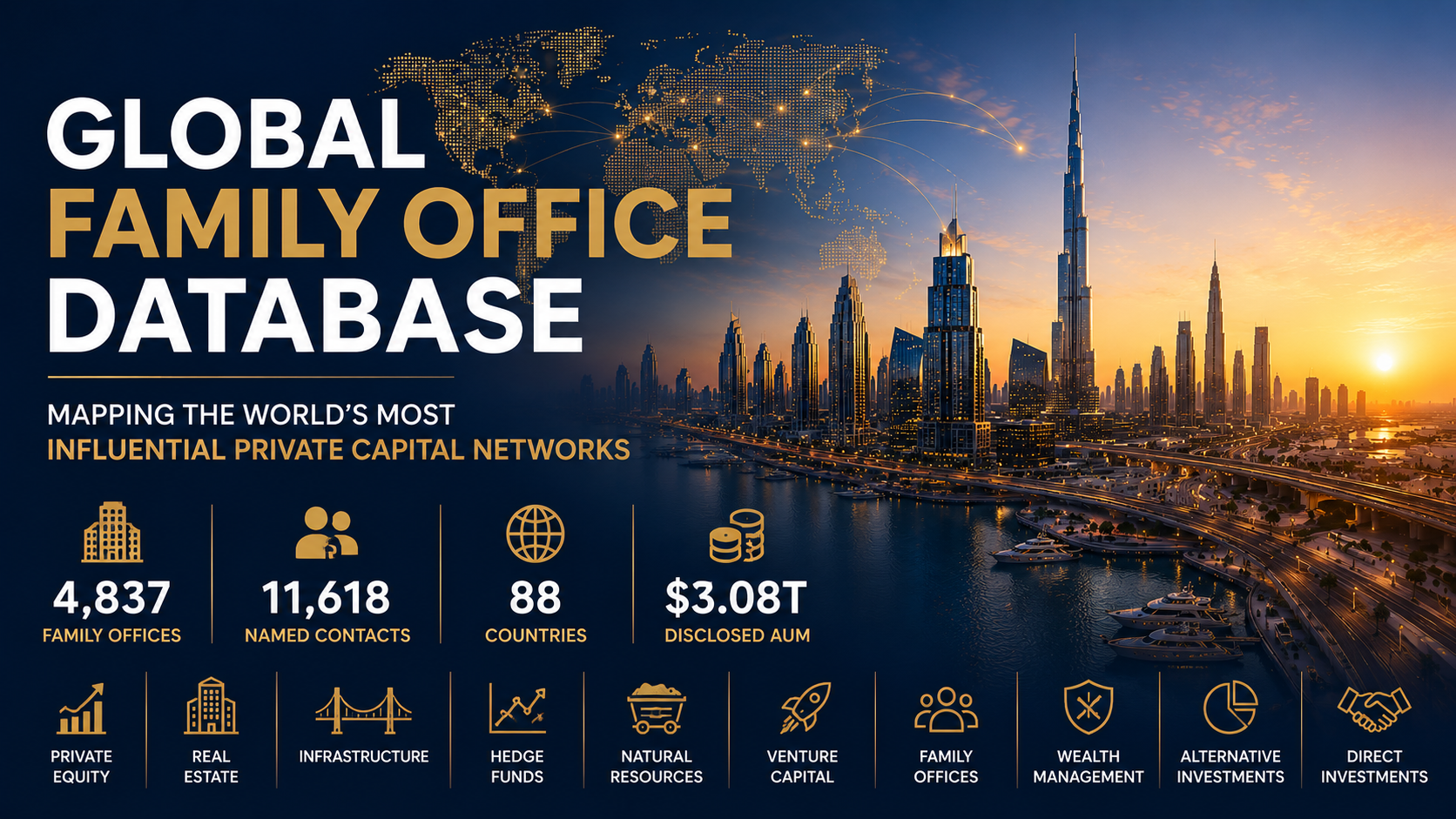
Global Family Offices in 2026: Growth, Investment Trends and Where the World’s Private Capital Is Flowing
June 2026
This report draws upon data from the Dubai Investors List Global Family Office Database, proprietary market intelligence, publicly available company disclosures, regulatory filings, industry research and investment announcements. The analysis combines exclusive database insights with broader market data to provide a comprehensive overview of global family office trends, investment activity and capital allocation patterns.
Introduction
Family offices have become one of the most influential forces in global capital markets.
While pension funds, sovereign wealth funds and institutional asset managers often dominate financial headlines, family offices now control trillions of dollars in private wealth and are increasingly competing directly with traditional investment firms for access to private market opportunities.
Recent industry research estimates there are now between 8,000 and 9,000 single-family offices worldwide, representing growth of more than 30% since 2019. Collectively, these organisations oversee approximately US$5.5 trillion in family wealth, while disclosed assets under management have already surpassed US$3.1 trillion and are projected to exceed US$5.4 trillion by 2030.
The modern family office bears little resemblance to the wealth preservation vehicles of previous generations. Today’s family offices actively pursue private equity transactions, venture capital opportunities, infrastructure projects, real estate developments, direct acquisitions and co-investment opportunities alongside some of the world’s largest institutional investors.
At the same time, geopolitical shifts, tax reforms, technological disruption and generational wealth transfers are reshaping how family offices allocate capital and where they choose to invest.
This report examines the latest global family office trends, highlights major investment themes shaping the sector, and analyses data from a global family office database containing 4,837 family offices and 11,618 investment professionals across 88 countries.
The Global Family Office Boom
The growth of the family office sector over the past decade has been extraordinary.
According to industry research, the number of single-family offices worldwide has increased from approximately 6,130 in 2019 to more than 8,000 today. Forecasts suggest that figure could exceed 10,000 by the end of the decade.
Global Family Office Growth
| Metric | Value |
|---|---|
| Single Family Offices (2019) | 6,130 |
| Single Family Offices (2026) | 8,000-9,000 |
| Growth Since 2019 | +31% |
| Projected Family Offices by 2030 | 10,000+ |
Much of this growth has been fuelled by entrepreneurial wealth creation.
Perhaps most surprisingly, approximately 68% of all family offices operating today were established after the year 2000.
Why This Matters
Historically, family offices were associated with legacy industrial fortunes and multi-generational dynasties.
Today’s family office landscape increasingly reflects:
- Technology entrepreneurs
- Private equity founders
- Real estate developers
- Manufacturing business owners
- Financial services executives
- Cross-border family businesses
The result is a younger, more globally connected and often more growth-oriented investor base.
Trillions of Dollars Are Being Managed Through Family Offices
Family offices are no longer a niche segment of the investment industry.
Global Family Office Capital Base
| Metric | Value |
| Estimated Family Wealth | US$5.5 Trillion |
| Disclosed Family Office AUM | US$3.1 Trillion |
| Forecast AUM by 2030 | US$5.4 Trillion |
| Five-Year Wealth Growth | +67% |
To put this into perspective, the collective wealth managed through family offices rivals many of the world’s largest institutional investment categories.
This growth is expected to accelerate as one of the largest intergenerational wealth transfers in history unfolds over the coming decades.
Why Family Offices Have Become So Important
Several characteristics differentiate family offices from traditional institutional investors.
Family Offices vs Traditional Institutions
| Characteristic | Family Offices | Traditional Institutions |
| Capital Source | Private Family Wealth | Third-Party Capital |
| Investment Horizon | Multi-Generational | Fund Lifecycle |
| Decision Making | Flexible | Committee Driven |
| Direct Investments | Common | Selective |
| Co-Investments | Frequent | Frequent |
| Mandate Flexibility | High | Moderate |
Because they are not constrained by traditional fund structures, many family offices can evaluate opportunities on a longer-term basis and pursue transactions that may not fit institutional mandates.
This flexibility has made them increasingly attractive partners for private equity sponsors, venture capital funds, infrastructure developers and real estate operators.
Direct Investing Is Reshaping Family Office Portfolios
One of the most significant developments within the sector is the rapid growth of direct investing.
Recent surveys indicate that approximately 70% of family offices now participate directly in private market transactions.
Direct Investment Statistics
| Metric | Value |
| Family Offices Engaging in Direct Investments | 70% |
| Direct Deal Growth (2025) | +123% |
| Direct Investment Volume | US$12.9 Billion |
| Recorded Transactions | 158 |
Rather than allocating exclusively through external fund managers, family offices increasingly pursue:
- Direct acquisitions
- Co-investments
- Club deals
- Growth equity investments
- Venture capital transactions
- Infrastructure projects
The implications for fund managers are significant.
Family offices increasingly expect access to proprietary opportunities and often prefer direct exposure to underlying assets whenever possible.
Technology Is Becoming a Core Family Office Theme
Technology investment has emerged as one of the strongest areas of family office deployment.
Artificial intelligence, machine learning, data infrastructure, fintech and advanced robotics have become major areas of focus.
Notable Family Office Technology Investments
| Family Office | Company | Value |
| Perennial | Anysphere | US$2.3 Billion |
| TWG Global / Tulco | Lambda | US$1.5 Billion |
| Emerson Collective | World Labs | US$1.0 Billion |
| Perennial | Luma AI | US$900 Million |
| Bezos Expeditions | Physical Intelligence | US$600 Million |
| Premji Family Office | Runway | US$315 Million |
These transactions demonstrate how family offices are increasingly participating alongside major venture capital firms and institutional investors in some of the largest technology financings globally.
The AI Infrastructure Opportunity
One of the most fascinating findings from recent family office surveys is the gap between AI enthusiasm and actual portfolio exposure.
Family Office AI Statistics
| Metric | Percentage |
| Planning to Prioritise AI | 65% |
| No Exposure to AI Infrastructure | 79% |
While most family offices recognise the transformative potential of artificial intelligence, relatively few have exposure to the infrastructure required to support it.
This creates potential opportunities in:
- Data centres
- Power generation
- Semiconductor infrastructure
- Fibre networks
- Connectivity assets
- Digital infrastructure
For sponsors operating in these sectors, family offices may represent a growing source of long-term capital.
ESG, Sustainability and Impact Investing
Environmental and social themes continue gaining momentum within family office portfolios.
Approximately 41% of family offices report increasing allocations to impact-oriented investments, particularly within:
- Renewable energy
- Climate technology
- Sustainable agriculture
- Education
- Healthcare innovation
The trend is especially evident among next-generation family members who increasingly influence investment policy and strategic asset allocation decisions.
At the same time, family offices remain selective.
Despite media attention surrounding digital assets and commodities, many family offices continue to avoid speculative exposures.
Alternative Asset Preferences
| Asset Class | Trend |
| Private Equity | Increasing |
| Infrastructure | Increasing |
| Real Estate | Increasing |
| Venture Capital | Increasing |
| Gold | Limited Exposure |
| Cryptocurrency | Limited Exposure |
Interestingly, surveys indicate that 72% of family offices have no gold allocation while 89% maintain no cryptocurrency exposure.
The Professionalisation of Family Offices
Modern family offices increasingly resemble institutional investment firms.
Sophisticated governance frameworks, dedicated investment teams and formal decision-making processes have become common across the industry.
Governance Statistics
| Metric | Value |
| Family Offices With Formal Boards | 73% |
| Women Leading Family Offices | 15% |
| Family Offices With Multiple Offices | 28% |
| Average Board Size | 4 Members |
This evolution reflects the growing complexity of managing multi-generational wealth across multiple jurisdictions and asset classes.
Large family offices frequently employ:
- Chief Investment Officers
- Investment Directors
- Portfolio Managers
- Risk Professionals
- Compliance Officers
- External Advisory Boards
Succession, Governance and Family Dynamics
Investment performance is only one priority for family offices.
Many families view governance, succession planning and family continuity as equally important objectives.
Key Challenges Facing Family Offices
| Challenge | Observation |
| Succession Planning | Major Priority |
| Internal Family Conflict | Rising Concern |
| Talent Acquisition | Increasingly Competitive |
| Cybersecurity | Growing Focus |
| Cross-Border Compliance | More Complex |
Research suggests that 41% of business-owning families identify internal conflict as one of their most significant risks, driving increased investment in governance frameworks, family constitutions and formal decision-making structures.
Mapping the Global Family Office Universe
Against this backdrop, our analysis of a global family office database containing 4,837 family offices across 88 countries provides insight into where private capital is concentrated today.
Database Overview
| Metric | Total |
| Family Offices | 4,837 |
| Named Investment Professionals | 11,618 |
| Countries Covered | 88 |
| Disclosed AUM | US$3.08 Trillion |
| Single Family Offices | 2,959 |
| Multi Family Offices | 1,878 |
The database captures both institutional entities and the decision-makers responsible for evaluating investment opportunities.
Global Distribution of Family Offices
Regional Distribution
| Region | Family Offices |
| North America | 1,700 |
| Europe | 1,389 |
| Asia | 842 |
| Middle East | 428 |
| Australasia | 245 |
| Latin America | 199 |
| Africa | 19 |
While North America remains the largest concentration of family offices, Asia and the Middle East continue to emerge as increasingly important centres of private capital.
Why the GCC Is Emerging as a Global Family Office Hub
The Middle East represents one of the most dynamic family office markets globally.
GCC Family Office Coverage
| Country | Family Offices |
| United Arab Emirates | 196 |
| Saudi Arabia | 105 |
| Oman | 32 |
| Kuwait | 24 |
| Bahrain | 18 |
| Qatar | 16 |
Several structural factors are driving this growth:
- UAE Golden Visa programmes
- Saudi Vision 2030
- Relaxation of foreign ownership restrictions
- Expansion of private capital ecosystems
- Growth in regional entrepreneurship
- Increasing cross-border wealth migration
Dubai and Abu Dhabi have become major wealth management hubs attracting families from Europe, Asia, Africa and the wider Middle East.
The Human Access Layer
Identifying family offices is only part of the challenge.
Understanding who makes investment decisions is equally important.
Contact Intelligence Statistics
| Metric | Total |
| Named Contacts | 11,618 |
| Senior Decision-Makers | 77% |
| Direct Emails | 6,259 |
| Direct Phone Numbers | 9,359 |
Key decision-making titles include:
- Chief Investment Officer
- Managing Director
- Managing Partner
- Founder
- Chairman
- Chief Executive Officer
- Investment Director
For fund managers and sponsors, access to the right individual frequently determines fundraising success.
What This Means for Fund Managers and Capital Raisers
Family offices are expected to remain one of the fastest-growing sources of private capital globally.
Their increasing appetite for:
- Private equity
- Real estate
- Infrastructure
- Venture capital
- Direct investments
- Co-investments
creates substantial opportunities for sponsors capable of presenting high-quality, mandate-aligned opportunities.
Many family offices regularly deploy between US$10 million and US$500 million per transaction while maintaining investment horizons measured in decades rather than quarters.
However, the professionalisation of the sector means expectations have changed.
Successful engagement increasingly requires:
- Institutional-quality documentation
- Strong governance frameworks
- Transparent reporting
- Alignment with family values
- Long-term relationship building
The era of generic fundraising outreach is rapidly disappearing.
Conclusion
The global family office sector has entered a new era.
What was once a fragmented network of private wealth structures has evolved into a sophisticated global investment ecosystem controlling trillions of dollars in capital.
With as many as 9,000 family offices worldwide, projected assets under management approaching US$5.4 trillion by 2030, and growing participation in private equity, infrastructure, technology and direct investments, family offices have become a critical source of capital for the global investment community.
The data points to a clear conclusion: family offices are becoming larger, more professional, more global and more influential.
For fund managers, sponsors and capital raisers seeking long-term investment partners, understanding where these investors are located, how they allocate capital and who ultimately makes investment decisions has never been more important.

