Who Are the UAE’s Most Influential C-Suite Executives in 2026?
Written by: Andrew Thomas – The Investors Link – June 2026
The UAE has long been one of the world’s most dynamic business environments, but understanding who actually sits at the helm of its corporate landscape requires more than a browse of LinkedIn or a glance at a news headline. The Elite UAE C-Suite & Executive Database — a proprietary dataset compiled by Dubai Investors List — gives us something far more precise: a verified, contact-level view of the executives shaping the country’s commercial future.
This report draws on data spanning thousands of verified C-Suite contacts across every major sector and emirate in the UAE. What emerges is a detailed portrait of where executive power is concentrated, how it is distributed, and what it means for anyone trying to engage with decision-makers in this market.
The Title Landscape: Who Holds Power?
The UAE executive landscape is dominated by four key title tiers, each carrying distinct authority and investment relevance. At the apex sit Chairmen and Founders — individuals who typically own or co-own their enterprises and hold ultimate strategic authority. Below them are CEOs and Managing Directors, responsible for day-to-day leadership. CFOs and COOs round out the operational C-Suite, while Partners — particularly prevalent in law, accounting, and professional services — hold significant commercial influence in their own right.
The database reveals that Founders and Co-Founders make up a significant proportion of the UAE executive pool, reflecting the country’s entrepreneurial character. Many of these individuals simultaneously hold the CEO title, combining ownership and operational control in a single decision-maker — the profile of maximum accessibility for capital raisers, B2B vendors, and placement agents alike.
| Seniority Level | Profile | Decision Authority | Relevance for Outreach |
| Chairman / Founder | Owner-operators, family principals | Strategic & capital allocation | Highest — direct investment authority |
| CEO / MD | Corporate leaders, top executives | Operational & growth decisions | Very High — gatekeepers to deals |
| CFO | Financial controllers | Budget, treasury, fundraising | High — capital and vendor decisions |
| COO | Operations heads | Procurement, partnerships | Medium-High — operational access |
| Partner | Professional services leaders | Client, mandate authority | High in legal, finance, advisory |
Industry Concentration: Where the Executives Are
The database spans over 40 industry classifications. The most densely populated sectors are information technology & services, real estate, financial services, law practice, and investment management — the five verticals that collectively account for a large majority of UAE executive activity in the private sector.
This distribution is not surprising. Dubai’s DIFC and Abu Dhabi’s ADGM have attracted a deep concentration of financial and legal talent, while the technology sector has exploded across free zones including DMCC, Dubai Internet City, and Dubai Silicon Oasis. Real estate remains the single most visible sector for founder-led businesses, with hundreds of property developers, brokers, and investment platforms all represented in the database.
| Industry Sector | Presence in Database | Typical Title Profile | Key Use Case |
| Information Technology & Services | Very High | CEO, Founder, COO, CTO | Tech vendor targeting, SaaS sales |
| Real Estate | Very High | CEO, Founder, Chairman | Capital raising, investor targeting |
| Financial Services | High | CEO, CFO, Partner | Placement, advisory, fundraising |
| Law Practice | High | Partner, Managing Partner | B2B professional services |
| Investment Management | High | CEO, Chairman, CFO | Fund distribution, LP outreach |
| Oil & Energy | Medium | CEO, CFO, COO | Procurement, JV, capital |
| Construction | Medium | CEO, Owner, Chairman | Supplier, procurement, finance |
| Higher Education | Medium | Chairman, CEO | Institutional partnerships |
Emirate Distribution: Dubai Leads, Abu Dhabi is Strategic
Dubai dominates the database in volume, which reflects its position as the UAE’s commercial capital. The majority of technology companies, financial services firms, and real estate operations are headquartered or operationally based there. However, Abu Dhabi carries disproportionate weight in the areas that matter most for institutional capital — sovereign entities, government-linked investment vehicles, oil and energy, and large infrastructure.
Sharjah, Ras Al-Khaimah, and other Northern Emirates are also represented, typically in manufacturing, industrial services, education, and cost-competitive professional services. For most capital raising or B2B outreach campaigns, a Dubai-first strategy with Abu Dhabi as a secondary tier is the optimal sequencing.
| Emirate | Volume | Dominant Sectors | Strategic Notes |
| Dubai | Largest | Tech, Real Estate, Finance, Legal | Primary outreach market |
| Abu Dhabi | Second largest | Investment mgmt, Oil & Energy, Govt | Institutional capital focus |
| Sharjah | Third | Education, Manufacturing, Trade | Cost-efficient targeting |
| Other Emirates | Smaller | Industrial, Hospitality, F&B | Niche sector plays |
Company Scale: SME vs. Enterprise
One of the most striking features of the UAE executive landscape as reflected in the database is the sheer range of company sizes. At one end sit global enterprises — ADNOC (21,000 employees), Majid Al Futtaim (43,000), Al Ghurair (4,500), Mubadala, and ADCB — whose executives carry institutional authority over enormous capital pools. At the other end are hundreds of founder-led SMEs with teams of two to fifteen people, where the CEO is also the sales director, investor relations manager, and key decision-maker.
This diversity is commercially significant. A blanket ‘UAE C-Suite’ list without stratification conflates vastly different buyer profiles. The Premium Database addresses this through the Employee Count field, allowing users to segment by company scale and build appropriately differentiated outreach sequences.
Contact Quality: What the Database Provides
Each record in the Premium Database includes verified direct email, LinkedIn URL, company website, mobile and corporate phone where available, city and state, industry classification, and seniority level. All contacts carry a ‘deliverable’ status flag, confirming email validity at time of compilation.
This combination — direct email plus LinkedIn plus company context — is the minimum viable dataset for any serious B2B or investor outreach campaign. Without it, you are either cold-emailing generic inboxes or relying on gatekeepers who may never pass your message to the executive.
Why This Data Matters in 2026
The UAE continues to attract record levels of foreign direct investment, with the country consistently ranking as the MENA region’s top FDI destination. Family offices are expanding their allocation to alternatives. Technology startups are raising increasingly large rounds. Real estate is experiencing sustained institutional demand. Capital is available — but it flows to those who can reach the right people.
For placement agents, fund managers, B2B technology vendors, and professional service providers, the ability to reach 3,000+ verified UAE C-Suite executives with a direct email and a personal LinkedIn address is not a marginal advantage. It is a foundational one.
Access the UAE Elite C-Suite & Executive Database at dubaiinvestorslist.com
The Premium Version includes verified direct emails, mobile numbers, LinkedIn URLs, and company intelligence for thousands of UAE decision-makers across all major sectors and emirates.
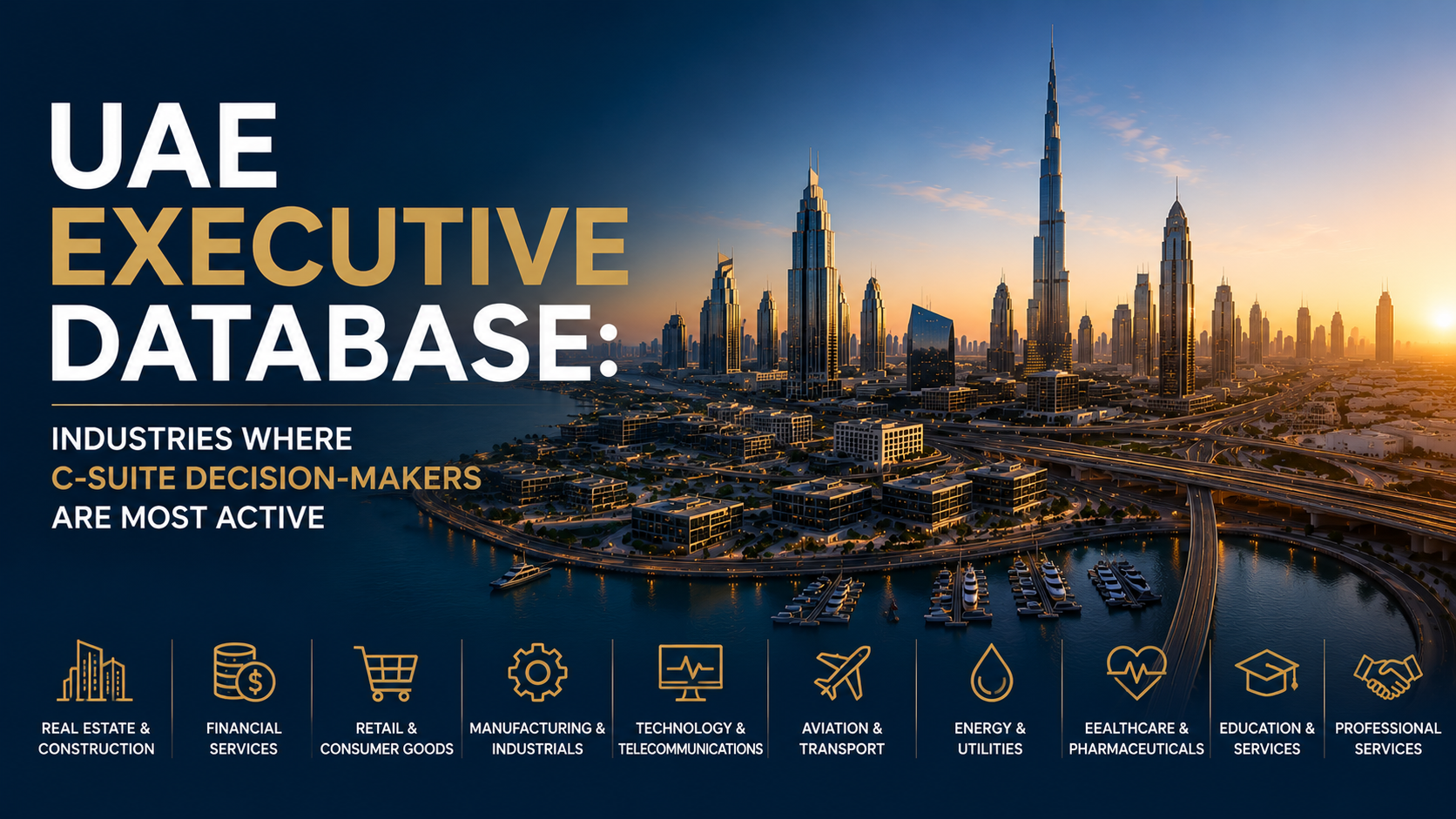
UAE Executive Database: Industries Where C-Suite Decision-Makers Are Most Active
Source: Dubai Investors List | UAE C-Suite Executive Database Premium | dubaiinvestorslist.com
Not all industries in the UAE are created equal when it comes to C-Suite density, deal flow, or outreach opportunity. The Elite UAE C-Suite & Executive Database — compiled by Dubai Investors List across thousands of verified executive contacts – reveals a clear hierarchy of sector activity, depth of seniority representation, and commercial relevance for those seeking to engage UAE decision-makers in 2026.
This report breaks down the top sectors by C-Suite concentration, maps the title profiles within each, and explains why these vertical distinctions matter for capital raisers, B2B vendors, and professional services firms targeting the UAE market.
The Top Eight Sectors by C-Suite Presence
The database spans more than 40 industry classifications. The eight sectors below account for the vast majority of executive records and represent the highest-priority verticals for any UAE outreach campaign.
| Sector | C-Suite Density | Primary Titles | Key Organisations (Examples) |
| Information Technology & Services | Highest | CEO, Founder, COO, CTO | ANY.RUN, Zero&One, VaporVM, Astra Tech |
| Real Estate | Very High | CEO, Founder, Chairman | Driven Properties, AHS Properties, One Development |
| Financial Services | Very High | CEO, CFO, Partner | SHUAA Capital, Mubadala, BHM Capital |
| Law Practice | High | Partner, Managing Partner | Al Tamimi & Company, Hadef & Partners |
| Investment Management | High | CEO, Chairman | ADNOC, Al Wahda Investment, Awgal Investments |
| Oil & Energy | Medium-High | CEO, CFO, COO | ADNOC, ENOC, Cockett Group, Dragon Oil |
| Construction | Medium | CEO, Owner, Chairman | TAMAS Projects, INC Group, Silver Coast |
| Higher Education | Medium | Chairman, Founder | Khalifa University, Abu Dhabi University |
1. Information Technology & Services – The Highest Volume Sector
IT & services is the single largest represented sector in the database, reflecting the UAE’s aggressive push to become a global technology hub. The country’s free zone infrastructure – particularly Dubai Internet City, Dubai Silicon Oasis, DMCC, and Abu Dhabi’s Hub71 – has attracted thousands of technology companies ranging from two-person startups to 400-person scale-ups.
The executive profile here skews heavily toward Founders and Co-Founders who simultaneously hold the CEO or CTO title. This is the ideal profile for a range of commercial engagements: these are principals who make their own purchasing, partnership, and investment decisions without committee approval. Companies like ANY.RUN (cybersecurity, 370 employees), Zero&One (IT services, 100 employees), and VaporVM (cloud infrastructure, 210 employees) exemplify the range within this sector.
For B2B technology vendors, this sector offers the highest volume of reachable decision-makers. For capital raisers and fund managers, the technology-founder segment is increasingly active as LP or co-investment candidates, particularly as UAE-based tech exits have generated meaningful liquidity events over the past three years.
2. Real Estate – High Volume, High Diversity
Real estate is the UAE’s most consistently active commercial sector and the second-largest represented vertical in the database. It spans a wide range of sub-sectors: development (residential and commercial), brokerage, property management, PropTech, and real estate investment platforms.
The title profile here is notably diverse. Large developers like AHS Properties (Abbas Sajwani, Founder & CEO, 110 employees), Driven Properties (Abdullah Alajaji, Founder, 780 employees), and One Development (Ayman Gayar, CEO, 140 employees) represent the institutional end of the market. At the other end, dozens of founder-led boutique brokerages and platforms with teams of 3-20 are also well-represented.
For capital raisers, real estate is particularly valuable because the founder-CEO profiles in this sector often control or advise on significant private capital. Real estate entrepreneurs in the UAE are typically high-net-worth individuals with appetite for alternative investments, making them logical LP prospects for private equity, real estate, or commodity-linked vehicles.
3. Financial Services – The Capital Conduit Sector
Financial services is the third major sector by C-Suite representation and arguably the most strategically valuable for anyone involved in fundraising, placement, or institutional engagement. The UAE’s DIFC hosts over 3,000 registered companies, a large proportion of which are financial services entities – asset managers, family offices, wealth managers, insurance companies, payment platforms, and fintech businesses.
Notable executives in this sector from the database include: Abdulla Al-Mazrouei (CEO, Mubadala), Ahmed Alahmadi (CEO, SHUAA Capital, 350 employees), Ali Alhashimi (CFO & Head of Strategy, Dubai Financial Market), and Aoun Al-Smadi (CEO, Shory, 250 employees). The CFO profile is particularly prevalent here, reflecting the sector’s financial reporting intensity.
For placement agents and alternative investment fund managers, this sector delivers the most direct exposure to investment decision-makers. A CFO at a mid-sized financial services firm is, in most cases, also on the investment committee or a direct advisor to it.
4. Law Practice – The Professional Services Gateway
Law practice is one of the most distinctively structured sectors in the UAE executive landscape. Unlike other sectors where CEO and Founder titles dominate, law is a partnership-driven model. The database reflects this accurately- the primary title in this sector is Partner or Managing Partner, often combined with practice area specialisation.
Al Tamimi & Company (1,800 employees) is the most represented firm in the database, with over a dozen named Partners including: Ali Awad, Ammar Haykal, Ahmad Ghoneim, Ali Bachrouch, Ahmad Zaza, Anton Konnov, Andrew Thomson, Andrew Fawcett, and Abdullah Mutawi. Hadef & Partners (170 employees) and NHB Legal also appear.
For B2B service providers, law firms are undervalued as targets. Partners are high-income professionals who make significant purchasing decisions over technology, data, research, and professional development. For capital raisers, senior legal partners often serve as connectors to family office and UHNWI networks.
5. Investment Management – The Capital Decision-Maker Sector
Investment management is the sector with the highest per-contact value in the database. The title profile here concentrates heavily at the Chairman, CEO, and Founder level — individuals with direct authority over capital allocation. Notable organisations include ADNOC Group (21,000 employees), Al Ghurair (4,500 employees), Galadari Brothers (6,000 employees), INDEX Holding, and Al Beed Investment Group.
Importantly, many investment management firms in the UAE are family-controlled entities where the Chairman or Founder is the primary or sole investment decision-maker. This means outreach efficiency is high – one email to the right person can open conversations about a $1M to $50M+ allocation.
This is the sector most directly relevant to capital raising campaigns, fund placement, and private investment vehicles including gold-backed, commodity-linked, and alternative asset structures.
Emerging Sectors Worth Watching
Beyond the five core verticals, several emerging sectors show strong and growing C-Suite representation in the database:
| Emerging Sector | Why It Matters | Representative Companies |
| Renewables & Environment | UAE’s Net Zero 2050 agenda driving capital | WATTZ, TRE Energies, Vcharge |
| Cybersecurity | Rising enterprise spend, government mandates | ANY.RUN, Paratus, Malcrove, EVAD |
| HealthTech / MedTech | Post-COVID investment surge | Fitcy Health, GMA Assistance, Elixir Clinic |
| EdTech / Professional Training | UAE’s human capital diversification agenda | TRADEPEDIA, Knowledge Group, EntSpace |
| Venture Capital / PE | Growing regional ecosystem | Shorooq Partners, Oryx Ventures, T2D3 Capital |
What This Means for Your Outreach Strategy
A sector-first approach to the UAE executive database dramatically improves outreach relevance and conversion. Rather than blasting a single message to 3,000 executives, the database’s industry field allows you to craft five to eight tightly tailored outreach sequences – each speaking to the commercial context, pain points, and opportunity set of a specific vertical.
For capital raising, the priority tier is: Investment Management > Financial Services > Real Estate > IT & Services founders. For B2B sales, the priority tier is: IT & Services > Financial Services > Construction > Oil & Energy. For professional service providers, the priority tier is: Law Practice > Financial Services > Accounting > Management Consulting.
Access the UAE Elite C-Suite & Executive Database at dubaiinvestorslist.com
The Premium Database includes verified direct contacts for thousands of UAE C-Suite executives, segmented by industry, title, emirate, and company size.
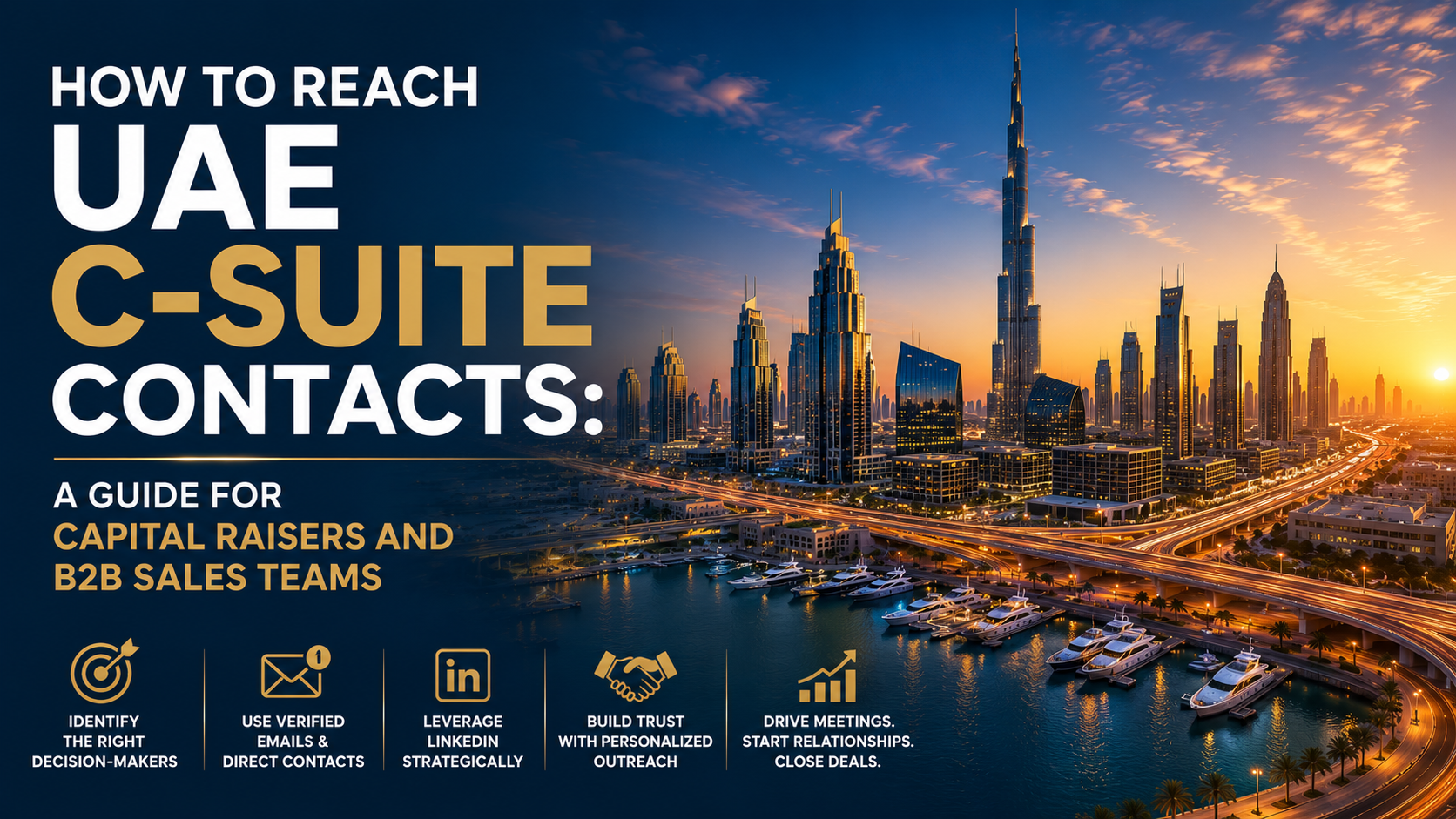
How to Reach UAE C-Suite Contacts: A Guide for Capital Raisers and B2B Sales Teams
Source: Dubai Investors List | UAE C-Suite Executive Database Premium | dubaiinvestorslist.com
Getting a meeting with a UAE CEO, CFO, or Chairman is not impossible. But doing it at scale – efficiently, professionally, and with a conversion rate that justifies the effort – requires more than cold LinkedIn messages and a generic pitch deck. It requires the right data, the right sequencing, and a clear understanding of how decision-makers in the UAE actually behave.
This guide draws on the intelligence embedded in the Elite UAE C-Suite & Executive Database to explain what signals matter, how to prioritise your contact universe, and how to structure outreach that converts.
Why Most UAE Outreach Fails
Most outreach campaigns targeting UAE executives fail for one of three reasons. First, they use bad data – scraped LinkedIn profiles with no email, generic info@ addresses, or outdated contact records. Second, they send the wrong message — a financial product pitch sent to the COO of an IT firm, or a real estate investment offer emailed to a law firm partner. Third, they have no segmentation logic – every contact gets the same message, regardless of seniority, industry, company size, or geography.
The UAE market compounds these problems. Decision-makers here receive a high volume of unsolicited outreach, much of it poorly targeted. Standing out requires genuine relevance – and genuine relevance requires data that goes beyond a name and a job title.
The Four Signals That Predict Response
Based on the structure of the UAE C-Suite database and the commercial context of the market, four contact attributes most reliably predict whether an executive is likely to engage with outreach:
| Signal | What It Tells You | Why It Matters | Database Field |
| Seniority Level | Chairman/Founder = principal capital | Higher authority = faster decision | Seniority column |
| Industry | Financial services/investment mgmt = investment mandate | Sector context drives message relevance | Industry column |
| Company Size (Employees) | Large firms = complex buying; small firms = fast decisions | Determines pitch approach | # Employees column |
| Title | CEO vs COO vs CFO signals different access | CFO = financial decisions; CEO = strategic | Job Title column |
When these four signals are aligned — for example, a Founder-CEO at a 50-employee investment management firm in Dubai – you have an ideal target for capital raising outreach. One person, maximum authority, accessible decision-making, high likelihood of personal investment appetite.
Building Your Target Segments
Rather than treating the database as a monolithic list, the right approach is to build distinct segments with distinct messaging. Here is a practical segmentation framework based on the database structure:
| Segment | Filter Criteria | Message Theme | Product/Service Fit |
| Senior Capital | Chairman OR Founder + Investment Mgmt OR Financial Services | Capital allocation, alternative assets, deal flow | Funds, private placements, gold-backed instruments |
| Founder-CEOs (Tech) | Founder + IT & Services + 10-200 employees | Growth capital, strategic partnership, product | SaaS, B2B technology, advisory |
| Real Estate Principals | CEO/Founder + Real Estate + Dubai/Abu Dhabi | Investment, financing, data intelligence | Debt, equity, market intelligence products |
| Professional Services Partners | Partner + Law/Accounting/Consulting | Data, efficiency, client intelligence | Research products, databases, professional tools |
| Operational C-Suite | CFO OR COO + any sector + 100+ employees | Procurement, compliance, operational solutions | Enterprise software, outsourcing, finance tools |
The Outreach Sequence That Works
For UAE C-Suite contacts, a three-touch sequence over 10-14 days is the most effective structure. The first touch should be a short, personalised email – under 150 words – that demonstrates sector-specific relevance and a clear, low-friction call to action (a 15-minute call or a reply with a specific question). Generic pitches are immediately discarded.
The second touch, sent 4-5 days later if no reply, should add a single piece of value – a relevant data point, a market observation, or a specific reference to their company or sector. This is where database intelligence pays dividends: knowing that a contact is a Founder in the renewables sector allows you to reference the UAE’s Net Zero 2050 agenda, instantly signalling that you understand their world.
The third touch, sent 7-8 days after the second, should be a brief close – acknowledging that timing may not be right, offering a resource (a report, a data sample, a relevant article), and leaving the door open without pressure. This touch should never be aggressive and often produces delayed responses days or weeks later.
| Touch | Timing | Format | Length | Goal |
| Touch 1 | Day 1 | Personalised email | < 150 words | Establish relevance, invite response |
| Touch 2 | Day 5 | Value-add follow-up | 100-120 words | Deepen relevance, reinforce credibility |
| Touch 3 | Day 12 | Soft close with resource | 80-100 words | Leave door open, offer value without pressure |
| LinkedIn (optional) | Day 3 or 7 | Connection request with note | < 300 chars | Build second channel visibility |
What Not to Do
Several outreach mistakes are disproportionately damaging in the UAE market. Sending an unsolicited mass pitch deck attachment is the most common – it triggers spam filters, signals zero personalisation, and immediately positions you as someone without local market understanding. Using an unverified email list is similarly dangerous: hard bounces damage your sending domain reputation, and with premium UAE contacts, a single bad campaign can blacklist your domain from DIFC and ADGM corporate email servers.
Over-formality is also counterproductive. UAE executives – particularly in tech and real estate – respond better to direct, commercially-grounded communication than to verbose introductory letters. Brevity signals respect for their time. The best first emails read like a message from a smart peer, not a template from a marketing automation platform.
The Role of LinkedIn in UAE Executive Outreach
LinkedIn plays a meaningful but secondary role in UAE C-Suite outreach. The database includes verified LinkedIn URLs for the vast majority of contacts, making it straightforward to run coordinated email-plus-LinkedIn sequences. However, LinkedIn response rates in the UAE are meaningfully lower than direct email rates, particularly for senior profiles who receive high volumes of connection requests.
The optimal use of LinkedIn is as a visibility and credibility layer – connecting on the same day as your first email ensures that when the executive checks your message and looks you up, your profile is already visible to them. It adds social proof without replacing the directness of email.
Converting Responses to Meetings
When a UAE executive does respond – whether with a question, a request for more information, or a simple ‘let’s talk’ – speed is everything. Responses sent within one hour convert to meetings at significantly higher rates than responses sent the following day. UAE business culture is fast-paced and values decisiveness; a slow follow-up signals that you are not serious.
When proposing a meeting, always offer two specific time slots rather than an open-ended ‘whenever works for you’. Keep the meeting format flexible – video calls are fully accepted for first meetings across the UAE executive community, and in-person meetings in Dubai or Abu Dhabi are straightforward for anyone with regional presence or visiting.
Access the UAE Elite C-Suite & Executive Database at dubaiinvestorslist.com
Thousands of verified UAE C-Suite executives with direct emails, LinkedIn profiles, mobile numbers, and company intelligence. All contacts deliverable-verified.
UAE’s Top Founder-CEOs: The Entrepreneurs Driving Private Capital in 2026
Source: Dubai Investors List | UAE C-Suite Executive Database Premium | dubaiinvestorslist.com
In the UAE’s executive landscape, no profile is more commercially valuable – or more strategically interesting – than the Founder-CEO. These are individuals who built their own enterprises, often from nothing, and who now sit at the intersection of operational leadership and private capital. They are simultaneously business leaders, investors, dealmakers, and often LP prospects for alternative investment vehicles.
The Elite UAE C-Suite & Executive Database contains a significant tier of verified Founder and Chairman contacts across every major sector. This report profiles the most commercially relevant segments of this group, explains what makes them distinctive as a target audience, and identifies the sectors and company types where they are most concentrated.
Who is a UAE Founder-CEO?
For the purposes of this analysis, a Founder-CEO is any executive who appears in the database with either ‘Founder’, ‘Co-Founder’, ‘Owner’, or ‘Chairman’ as their seniority classification and who simultaneously holds a CEO, Managing Director, or equivalent operational title. This profile combines ownership – and therefore personal wealth exposure — with day-to-day strategic control.
In a market like the UAE, this profile carries special significance. Unlike Western markets where founder-CEOs of large companies are relatively rare (most public company CEOs did not found their firms), the UAE’s private sector is dominated by owner-operated businesses. Family groups, first-generation entrepreneurs, and serial founders all contribute to a landscape where the person running the company is usually the person who built it.
| Founder Profile Type | Description | Capital Relevance | Example Sectors |
| Founder-Chairman (Heritage) | Established family business principal, 20+ year tenure | Highest — significant private capital | Investment Mgmt, Retail, Conglomerates |
| Founder-CEO (Scale-Up) | Built company to 50-500 employees, still leading | High — profitable, exploring alternatives | Real Estate, Financial Services, IT |
| Founder-CEO (Startup) | Sub-50 employee, 3-7 years operating | Medium — growing, seeking capital | Tech, HealthTech, EdTech, B2B SaaS |
| Co-Founder-COO/CTO | Technical or operational co-founder | Medium — less capital authority | IT Services, Cybersecurity, PropTech |
The Investment Management Founder Tier
The highest-value Founder profiles in the database are concentrated in investment management — a sector where the Founder and Chairman title almost invariably denotes a principal capital allocator. Examples from the database include Abdulwahab Galadari (Chairman and Owner, Awgal Investments), Rashid Alameri (Founder & Chairman, AAMERAH), Anas Almadani (Vice Chairman and CEO, INDEX Holding, 170 employees), and Abdul Majeed (CFO, Al Beed Investment Group).
These are not passive investors. Many of these individuals actively manage diversified portfolios spanning real estate, private equity, listed equities, and increasingly, alternative assets. Their investment appetite is typically broad-based, and their decision-making is fast — unconstrained by the committee structures that slow institutional capital deployment.
For capital raisers and placement agents, this tier represents the most direct path to an investment decision. A well-targeted approach to 50 such contacts – personally relevant, clearly structured, and professionally presented – can yield more qualified conversations than a mass blast to 5,000 generic executives.
The Real Estate Founder Tier
Real estate is the second most commercially significant sector for Founder-CEO profiles. The database includes a dense cluster of property entrepreneurs across development, brokerage, investment, and PropTech – many of whom have generated significant personal liquidity through property exits and are actively seeking alternative investment vehicles.
Notable profiles include: Abbas Sajwani (Founder & CEO, AHS Properties, 110 employees), Abdullah Alajaji (Founder, Driven Properties, 780 employees), Ashraf Jibril (Founder & CEO, ASTRO Properties, 53 employees), Aaron Grieve (Co-Founder & MD, Luxfolio Real Estate, 200 employees), and Ahmed Al-Zinati (Founder/CEO, Above & Beyond Properties, 21 employees).
The real estate founder profile in the UAE is particularly interesting because these executives simultaneously have domain expertise in hard assets, personal liquidity from past transactions, and an investment orientation toward tangible, collateralised structures. This makes them natural candidates for gold-backed instruments, property debt vehicles, and commodities-linked investment products.
| Company | Founder / Title | Employees | Investment Profile Notes |
| Driven Properties | Abdullah Alajaji, Founder | 780 | Large brokerage — high transaction volume, LP prospect |
| AHS Properties | Abbas Sajwani, Founder & CEO | 110 | Active developer — direct capital deployment |
| Luxfolio Real Estate | Aaron Grieve, Co-Founder & MD | 200 | Premium segment — wealth management adjacent |
| ASTRO Properties | Ashraf Jibril, Founder & CEO | 53 | Mid-size developer — active deal flow |
| Springfield Properties | Abdullah Syed, Founder | 230 | High volume brokerage — investor-oriented client base |
The Technology Founder Tier
The UAE’s technology sector has produced a generation of founder-CEOs who are increasingly visible as investors, LPs, and co-investment partners. Unlike earlier generations of tech entrepreneurs who might have reinvested exclusively into their own businesses, today’s UAE tech founders are diversifying – allocating to real assets, alternative funds, and structured instruments as their primary business achieves scale.
The database contains many such profiles: Abdulla Al-Mazrouei (CEO, Mubadala – though a public entity, it reflects the largest sovereign tech investor), Aahan Bhojani (Founder & CEO, Silkhaus, 64 employees), Ammar Alsoos (CEO, LikeCard, 150 employees), and Ali Kontar (CEO, Zero&One, 100 employees) are representative of the tech founder profile. These individuals are operationally focused but personally sophisticated as investors, particularly in the DIFC and ADGM regulatory context.
The Galadari and Al Ghurair Dimension
Any analysis of UAE Founder-CEO profiles is incomplete without acknowledging the role of the major family business conglomerates. The database includes senior executives from entities like Galadari Brothers (Armand Andrea, Group CMO, 6,000 employees) and Al Ghurair (Essa Al Ghurair, Owner, 4,500 employees) – organisations where the founding family retains active ownership and operational involvement across multiple business lines.
Engaging with executives at these conglomerates is a different proposition from engaging with a startup Founder-CEO. The decision-making chain is longer, the due diligence process more formal, and the entry point matters significantly – a wrong-level engagement can stall a relationship before it starts. The database’s title and seniority fields allow you to identify the right person within these complex organisational structures, targeting the investment or corporate development function rather than the operating division.
What Founders Actually Want
Based on the commercial context of the UAE in 2026, the most compelling investment narratives for Founder-CEO profiles are those that combine three elements: a hard asset or collateralised structure (which resonates with real estate and energy founders); a clear, contracted return mechanism (which resonates with financially sophisticated operators); and a defined exit or liquidity horizon (which resonates with entrepreneurs who understand time value of capital).
Vague equity upside narratives, speculative tech valuations, and opaque fund structures are the least effective with this audience. They have built real businesses and they invest the same way they operate – with clear expectations, defined downside protection, and executable terms.
Building Your Founder-CEO Outreach List
The Premium Database allows you to filter specifically for Founder, Co-Founder, Chairman, and Owner seniority profiles and to cross-reference with industry, company size, and emirate. A well-constructed Founder-CEO list of 200-500 contacts – filtered for investment management, real estate, and financial services – represents one of the most valuable prospecting assets available in the UAE market.
Combined with a professionally crafted outreach sequence and a product with genuine structural appeal, such a list can drive serious capital conversations within a single campaign cycle. The data is the foundation. Everything else follows from it.
Access the UAE Elite C-Suite & Executive Database at dubaiinvestorslist.com
Filter by Founder, Chairman, and Owner seniority to build your UAE principal capital list. Direct emails, LinkedIn profiles, and company intelligence included for every verified contact.
UAE Family Offices in 2026: How to Identify and Approach Private Capital Decision-Makers
Source: Dubai Investors List | UAE Family Office Database & C-Suite Executive Database | dubaiinvestorslist.com
The UAE is home to one of the highest concentrations of family office capital anywhere in the world. Estimates place the number of formal and semi-formal family investment offices operating across Dubai and Abu Dhabi in the hundreds, with total assets under management spanning hundreds of billions of dollars. Yet for most fund managers, placement agents, and capital raisers, this capital remains largely inaccessible – not because it is unavailable, but because the people who control it are difficult to find, harder to identify, and almost impossible to reach without the right intelligence.
This report draws on two proprietary Dubai Investors List datasets – the UAE Family Office Database and the Elite C-Suite & Executive Database — to explain who controls UAE family office capital, how these structures are organised, and what a credible approach looks like in 2026.
What Is a UAE Family Office?
A UAE family office is a private wealth management entity established to manage the financial affairs of a high-net-worth or ultra-high-net-worth family. They range from single-family offices (SFOs) serving one family exclusively, to multi-family offices (MFOs) that aggregate capital and services across several families, to informal investment holding companies that function as family offices without carrying that label explicitly.
In the UAE context, the distinctions blur further. Many of the country’s most prominent family offices operate under a broader conglomerate or holding company structure – entities like Galadari Brothers, Al Ghurair, Al Naboodah Group, and Mubadala sit on a spectrum between corporate group and family office. The executive contacts within these organisations are simultaneously corporate leaders and de facto family wealth managers.
| Family Office Type | Structure | Typical AUM Range | Decision-Making Profile |
| Single Family Office (SFO) | Private entity, one family | $100M — $5B+ | Patriarch / Chairman / Family CEO |
| Multi-Family Office (MFO) | Shared platform, several families | $50M — $2B per family | CIO / CEO / Investment Committee |
| Holding Company / Conglomerate | Business group with investment arm | $500M — $50B+ | Chairman / Group CEO / CFO |
| Informal Investment Entity | No formal FO label, functions as one | $20M — $500M | Founder-CEO / Owner |
The Emirati Family Capital Tier
The most significant family office capital in the UAE is controlled by Emirati nationals whose families built their wealth across real estate, trading, construction, retail, and government-linked enterprises over multiple generations. These families operate with long investment horizons, genuine risk tolerance for private markets, and a preference for personal relationships over institutional intermediaries.
The C-Suite database contains verified executives from some of the UAE’s most prominent family-affiliated entities. Abdulwahab Galadari (Chairman and Owner, Awgal Investments) represents one branch of the Galadari family, one of Dubai’s most storied trading dynasties. Essa Al Ghurair (Owner, Al Ghurair, 4,500 employees) leads one of the largest diversified family conglomerates in the Arab world. Abdullah Al Naboodah (Group Chairman, Saeed & Mohammed Al Naboodah Group, 4,000 employees) represents another multi-generational family holding structure.
These are not liquid investors who can be converted in a single email sequence. They require a credentialing process – ideally involving a warm introduction, a credible intermediary, or a demonstrable track record with similar families in the region. But for funds and investment vehicles that can demonstrate institutional quality and regional alignment, the capital allocation potential is transformative.
The Expatriate Family Office Tier
Alongside Emirati family capital, the UAE hosts a substantial and growing tier of expatriate family offices – wealth management structures established by non-Emirati HNWIs who have made the UAE their primary business and personal base. This includes Indian, Lebanese, Pakistani, Egyptian, British, and European families who have built significant businesses in the region over one to three generations.
This tier is often more accessible than the Emirati family capital tier. Decision-makers are typically first-generation wealth creators who are still actively building their businesses and have direct personal involvement in investment decisions. Many are represented in the C-Suite database as Founder-CEOs, Chairman-Owners, or Managing Partners of their primary business entities.
| Nationality Cluster | Primary Business Concentration | Investment Orientation | Outreach Approach |
| Emirati (Heritage) | Real estate, conglomerates, government-linked | Long-term, alternatives, real assets | Warm intro preferred, institutional quality required |
| Indian (Diaspora) | Trading, IT, retail, hospitality, real estate | Diversified, growth-oriented | Direct email effective, relationship builds quickly |
| Lebanese / Levantine | Finance, professional services, retail, F&B | Sophisticated, alternatives-oriented | Peer referral highly effective |
| Pakistani / South Asian | Construction, IT, manufacturing, services | Real assets, structured products | Direct outreach works, personal meeting preferred |
| European / Western | Financial services, advisory, tech | Institutional, diversified | Professional email sequences, LinkedIn outreach |
How UAE Family Offices Actually Make Investment Decisions
Understanding UAE family office decision-making processes is essential for anyone trying to place a fund or investment product. Unlike institutional investors who follow formal mandate-driven processes, family offices in the UAE typically make decisions based on a combination of relationship trust, structural simplicity, and personal conviction. The gatekeeping function sits with whoever controls the family’s investment mandate – often the patriarch, the eldest operating family member, or a trusted senior advisor.
Investment committees exist in more formalised structures, but even then they are typically small (three to five people) and heavily influenced by one or two principal voices. Reaching the right person – the actual decision-maker, not their assistant or a junior family member – is the critical first step. This is precisely what the UAE Family Office Database and C-Suite Executive Database are designed to enable.
What Family Offices Are Looking for in 2026
The current investment climate across UAE family offices in 2026 reflects several converging themes: a continued appetite for hard asset exposure (real estate, gold, commodities, infrastructure); growing interest in private credit and structured income vehicles as a complement to equity; selective engagement with private equity in sectors aligned with UAE’s Vision 2031 agenda; and increasing attention to ESG-compliant and Sharia-compliant structures that meet both ethical and commercial requirements.
Vehicles with clear collateralisation, defined return profiles, and a credible counterparty carry a significant advantage in this environment. Vague growth equity narratives and speculative venture bets are the least appealing to this audience — they have enough exposure to market risk in their primary businesses.
Building Your UAE Family Office Outreach List
The Dubai Investors List UAE Family Office Database covers over 195 verified family office entities across the UAE, including 430 named executives with direct contact information. Combined with the Elite C-Suite & Executive Database’s Chairman, Founder, and Owner seniority tier, you have a comprehensive view of where UAE family capital is controlled and who controls it.
A targeted approach to 150-300 well-qualified family office contacts – personalised by family background, business sector, and investment profile – will consistently outperform a mass-blast approach to 10,000 unqualified executives. Quality of targeting is the primary variable that determines campaign ROI in this segment.
Access the UAE Family Office Database and Elite C-Suite Database at dubaiinvestorslist.com
195 verified UAE family office firms, 430 named executives, and thousands of C-Suite contacts — all with verified direct emails, LinkedIn profiles, and company intelligence.
UAE Nationals in Business: The Emirati C-Suite Executives You Need to Know in 2026
Source: Dubai Investors List | UAE C-Suite Executive Database Premium | dubaiinvestorslist.com
For any international business, fund manager, or professional services firm seeking to establish genuine commercial roots in the UAE, one objective stands above all others: building authentic relationships with Emirati principals. UAE Nationals – Emiratis – represent the country’s most influential business network, its largest sovereign capital pools, and its primary gatekeepers to government-linked contracts, regulatory approvals, and institutional deal flow.
Yet Emirati executives remain among the most inaccessible contacts in the UAE market for outsiders. They are not listed in generic databases. They do not respond to cold mass-email campaigns. They engage through relationships, credibility signals, and introductions – and reaching them requires first knowing who they are, where they sit, and what they care about.
The Elite UAE C-Suite & Executive Database contains verified contact records for a significant number of Emirati C-Suite executives across investment management, government, real estate, energy, and conglomerates. This report profiles the key segments of this group and explains how to approach them effectively.
Why Emirati Executive Connections Are Different
Doing business with Emirati principals is structurally different from doing business with most other executive profiles in the UAE. Several factors combine to make this the case. First, personal and family reputation carries enormous weight – an unsolicited, poorly targeted approach does not just fail; it can actively close a door that was previously open. Second, many Emirati executives hold roles that combine private commercial responsibility with public or government-linked mandates, meaning their decision-making operates within a broader social and institutional context. Third, the pace of relationship-building is slower and the expectations around trust and consistency are higher.
None of this means these relationships are impossible to build. It means they must be approached correctly – with genuine relevance, appropriate deference to their commercial context, and a clear understanding of what they are and are not looking for.
Key Emirati Executive Profiles in the Database
The C-Suite database contains Emirati executives across several major categories. The following table profiles the most commercially significant segments:
| Segment | Example Executives / Organisations | Commercial Focus | Best Approach |
| Sovereign / Govt-Linked CEOs | Abdulla Al-Mazrouei (Mubadala), Ahmad Alfalasi (Dubai DET), Ahmed Alqaseer (Shurooq) | Strategic investment, national development | Formal introduction, institutional credibility required |
| Conglomerate Chairmen | Essa Al Ghurair (Al Ghurair), Abdullah Al Naboodah (Al Naboodah Group) | Multi-sector capital allocation | Warm introduction, heritage and track record critical |
| Investment Mgmt Principals | Abdulwahab Galadari (Awgal Investments), Abdulla Aljallaf (AJ Capital) | Private capital, alternatives | Direct email acceptable if relevant and concise |
| Real Estate Founders | Abdulla Alajaji (Driven Properties), Abdulla Alnuaimi (AKN Properties) | Property investment, development | Sector-specific messaging, direct outreach works |
| Tech & Innovation Leaders | Ahmed Alhameli (Zero Two), Abdulla Suwaidi (UXE Security) | Technology, smart city, security | Innovation narrative, UAE Vision 2031 alignment |
The Sovereign and Government-Linked Executive Tier
The highest-profile Emirati executive tier is concentrated in sovereign and government-linked entities – ADNOC, Mubadala, ADQ, Dubai Holding, DIFC, and the various emirate-level investment and development authorities. These organisations collectively control trillions of dirhams in assets and represent the most significant institutional capital pools in the Arab world.
Executives at this level – such as Abdulla Al-Mazrouei (CEO, Mubadala, 2,100 employees), Ahmad Alfalasi (CEO, Dubai Business Licensing Corporation, Dubai DET), and Ahmed Alqaseer (CEO, Sharjah Investment and Development Authority Shurooq, 380 employees) – operate within highly structured mandates. Direct cold outreach is rarely appropriate. The correct engagement path typically involves a formal institutional introduction, a credible local intermediary, or participation in UAE-sanctioned investment forums such as those hosted by DIFC, Mubadala, or the Abu Dhabi Investment Forum.
The Conglomerate and Family Business Tier
Below the sovereign tier sits the UAE’s major Emirati family conglomerates – businesses founded in the 1960s through 1980s by first-generation entrepreneurs who built diversified empires across trading, construction, real estate, retail, and services. The second and third generations now lead these organisations, combining commercial sophistication with deep local networks.
Al Ghurair (Essa Al Ghurair, Owner, 4,500 employees), the Saeed & Mohammed Al Naboodah Group (Abdullah Al Naboodah, Group Chairman, 4,000 employees), and Galadari Brothers (multiple senior executives, 6,000 employees) are the most prominent examples. These families collectively control capital measured in the tens of billions of dollars and have historically allocated to a broad range of private market investments.
The key to engaging this tier is understanding that business and personal reputation are inseparable. Any introduction or approach that touches on personal integrity, family legacy, or community standing will be scrutinised carefully. What works is a straightforward, commercially clear proposition delivered through a mutual contact or introduced with appropriate context about your track record and the relevance of what you are offering.
The Rising Emirati Entrepreneur Tier
Perhaps the most accessible and fastest-growing segment of Emirati executive profiles in 2026 is the new generation of Emirati entrepreneurs — founder-CEOs in their 30s and 40s who have built tech companies, investment platforms, real estate ventures, and professional services firms. This cohort is actively supported by UAE government initiatives including Hub71, the Mohammed Bin Rashid Innovation Fund, and Khalifa Fund, which have collectively seeded hundreds of Emirati-led startups.
Executives like Abdulla Al-Mazrouei (CEO & Founder, MatchOn MENA), Abdulla Dhaheri (CEO, The Blockchain Center Abu Dhabi), Ahmed Alhameli (CEO, Zero Two, Abu Dhabi), and Abdulaziz Alshamsi (CEO, Vcharge) represent this new cohort. They are more accessible than their predecessors, more globally oriented in their investment and business thinking, and actively seeking partnerships with credible international counterparties.
How to Approach Emirati Executives: Practical Guidance
Several principles apply consistently when approaching Emirati C-Suite contacts. First, personalisation is non-negotiable — a message that demonstrates genuine knowledge of their business, their sector, and the UAE context will always outperform a generic template. Second, the ask should be proportionate to the relationship — a first outreach should invite a conversation, not a commitment. Third, respecting cultural context matters — Friday is the Islamic holy day, Ramadan changes business rhythms significantly, and references to family and community are treated with seriousness.
| Do | Don’t |
| Personalise every message with specific company/sector context | Send mass-blast generic templates |
| Reference UAE Vision 2031 or national development themes | Lead with aggressive ROI claims |
| Offer a credible introduction or shared reference point | Cold outreach without any context |
| Keep the first ask small — a call, a brief meeting | Request large commitments immediately |
| Follow up consistently but not aggressively | Disappear after one attempt or follow up daily |
Access the UAE Elite C-Suite & Executive Database at dubaiinvestorslist.com
Includes verified Emirati and non-Emirati C-Suite executive contacts with direct emails, LinkedIn profiles, and company intelligence across every major sector and emirate.
Raising Capital in the UAE in 2026: What Foreign Fund Managers Need to Know About the Investor Landscape
Source: Dubai Investors List | UAE C-Suite Executive Database Premium | dubaiinvestorslist.com
The UAE has cemented its position as the capital-raising hub of the Middle East, Africa, and increasingly South Asia. For international fund managers, placement agents, and alternative investment vehicles seeking to access the region’s private wealth pools, the opportunity is real and the timing in 2026 is arguably as good as it has ever been. But the path from ‘the UAE is a target market’ to ‘we have closed LP commitments from UAE investors’ is more complex than many first-time entrants anticipate.
This report draws on intelligence from the Dubai Investors List UAE C-Suite & Executive Database to map the UAE investor landscape as it exists in 2026, explain the regulatory and structural context, and give foreign fund managers a clear-eyed framework for where to focus and how to engage.
The UAE Investment Landscape in 2026: Key Facts
| Metric | Estimate / Detail |
| UAE household wealth | Among top 10 globally per capita |
| Number of UAE millionaires (USD) | Estimated 130,000+ (Henley & Partners 2024 basis) |
| Family offices in Dubai & Abu Dhabi | Hundreds of formal and informal structures |
| DIFC registered entities | Over 6,000 active registered companies |
| ADGM registered entities | Over 1,000 financial services firms |
| Primary investor types | Family offices, HNWIs, SWFs, PE/VC funds, RIAs |
| Dominant investment preference (2026) | Real assets, private credit, alternatives, infrastructure |
| Key regulatory frameworks | DIFC (DFSA), ADGM (FSRA), SCA (onshore UAE) |
The Five Investor Types You Will Encounter
The UAE investor landscape is not monolithic. Foreign fund managers who treat it as such – pitching the same narrative to every contact – consistently underperform those who segment and tailor. There are five primary investor archetypes in the UAE market, each with distinct decision-making processes, investment mandates, and engagement preferences.
| Investor Type | Profile | Typical Ticket Size | Decision Speed | Best Engagement Channel |
| Ultra-HNW Family Offices | Emirati and expat patriarch-led wealth structures | $1M — $25M+ | Slow — relationship-driven | Warm introduction, in-person |
| Multi-Family Offices (MFOs) | Formalised platforms, CIO-led | $500K — $10M | Medium — committee process | Formal presentation, DIFC events |
| Sovereign Wealth Funds | Mubadala, ADQ, ICD, ADIA-affiliated | $10M — $1B+ | Very slow — institutional mandate | Government relations, institutional channels |
| Private Equity / VC Funds | Regional PE, growth equity, venture | $250K — $5M co-invest | Fast — mandate-driven | Direct email, conference networking |
| HNWI Principals (Direct) | Founder-CEOs, Chairmen investing personally | $100K — $5M | Fast — personal decision | Verified direct email, LinkedIn |
The Regulatory Framework: What You Must Understand
The UAE operates three distinct financial regulatory environments, and understanding which applies to your fundraising activity is non-negotiable. Getting this wrong – whether by soliciting investments without appropriate registration or by approaching retail investors with institutional products – can result in regulatory action that permanently damages your reputation in the market.
The Dubai International Financial Centre (DIFC) is governed by the Dubai Financial Services Authority (DFSA) and operates under English common law. It is the preferred base for international fund managers and placement agents targeting UAE investors, offering a familiar regulatory environment and direct access to the country’s largest concentration of financial services professionals. The Abu Dhabi Global Market (ADGM) on Al Maryah Island operates under a similar framework governed by the Financial Services Regulatory Authority (FSRA) and is increasingly favoured by institutional players targeting the Abu Dhabi capital market.
The onshore UAE market – outside DIFC and ADGM – is regulated by the Securities and Commodities Authority (SCA) and follows UAE federal law. Private placements to professional investors within this framework are permissible under specific conditions but require careful legal structuring. Most international fund managers raising capital in the UAE operate through DIFC or ADGM registration, using private placement exemptions targeting professional clients or market counterparties.
| Regulatory Zone | Regulator | Legal Basis | Best For |
| DIFC (Dubai) | DFSA | English common law | International funds, family office targeting, placement agents |
| ADGM (Abu Dhabi) | FSRA | English common law | Institutional capital, SWF-adjacent, Abu Dhabi base |
| Onshore UAE | SCA (federal) | UAE federal law | Local corporate investors, GCC-licensed structures |
What UAE Investors Are Allocating to in 2026
The investment appetite across UAE family offices, HNWIs, and institutional investors in 2026 reflects a market that has matured significantly over the past decade. The era of speculative growth-at-all-costs venture capital is less dominant here than in Silicon Valley or London – UAE private capital has a strong orientation toward tangible value, income generation, and capital preservation alongside growth.
The most consistently in-demand investment themes for 2026 are: real assets (real estate, commodities, infrastructure, gold-backed structures); private credit and structured income (fixed-return, collateralised vehicles with clear maturity profiles); select technology (AI infrastructure, cybersecurity, fintech – particularly if UAE or GCC-focused); ESG and sustainability-linked investments aligned with the UAE’s Net Zero 2050 agenda; and healthcare and life sciences, driven by the post-pandemic acceleration of health sector investment across the region.
| Asset Class | UAE Investor Appetite (2026) | Key Selling Points | Caution Points |
| Real Estate / Real Assets | Very High | Tangible, income-generating, familiar | UAE market saturation narrative — counter with data |
| Gold / Commodities-Backed | High | Inflation hedge, hard collateral, clear structure | Must demonstrate counterparty quality and delivery mechanism |
| Private Credit / Structured Income | High | Fixed return, defined maturity, capital protection | Transparency of underlying assets critical |
| Private Equity (regional) | Medium-High | Growth exposure, GCC alignment | Fund track record and manager credibility essential |
| Venture Capital | Medium | Innovation narrative, upside potential | Liquidity timeline and valuation methodology scrutinised |
| Public Equities / Liquid | Lower | Allocated through local brokers | Less competitive for international managers |
The Role of Data in UAE Capital Raising
The single most consistent differentiator between fund managers who successfully raise capital in the UAE and those who do not is the quality of their contact intelligence. The UAE private wealth market is not intermediated in the way that, for example, the UK wealth management market is — you cannot simply approach a handful of large IFA networks and gain exposure to thousands of investors. Access is direct, personal, and relationship-dependent.
This means that a verified list of 500 UAE C-Suite principals — filtered by industry, seniority, emirate, and company size — is not a marketing asset. It is a fundraising asset. Each contact represents a potential LP conversation. Each verified email is a door that can be opened with the right approach. The difference between a fund that closes $10M in UAE commitments and one that closes $100M often comes down to nothing more than the breadth and quality of the contact list they started with.
Building Your UAE Capital Raising Contact Strategy
A practical UAE capital raising campaign in 2026 should be built on three concentric rings of outreach. The inner ring – 50-100 contacts – consists of the highest-priority targets: Emirati Chairman and Founder profiles in investment management, large real estate developers, and DIFC/ADGM-based family office executives. These receive the most personalised, relationship-intensive engagement.
The middle ring – 200-400 contacts – consists of Founder-CEOs and senior executives in financial services, real estate, and technology who have personal investment capacity and demonstrated appetite for alternatives. These receive a tailored but scalable email sequence with personalisation at the sector and company level.
The outer ring – 500-1,000 contacts – consists of the broader C-Suite universe filtered for seniority and industry relevance. These receive a professionally structured campaign designed to surface the 10-15% who are actively evaluating investment opportunities, with a clear path to move qualifying responses into the inner ring process.
The Elite UAE C-Suite & Executive Database provides the verified contact foundation for all three rings. Combined with a disciplined sequencing strategy and a well-structured investment product, this architecture consistently produces qualified LP conversations within a single campaign cycle.
Access the UAE Elite C-Suite & Executive Database at dubaiinvestorslist.com
Thousands of verified UAE C-Suite decision-makers across family offices, investment management, real estate, financial services, and more — with direct emails, LinkedIn profiles, and company intelligence. The foundation for any serious UAE capital raising campaign.
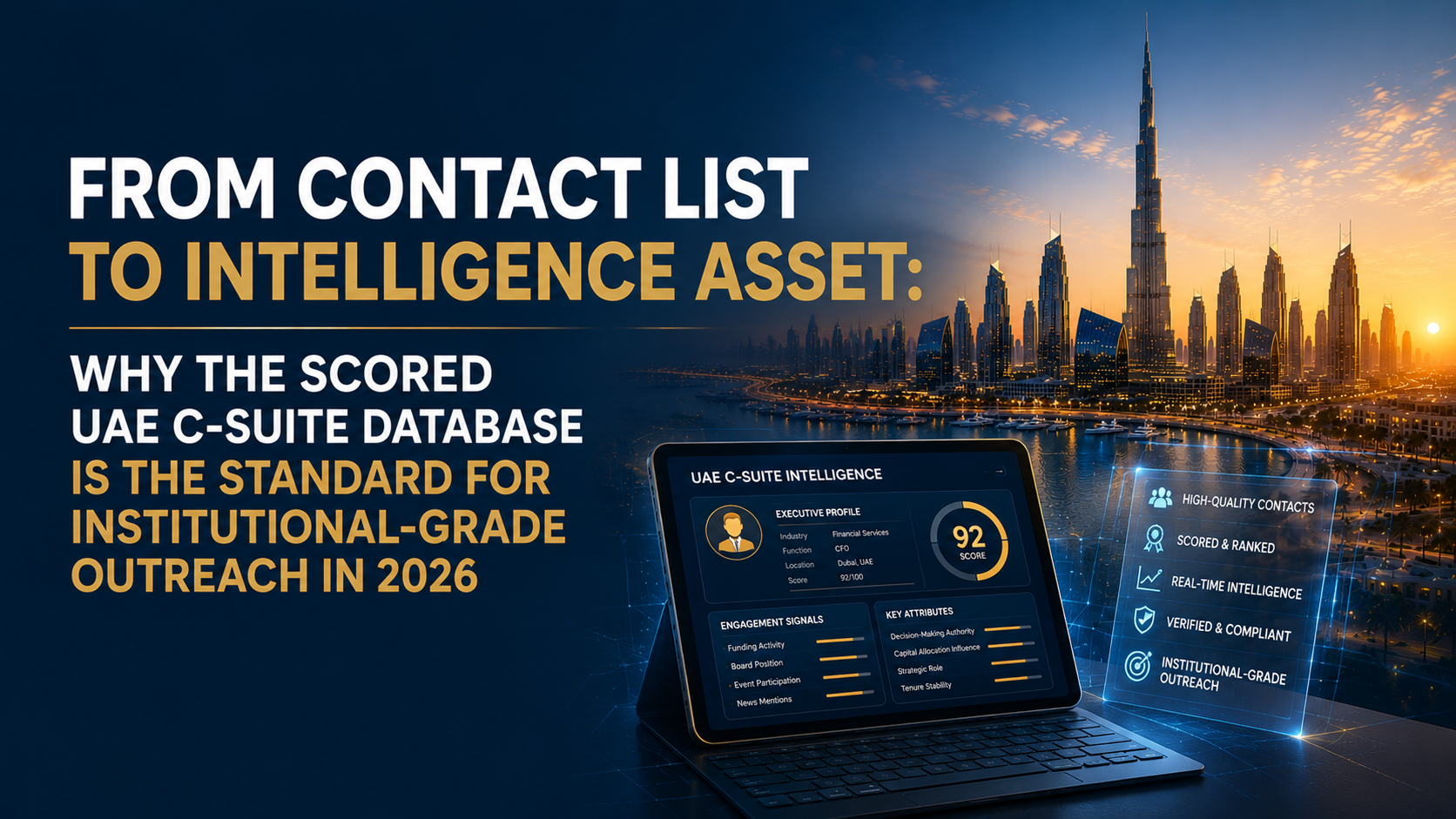
From Contact List to Intelligence Asset: Why the Scored UAE C-Suite Database Is the Standard for Institutional-Grade Outreach in 2026
Source: Dubai Investors List | UAE C-Suite Executive Database Premium — Scored Edition | dubaiinvestorslist.com
There is a fundamental difference between a contact list and an intelligence asset. A contact list gives you names and email addresses. An intelligence asset gives you a ranked, scored, multi-dimensional view of every contact – their commercial authority, their sector relevance, their capital potential, and the completeness of the data available to reach them. For institutional-grade marketers, fund placement teams, and B2B revenue organisations operating in the UAE, that difference is not cosmetic. It is the difference between a campaign that generates qualified conversations and one that burns budget against an undifferentiated mass.
The Scored Edition of the Elite UAE C-Suite & Executive Database — exclusively available through Dubai Investors List – transforms 17,779 verified UAE executive contacts into a stratified, prioritised intelligence system. Every contact has been evaluated across five commercial dimensions, assigned a score out of 100, classified into a tier, and flagged for investor potential. The result is a dataset that professional outreach teams can deploy immediately, with confidence, at scale – and with the kind of segmentation sophistication that previously required weeks of manual research or a dedicated data science function.
This report explains exactly how the scoring works, what it enables, and why it represents a step-change in how serious operators approach the UAE market.
The Problem with Raw Executive Databases
Most executive databases – including many sold at premium prices – are fundamentally flat. They contain rows of names, titles, emails, and company names, arranged in alphabetical order or sorted by industry with no further intelligence applied. The implicit assumption is that the buyer will figure out the prioritisation themselves.
For a small team making ten calls a day, that might be manageable. For an institutional marketing operation deploying outreach across thousands of contacts – a placement agent running a fund distribution campaign, a B2B technology company entering the UAE market, a wealth management firm building an LP pipeline – flat data creates compounding inefficiencies. Every hour spent manually assessing whether a contact is worth prioritising is an hour not spent on the outreach itself. Every undifferentiated campaign that treats a two-person startup founder the same as the Chairman of a $4 billion investment conglomerate is a campaign with structurally compromised conversion rates.
“The question is never how many contacts you have. It is how many of the right contacts you can reach with the right message at the right moment.”
The scored database eliminates this problem at the source. Every contact enters your pipeline pre-assessed, pre-ranked, and pre-classified. Prioritisation is built into the data itself.
See how this looks on my exclusive C-Suite / Executive Database (Premium Version Only)
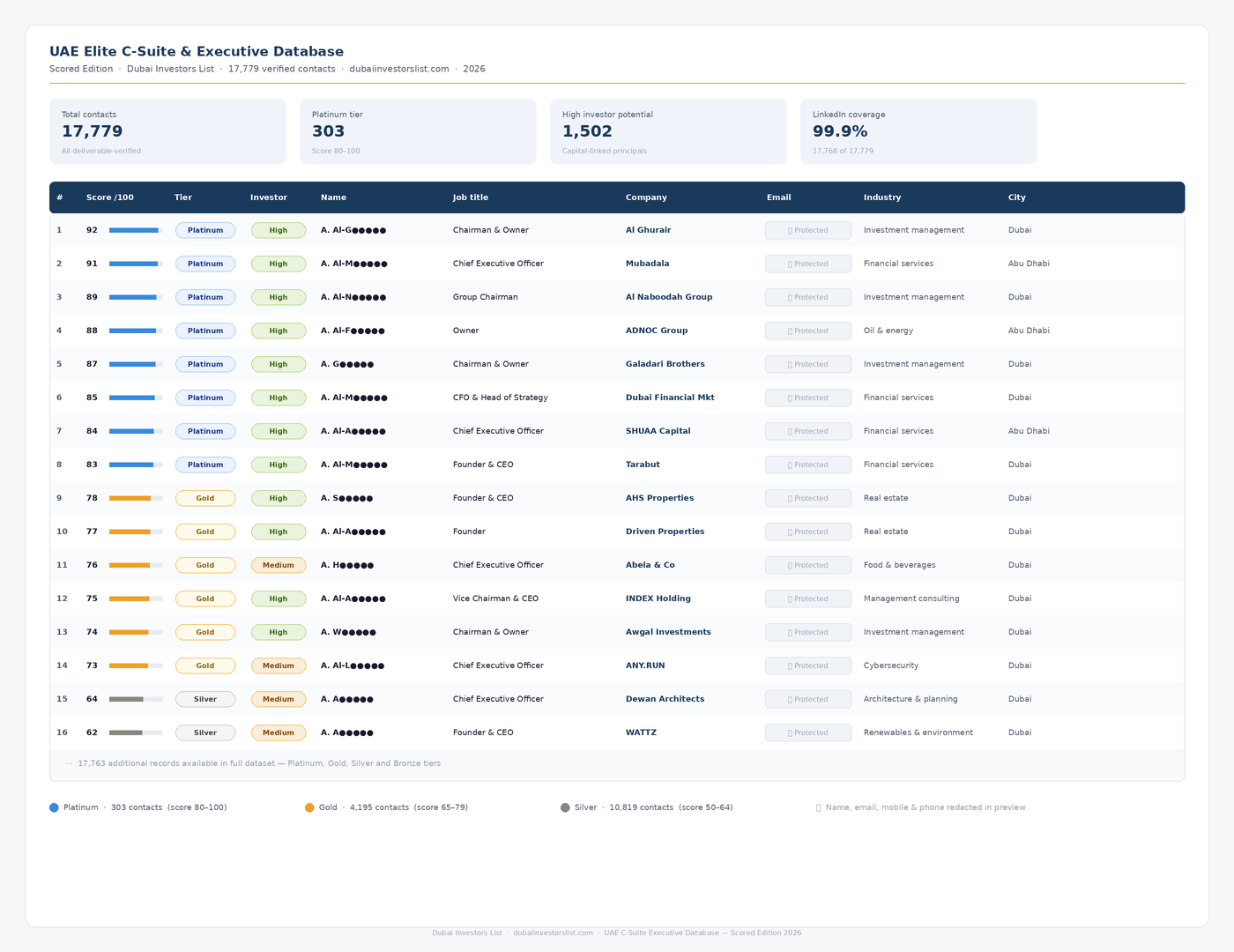
The Five Dimensions of the Scoring System
The scoring methodology was designed to answer one question for every contact: how commercially valuable is this person for capital raising, institutional B2B outreach, or professional services engagement in the UAE? Five dimensions were identified as the most reliable predictors of that value, each weighted according to its relative importance.
| Dimension | Max Points | What It Measures | Why This Weight |
| Seniority | 30 pts | Title-level capital and decision authority | The single most important variable — a Chairman controls capital that a COO does not |
| Industry | 25 pts | Sector relevance to capital and investment activity | Investment management and finance sectors score highest; lifestyle sectors score lowest |
| Company Scale | 20 pts | Employee count as proxy for mandate size | Larger organisations carry larger budgets and investment mandates |
| Contact Completeness | 15 pts | How many verified contact channels are populated | Direct email + mobile + LinkedIn = maximum reachability; gaps reduce campaign effectiveness |
| Location | 10 pts | Emirate commercial weight | Abu Dhabi (institutional capital) and Dubai (commercial hub) score highest |
The seniority dimension is weighted most heavily because it is the most direct proxy for decision-making authority. A Chairman or Founder who owns their business makes capital allocation decisions personally and immediately. A C-Suite executive at a large organisation operates within a mandate structure where multiple approvals are typically required. A Partner at a law or accounting firm has significant purchasing authority but a different investment profile. The scoring reflects these distinctions precisely.
The industry dimension captures sector-level investment relevance. Investment management and venture capital contacts score 25 out of 25. Financial services and banking score 22-23. Oil and energy scores 20. Real estate scores 19. Information technology, which is the largest sector in the database by volume, scores 12 – reflecting its high commercial value for B2B outreach but lower direct relevance for capital raising compared to finance and investment sectors. Marketing, events, and lifestyle sectors score 5-8, reflecting their utility for certain outreach campaigns but limited relevance to institutional investment mandates.
Contact completeness deserves particular attention because it is frequently overlooked in database quality discussions. A contact with a verified email, a mobile number, a LinkedIn profile, a corporate phone, and a company website scores 15 out of 15 and can be reached through five independent channels. A contact with only an email address scores 5 out of 15. In a market like the UAE, where senior executives are often unreachable through corporate email alone – assistants intercept, spam filters catch, inboxes overflow – mobile and LinkedIn provide critical alternative pathways. The scoring penalises data gaps directly.
The Tier Architecture: From Standard to Platinum
Every contact’s total score maps to one of five tiers. The tier classification is not cosmetic – it directly informs campaign architecture, message investment, and outreach sequencing strategy.
| Tier | Score Range | Count in Database | % of Total | Strategic Role |
| Platinum | 80-100 | 303 | 1.7% | Maximum investment outreach — personal, research-led engagement |
| Gold | 65-79 | 4,195 | 23.6% | Primary campaign tier — tailored sequences, sector-specific messaging |
| Silver | 50-64 | 10,819 | 60.9% | Core volume tier — structured outreach with persona-level personalisation |
| Bronze | 35-49 | 2,462 | 13.8% | Supplementary tier — standard campaign inclusion, lower priority |
| Standard | Under 35 | 0 | 0% | Not present — database quality floor applied at compilation |
The Platinum tier – 303 contacts scoring 80 or above – represents the highest-value segment in the entire database. These are overwhelmingly Chairman, Owner, or Founder-level executives in investment management, financial services, or oil and energy, based in Dubai or Abu Dhabi, at large organisations, with complete or near-complete contact data. This list does not exist anywhere else in a verified, scored, and immediately deployable form. For a placement agent distributing a private fund, a single successful engagement from this tier can represent a $5M to $25M+ allocation. The ROI calculation on a $395 database purchase becomes straightforward.
The Gold tier – 4,195 contacts – is the primary campaign tier for most institutional outreach operations. These contacts have strong commercial profiles: typically CEO or Founder-level executives in capital-relevant sectors, with good to excellent contact data, based in major UAE commercial centres. A well-constructed campaign targeting the Gold tier exclusively – with appropriately tailored messaging – is a more efficient deployment than a mass campaign across the entire database. The scoring makes that selective deployment possible.
The Silver tier – 10,819 contacts, the largest segment at 61% of the database – is the core volume tier. For B2B technology companies, professional services firms, and outreach operations where total addressable market breadth matters as much as individual contact value, this tier delivers scale without sacrificing relevance. Average Silver-tier contacts are C-Suite executives at mid-sized UAE firms in IT, construction, management consulting, or marketing – profiles with genuine purchasing authority and commercial relevance for a wide range of products and services.
The Investor Potential Flag: A Dedicated Capital-Raising Signal
Separate from the tier system, every contact in the scored database carries an Investor Potential flag – classified as High, Medium, or Low. This flag was designed specifically for capital raisers, fund managers, and placement agents who need to identify, quickly and reliably, which contacts have the highest probability of being investment decision-makers rather than operational executives or professional advisors.
| Flag | Count | % of Database | Criteria | Primary Use Case |
| High | 1,502 | 8.4% | Capital-linked sector AND capital-level seniority simultaneously | Fund placement, LP pipeline, private placements, gold-backed structures |
| Medium | 9,484 | 53.3% | Either capital sector OR capital seniority — not both | Mixed campaigns: investment products + B2B services |
| Low | 6,793 | 38.2% | Neither capital sector nor capital seniority | B2B products, SaaS, professional services, operational vendors |
The High Investor Potential segment – 1,502 contacts – is a standalone product within the database. These are Chairmen, Owners, and Founders in investment management, financial services, banking, oil and energy, real estate, government administration, and venture capital. They represent principals: individuals who personally control or directly influence capital allocation decisions, with the sector context to make investment products immediately relevant. For a fund manager running a UAE LP campaign, a shortlist of 1,502 verified High-potential contacts with direct emails, LinkedIn profiles, and mobile numbers is an asset that normally takes months of manual research and relationship-building to construct.
The Medium flag covers the largest segment – 9,484 contacts. This group is appropriately targeted for campaigns where investment products and B2B services are being run in parallel: a financial technology company selling both a SaaS product and an investment vehicle, for example, or a professional services firm that also manages a small fund. The Medium flag signals that contextual relevance exists on at least one dimension, warranting inclusion in a properly sequenced mixed campaign.
What Institutional-Grade Outreach Actually Looks Like
Understanding the scored database’s architecture is one thing. Translating it into a functioning outreach operation is another. The following framework shows how institutional marketing teams – placement agents, fund distribution desks, enterprise B2B sales organisations – should deploy the database in practice.
| Campaign Tier | Contacts Deployed | Outreach Style | Personalisation Level | Expected Outcome |
| Platinum (303) | Hand-selected 50-100 for initial phase | Fully bespoke — individual research, named reference points, custom narrative | Maximum — every message unique | 5-15% response rate; 2-8 qualified conversations per 100 contacts |
| Gold Investor Potential High (est. 800-1,000) | Full segment or filtered sub-set | Tailored sequence — sector-specific template with contact-level personalisation | High — persona + company + title | 2-6% response rate; 15-40 qualified conversations per 1,000 contacts |
| Gold / Silver Mixed (2,000-4,000) | Industry or city-filtered sub-set | Structured sequence — persona-level personalisation, 3-touch over 12 days | Medium — sector + seniority | 1-3% response rate; 20-80 conversations per 2,000 contacts |
| Silver Broad (5,000-8,000) | Full Silver with industry filter | Professional broadcast — minimal personalisation, strong subject line and CTA | Low — title + sector | 0.5-1.5% response rate; volume-driven awareness and list qualification |
The critical discipline in institutional outreach is matching the level of message investment to the value of the contact. Writing a fully bespoke 200-word email for every one of 10,000 contacts is neither economically viable nor strategically necessary. Writing a generic template for the 303 Platinum-tier contacts is a waste of the most valuable asset in the database. The tier architecture imposes the right discipline automatically – it tells you where to invest, where to systematise, and where to scale.
For fund placement operations specifically, the recommended deployment is a three-phase campaign. Phase one targets the 303 Platinum contacts with individually crafted outreach and direct calendar requests, running over a 30-day cycle. Phase two targets the full High Investor Potential segment (1,502 contacts) with a three-touch tailored sequence over 14 days, using sector-specific messaging. Phase three targets the remaining Gold-tier contacts (approximately 3,900 once High Investor Potential is removed) with a structured persona-based sequence. This architecture focuses maximum effort on maximum value while ensuring broad market coverage.
The Data Quality Foundation
The scored database is only as valuable as the underlying data quality. The Contact Completeness dimension of the scoring system is explicitly designed to surface data quality as a first-class consideration rather than an afterthought. Every contact’s reachability – the practical ability to actually deliver a message to them through multiple channels – is built into their score.
The database was compiled with deliverability verification applied at the email level – all contacts carry a confirmed deliverable status, meaning hard bounce rates on email campaigns are minimised from the outset. Beyond email, the database’s coverage of mobile numbers (7,279 contacts), corporate phone numbers (11,047 contacts), and LinkedIn profiles (17,768 contacts – 99.9% coverage) provides an unusually complete multi-channel contact picture for an executive database of this scale.
To put this in context: a typical purchased executive database at this scale might have email-only data for 70-80% of contacts, with mobile coverage below 20% and LinkedIn URLs included for fewer than half. The scored UAE C-Suite database inverts this – LinkedIn coverage is near-universal, mobile coverage approaches 41%, and corporate phone coverage exceeds 62%. For institutional outreach teams running LinkedIn-plus-email sequences, this coverage profile is operationally significant.
Practical Applications by Buyer Profile
The scored database’s utility varies by the nature of the buyer’s commercial operation. The following profiles represent the highest-value applications:
| Buyer Type | Primary Use | Recommended Tier Focus | Key Filters to Apply |
| Alternative Fund Manager / Placement Agent | LP pipeline, fund distribution | Platinum + Gold with High Investor Potential flag | Investor Potential = High; Seniority = Chairman / Founder / Owner; Industry = Investment Mgmt / Financial Services / Real Estate |
| Private Placement Vehicle (e.g. gold-backed, commodity-linked) | Accredited investor outreach | Platinum + High Investor Potential flag | Total Score > 70; Investor Potential = High; City = Dubai / Abu Dhabi |
| Enterprise B2B Technology / SaaS | Decision-maker pipeline, UAE market entry | Gold + Silver | Industry = IT / Financial Services / Construction / Oil & Energy; Seniority = C-Suite / Founder; Employees > 50 |
| Professional Services (Legal, Accounting, Advisory) | Business development, new client acquisition | Gold + Silver — Partner and C-Suite focus | Industry = Financial Services / Investment Mgmt / Real Estate / Law; Seniority = C-Suite / Partner |
| Wealth Management / Private Banking | HNWI and UHNWI prospect identification | Platinum + Gold — Founder / Chairman / Owner tier | Investor Potential = High; Company Scale score > 12; Seniority = Chairman / Founder |
| Research / Intelligence Products | Resale, enrichment, market mapping | Full database — all tiers | Full dataset; segment and filter for specific deliverables |
Why the Scored Edition Represents a New Standard
The broader trend in B2B data is unmistakable: the era of raw contact lists as a commercially viable product is ending. Enterprise buyers – fund managers, institutional sales teams, sophisticated marketing operations – now expect data products that arrive pre-enriched, pre-segmented, and deployment-ready. They expect scoring. They expect tiering. They expect investor potential flags. They expect the data to do work before the campaign begins.
Most data providers serving the UAE and MENA market have not caught up with this expectation. The scored edition of the Elite UAE C-Suite & Executive Database is built for buyers who have. It is the only UAE executive database product on the market that combines verified contact data at scale with a transparent, documented, five-dimensional scoring methodology – producing a ranked, tiered, investor-flagged output that is ready for immediate institutional deployment.
For placement agents, fund managers, and enterprise outreach teams, the commercial logic is simple. The database costs a fraction of the cost of a single failed campaign run against undifferentiated data. The scoring system eliminates the research overhead that would otherwise sit between acquisition and deployment. And the Platinum and High Investor Potential tiers provide a ready-made shortlist of the UAE’s most commercially valuable executive contacts – a list that took months of data compilation, verification, and scoring to produce, and that you can begin using the day you download it.
Access the UAE Elite C-Suite & Executive Database — Scored Edition at dubaiinvestorslist.com
17,779 verified UAE C-Suite executives. Ranked, scored, tiered, and investor-flagged across five commercial dimensions. Platinum, Gold, Silver, and Bronze tiers. 1,502 High Investor Potential contacts. Direct emails, mobile numbers, LinkedIn profiles, and company intelligence – all deliverable-verified. The institutional standard for UAE executive outreach in 2026.
Inside 17,779 UAE Decision-Makers: How Many Are Really Tied to a Family Office?
There is a question that sits underneath almost every capital-raising conversation in the Gulf, and it rarely gets answered with data.
When a fund manager, developer, or M&A advisor talks about “reaching UAE family offices,” they usually have a feeling rather than a verified answer. The money is assumed to be there, somewhere behind the founders and chairmen who run the Emirates’ private economy. What is usually missing is a defensible map showing who those people actually are and which of them can genuinely be linked to a family office.
I decided to answer that question properly.
Starting from my database of 17,779 verified UAE C-suite executives, I cross-referenced every single record against my Global Family Office Database and UAE Family Office Database to determine how many of these business leaders can be credibly linked to a known family investment office.
The result is more nuanced, and ultimately more useful, than the marketing version many data vendors would give you.
Executive Summary
Key Findings at a Glance
| Metric | Result |
|---|---|
| Total UAE Executives Analysed | 17,779 |
| Founders | 7,110 |
| C-Suite Executives | 6,422 |
| Partners | 2,685 |
| Verified Family Office Executives | 135 |
| Likely Family Office-Linked Executives | ~680 |
| Global Family Offices Cross-Referenced | 4,837 |
| UAE Family Offices Cross-Referenced | 196 |
The purpose of this study was simple: determine how many executives within my UAE C-Suite Executive Database can be credibly linked to a known family office.
The outcome challenges many assumptions about the Gulf investment landscape. While family offices play an outsized role in regional capital allocation, only a relatively small percentage of UAE business leaders can be directly tied to a verified family office. At the same time, a significantly larger group sits adjacent to family investment activity through private investment vehicles, holding companies, and family-controlled conglomerates.
The result is a more realistic and actionable view of the UAE investor landscape, allowing capital raisers to distinguish between verified family office principals, likely family-office-affiliated executives, and the broader universe of UAE business leadership.
A Verified Map of UAE Business Leadership
My UAE C-Suite Executive Database is not a mailing list.
It is a structured profile of the people who actually run the Emirates’ private economy: founders, owners, chairmen, and C-level decision-makers across every major industry, from technology and real estate to consulting, financial services, and trading.
Each record is a real, named individual with a title, a company, a role, and contact data, not an anonymous entry scraped from a directory.
Three things distinguish it from the generic contact files that circulate in the market.
First, every contact is verified and named.
Second, every contact carries an investor-potential score and priority tier.
Third, the database is built specifically for capital-raising outreach.
That structure matters because it transforms a list of names into a targeting platform.
A flat list tells you who exists.
A scored, tiered, verified database tells you who to approach first.
It is the difference between a phone book and an investor-targeting engine.
The Scale: Seventeen Thousand Decision-Makers
The headline numbers illustrate the depth of the dataset.
UAE Executive Database Composition
| Executive Category | Count |
| Founders | 7,110 |
| C-Suite Executives | 6,422 |
| Partners | 2,685 |
| Other Senior Executives | 1,562 |
| Total Records | 17,779 |
This is, in effect, the operating leadership of the UAE private sector captured at scale.
The industry composition reflects the actual structure of the Emirates’ economy.
Largest Industry Segments
| Industry | Executive Count |
| Information Technology & Services | 2,604 |
| Real Estate | 1,402 |
| Management Consulting | Significant |
| Financial Services | Significant |
| Marketing & Advertising | Significant |
The importance of this scale is not simply the number of records.
It is the breadth of coverage.
A database of this size, weighted toward founders, owners, and chairmen, provides a genuine cross-section of UAE business leadership rather than a narrow slice of a single sector.
That breadth is what made the family-office analysis worthwhile.
The Question That Matters: How Many Are Family Offices?
In the Gulf, private wealth and operating business are deeply intertwined.
Many family offices are not standalone institutions with dedicated investment teams and prominent branding. Instead, they sit alongside family-controlled operating groups, often run by the same founders and chairmen who built the underlying businesses.
The family that owns the conglomerate is frequently the same family allocating capital through private investment vehicles.
That overlap creates confusion.
A raw contact list overstates the opportunity if every wealthy founder is assumed to be a family-office investor.
Equally, it understates the opportunity if only entities explicitly labelled “family office” are counted.
The truth sits somewhere in between.
To establish a defensible answer, I cross-referenced all 17,779 executives against:
- My Global Family Office Database (4,837 firms)
- My UAE Family Office Database (196 firms)
The objective was straightforward:
How many executives can be directly tied to a verified family office, and how many more are plausibly connected through adjacent investment structures?
The Results
Family Office Affiliation Results
| Confidence Tier | Executive Count | Description |
| Verified Family Office Executives | 135 | Directly matched to known family offices or explicitly identified family-office entities |
| Likely Family Office-Linked Executives | ~680 | Senior investment professionals and executives within family investment structures |
| Broad Family Conglomerate Universe | 1,000+ | Looser definition including family-controlled operating groups |
| Total Executives Analysed | 17,779 | Complete UAE executive universe reviewed |
The results came in two meaningful tiers.
At the highest confidence level, 135 executives can be directly tied to a verified family office through confirmed firm matches or explicit family-office naming.
At a broader but still realistic level, approximately 680 executives appear linked to family-office activity once adjacent private investment vehicles and family investment platforms are included.
This is the figure worth focusing on.
Not 17,779 “family office contacts.”
Not an inflated marketing number.
But approximately 600 to 700 realistic prospects, of which 135 can be considered highly verified.
In a market where exaggerated database claims are common, a smaller credible number is far more valuable than a larger fictional one.
How I Identified Them
The methodology matters because it explains why the numbers are trustworthy.
I used three independent signals and assigned confidence levels accordingly.
Family Office Identification Methodology
| Signal | Confidence Level |
| Verified Match Against Global or UAE Family Office Database | Very High |
| Explicit Family Office Naming Convention | High |
| Investment Role + Investment Industry Classification | Moderate |
| Family Conglomerate Association Alone | Low |
Signal One: Verified Name Matching
The strongest signal was a direct match between company names in the executive database and firms already verified within my Global and UAE Family Office Databases.
This represents the gold standard of identification.
Examples include many of the UAE’s most established family groups, including Galadari Brothers, Al Ghurair, AW Rostamani Group, Easa Saleh Al Gurg Group, Chalhoub Group, Al Masaood, Ghassan Aboud Group, Aujan Group Holding, and Al Naboodah.
Signal Two: Explicit Family Office Naming
Some firms openly identify themselves through terms such as:
- Family Office
- Family Investment
- Single Family Office
- Multi Family Office
These were classified directly into the high-confidence category.
Signal Three: Investment Role Plus Industry
The third signal focused on senior investment professionals working within:
- Investment Management
- Venture Capital
- Private Equity
Titles included:
- Chief Investment Officer
- Principal
- Managing Director
- Founder
- Chairman
This methodology expanded the population from the 135 verified executives to approximately 680 likely-affiliated individuals.
Importantly, I deliberately rejected broader definitions that would have produced larger headline numbers.
A looser approach could easily have generated figures exceeding 1,000 executives.
However, that methodology would have swept in numerous operating businesses whose only qualifying characteristic was the presence of “Group” or “Holding” within the company name.
Accuracy was prioritised over marketing appeal.
Why the Share Is Modest
A family-office share of under four percent may initially appear low.
In reality, it reflects the true nature of the database.
The UAE Executive Database was built to map business leadership across the Emirates.
Its largest sectors are technology, real estate, consulting, and financial services.
Many founders and chairmen within these sectors are personally wealthy, but personal wealth alone does not make someone a family-office principal.
That distinction matters.
Defined strictly, the family-office population consists of approximately 135 verified executives.
Defined realistically, it rises to approximately 680.
Defined broadly, it exceeds 1,000.
All three figures can be defended depending on methodology.
I chose to report the most transparent segmentation possible.
Why This Matters for Capital Raising
Investor Prioritisation Framework
| Target Group | Size | Recommended Priority |
| Verified Family Office Executives | 135 | Immediate outreach |
| Likely Family Office-Linked Executives | ~680 | Secondary outreach |
| Broader UAE Business Leaders | 17,000+ | Strategic relationship development |
| Entire Database Universe | 17,779 | Long-term opportunity set |
For capital raisers, this creates a clear order of operations.
Begin with the 135 verified family-office executives.
Then expand into the approximately 680 likely-affiliated prospects.
Only after those segments have been exhausted should broader relationship-building across the wider executive universe become the primary focus.
This approach maximises efficiency while preserving credibility.
The analysis also demonstrates an important point often overlooked in fundraising campaigns. The goal is not simply to find wealthy individuals. The goal is to identify people actively involved in allocating capital. The distinction is subtle but critical. A successful campaign is built on targeting the right decision-makers, not the largest possible list.
A Note on How This Database Is Used
One final clarification is important.
This custom database is not offered for sale and is not licensed externally.
It exists to support retainer-based capital-raising mandates, typically for clients seeking to raise $50 million or more.
The analysis described above is not a product feature.
It is the type of investor intelligence work that sits behind an active fundraising campaign.
The value is not in owning 17,779 names.
Anyone can accumulate names.
The value lies in identifying which names matter for a specific capital raise, being able to defend that conclusion with data, and understanding how to prioritise outreach accordingly.
That distinction is what separates a contact list from a fundraising strategy.
Conclusion
The headline result is simple.
Out of 17,779 UAE business leaders, approximately 135 can be directly tied to a verified family office, while roughly 680 appear linked through family investment platforms and adjacent investment structures.
The remaining executives remain valuable for their original purpose: mapping the leadership of the UAE private sector.
What the cross-reference achieves is not inflation, but precision.
It identifies the subset of executives most relevant to family-office fundraising while preserving the integrity of the broader dataset.
In capital raising, that precision matters.
Because the objective is not to reach everyone.
The objective is to reach the right people.
For fund managers, placement agents, real estate sponsors, private equity firms, venture capital managers, and corporate finance advisors seeking capital in the Gulf, understanding that distinction can mean the difference between a campaign built on assumptions and one built on verified intelligence.
See YouTube Video Description of this Exclusive Database
 DUBAI INVESTORS LIST