
Why It’s the Only One of Its Kind
For Institutional-Grade Clients Only
This database is licensed to institutional-grade capital markets participants only. Before anything else, here is exactly what that means, because it determines whether this is the right resource for you.
Who qualifies. The license is built for four buyer categories:
Private equity real estate funds and sponsors sourcing verified, wealth-evidenced capital for live raises and club deals
Investment banks and capital-introduction teams qualifying UHNW counterparties for structured, off-market, or cross-border transactions
Real estate developers seeking buyers with a demonstrated history of property investment, not cold names
Family offices and private banks mapping UAE investor relationships against a verified ownership record
In practice, that means an active or imminent capital raise, typically in the $10M–$50M range, filled by individual checks of $250K–$1M rather than a handful of large institutional LP allocations. If you are running a fund, syndicating a deal, or building a cross-border investor pipeline, this is built for you.
Who it is not for. This is not a retail contact list, and it is not sold to individuals outreach-marketing on their own behalf, data resellers or aggregators planning to redistribute or sublicense the file, or boutique marketers without an active institutional mandate. It is also not sized for sub-$10M micro-raises or single institutional LP allocations above $1M — the file is purpose-built for the individual-check segment in between.
What institutional-grade licensing means here. The database is sold under a single-enterprise, one-time license: one firm, internal use for its own capital-raising or origination activity, no resale and no redistribution. This keeps the file’s value intact for every licensee — a database that gets resold or scraped into a dozen cheaper copies stops being a differentiator for anyone who holds it. If your firm fits the profile above, the rest of this article explains exactly what you would be licensing and why nothing comparable exists on the market today.
What This Database Actually Is
Most “investor databases” sold in Dubai are executive contact lists wearing an investor label: a name, a title, a company, an email address — scraped or licensed in bulk, with no evidence anyone on the list has ever written a property check. The UAE Investor Intelligence Database starts from a different premise: a contact only belongs in an investor database if there is a verified, dated property transaction (or a current holding) behind their name.
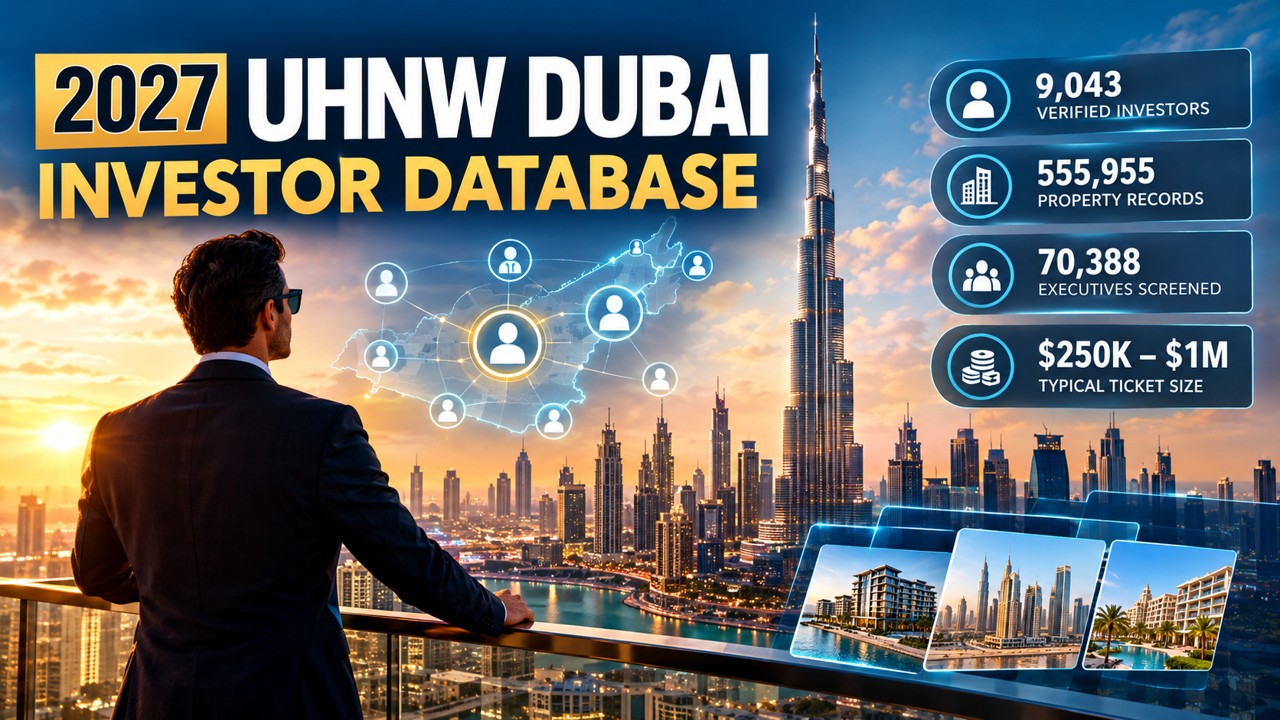
To build that, four independently sourced databases — one executive directory and three property-ownership registers — were cross-referenced at the individual level: 70,388 senior UAE executives tested against 555,955 property records spanning Dubai and Abu Dhabi. That process surfaces 9,043 individuals as verified or well-evidenced property investors, each carrying a full executive profile and a data-backed investment rating, and 6,928 of them clear a $250,000 minimum-check qualifier on dated transaction evidence, a discounted real-estate-adjusted estimate, or role-and-company-scale alone where no transaction is on file. Every match is confidence-tiered, screened for false positives, and adjusted for real-estate-industry distortion — nothing is taken at face value, and nothing is asserted without a recorded basis.
The rest of this article walks through exactly how that was built, what makes it different from everything else on the market, and why none of it was possible before these four specific data sources existed in one place.
View the Detailed Video about this Database below
Why a Contact List Isn’t an Investor List
A senior job title tells you someone is important. It tells you nothing about whether they have ever invested in property, in the UAE or anywhere else — and that gap is where most “investor lists” quietly fail.
Four failure modes show up repeatedly in off-the-shelf executive data:
Seniority is treated as evidence. A Chairman or Managing Director title gets sold as an investor signal on its own, with nothing behind it.
Filtering stops at role and company. Standard executive databases are filtered by title and industry, never by verified transaction history.
Phone-only matching misattributes institutions to people. A common shortcut — matching by phone number alone — regularly resolves to a bank, developer, or municipality rather than a person. A mortgage registration lists the lender bank as a party, and a bank’s registered contact number can coincidentally equal an executive’s listed corporate phone. Building this database, that exact defect was traced to 27% of an earlier internal cross-reference’s headline transaction value — found and corrected before anything shipped.
Real-estate industry volume gets counted as personal wealth. Brokers and developers have their name and phone attached to every deal they broker, not just deals they personally invest in. One contact in the underlying data was linked to over 1,500 brokered transactions worth billions of dirhams — that is business volume, not a personal balance sheet.
The industry-wide result is a market full of lists marketed as “investors” that are really just senior employees who have never written a property check themselves. Correcting for all four of these failure modes — not just the first one — is what the rest of this methodology is built around.
Built on Four Independent Databases
The foundation is four separately sourced datasets, none of which were built with this product in mind — which is precisely what makes fusing them valuable.
| Source | Scale | What it captures |
|---|---|---|
| UAE C-Suite Master Database | 70,388 senior executives | Two independently compiled executive pools — an “Elite” tier of 17,779 deep-enriched C-suite contacts and a “Standard” tier of 52,610 broader senior executives — merged and confirmed as independent pools |
| UAE Master Property Database | 445,882 registered transactions | Dubai’s official property transaction register, January 2018 to July 2024, AED 1.71 trillion in total registered value |
| Dubai 2025 Sales Database | 88,237 owner records | A current ownership roll-up consolidated from 61 building-level broker sheets across 621 distinct buildings |
| Abu Dhabi 2025 Buyers Database | 21,836 owner records | Ownership data consolidated from 88 separate building-level broker worksheets, extending coverage beyond Dubai |
Together that is 555,955 property records — cross-referenced against every one of the 70,388 executives. The C-suite database supplies the executive identity and professional signal (title, seniority, company size, industry); the three property registers supply the ground truth — who actually bought what, when, and for how much. Neither half is unique on its own. The UAE has several executive-contact vendors and several property-data providers. What does not exist elsewhere is the two fused at the individual level, with the matching and verification work described next.
The Matching and Verification Engine
Testing 70,388 executives against 555,955 property records is not a single lookup — it is a matching engine followed by four layers of filtering, because a name-and-phone match alone produces exactly the false positives described above.
Matching. Candidates are found through positional, fuzzy name matching — first-token and last-token anchors, fuzzy-matched rather than exact-string matched, because exact matching misses the transliteration and ordering differences common in Arabic-to-English names. Every name match is then independently corroborated against normalized mobile numbers as a second signal; a name match and a phone match are never assumed to confirm each other automatically. Every candidate is scored, not accepted on sight.
Four filtering layers then run in sequence:
Confidence tiering — matches are graded Verified (name and phone both match), High (unique name match, no ambiguity), Medium (phone-only unique match or common-name ambiguity, flagged for manual review), or Low (a shared or generic phone number appearing across five or more unrelated names, excluded outright). Only Verified, High, and reviewed Medium-tier matches carry into the final database.
Removing institutions mistaken for people — a pattern-based entity filter strips out banks, PJSCs, LLCs, municipalities, and developers from unverified phone-only matches, then is checked against real human surnames that resemble institution names (such as “Banks”) to confirm zero false exclusions.
Correcting for real-estate-industry volume — contacts flagged as real-estate-industry professionals are scored on their average single-deal size rather than a raw transaction sum, so a broker linked to 1,590 brokered deals worth AED 4.27B reduces to a defensible ~$730,000 typical deal rather than a fictitious nine-figure personal position. 1,332 contacts (14.7% of the final database) carry this flag — never excluded, always visible, with a manual-review note attached.
One person, one profile — an executive can legitimately appear across more than one property database (the Dubai register, the Dubai 2025 roll-up, Abu Dhabi), matched independently each time. Every match is grouped by normalized name and company and consolidated into one row, with property counts, transaction value, and holdings combined rather than duplicated.
The Investor Scoring Model
Every verified profile is scored on three inputs — role and seniority rank (Chairman, Founder, and Owner rank highest), company-size rank (from verified employee-count bands), and verified single-property average (total matched value divided by number of transactions, a typical deal rather than a sum) — producing two separate outputs. The first is an Investment Rating from A (Priority Target) through D (Developing Lead), based on role and company scale. The second is a direct yes/no qualifier: can this person clear a $250,000 minimum check? Every rating is sourced, not asserted — the basis behind it, whether a verified average deal size or an estimate from role and company size alone, is recorded on every single record.
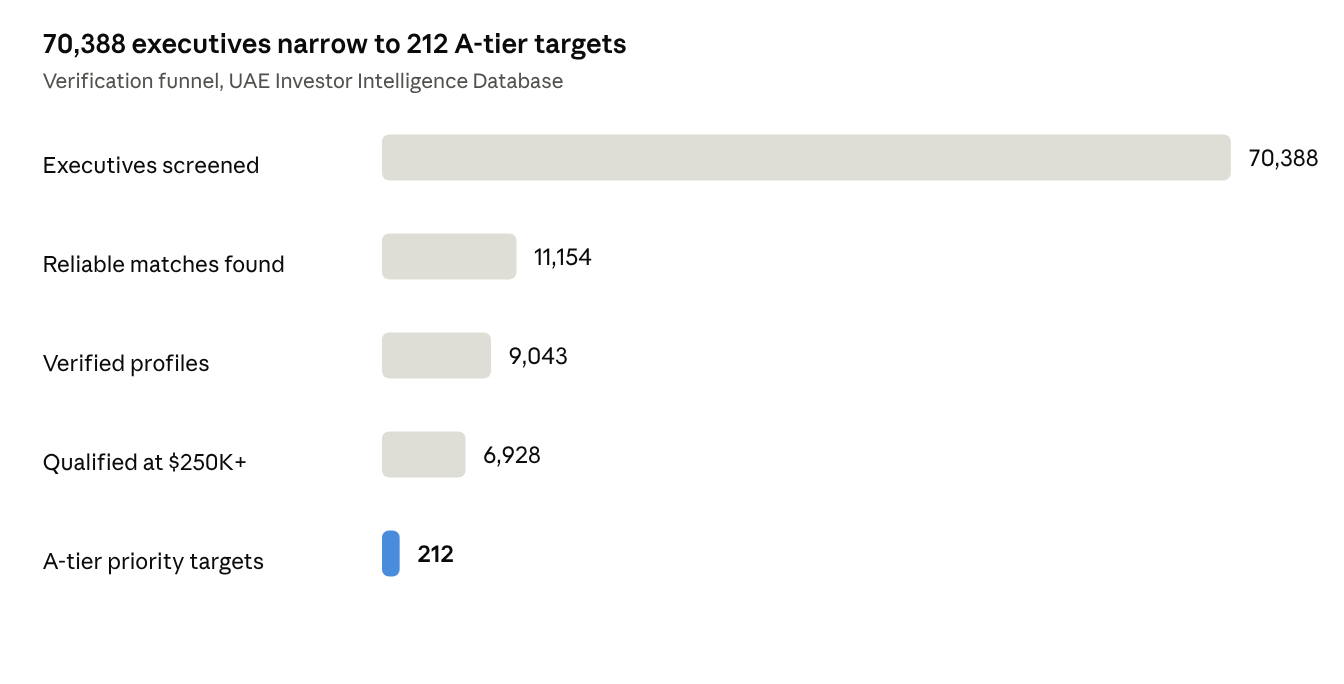
Derived from the matching engine and filters above.
The funnel shows what verification actually removes: of 70,388 executives screened, 11,154 produce a reliable match against the property registers, and those consolidate to 9,043 distinct verified profiles once duplicates across databases are merged. From there, 6,928 clear the $250,000+ capacity qualifier on recorded evidence, and 212 sit at the top of the file as A-tier priority targets — Chairman, Founder, or Owner-level contacts with the strongest combination of seniority and verified capacity.
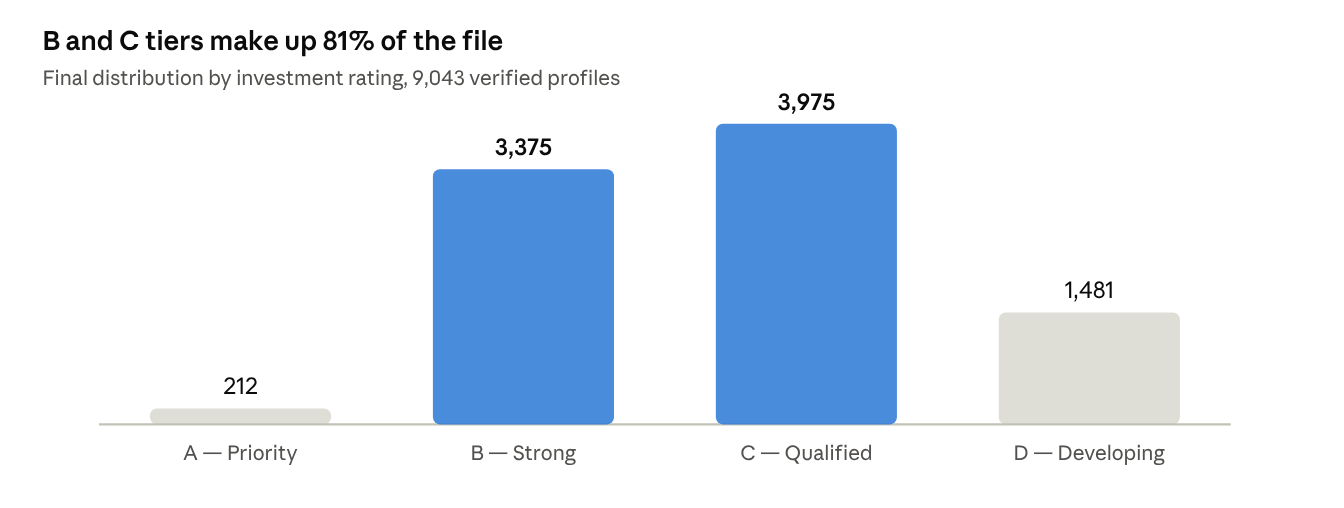
Derived from the investor scoring model.
The Investment Rating and the $250K+ qualifier are deliberately separate outputs, not duplicates of each other — a profile can rate highly on seniority without yet having transaction evidence to clear the cash threshold, or vice versa. Of the 9,043 verified profiles, B and C tiers together account for 7,350 — 81% of the file — which is the working core of the database for most capital raises in the $10M–$50M range.
Sized for Your Raise, Not Just Verified
Verification alone does not make a database useful — it has to be sized to the raise you are actually running. A buyer-ready analytics layer breaks the file into ticket-size bands, so outreach can be built around who can realistically write what size check.
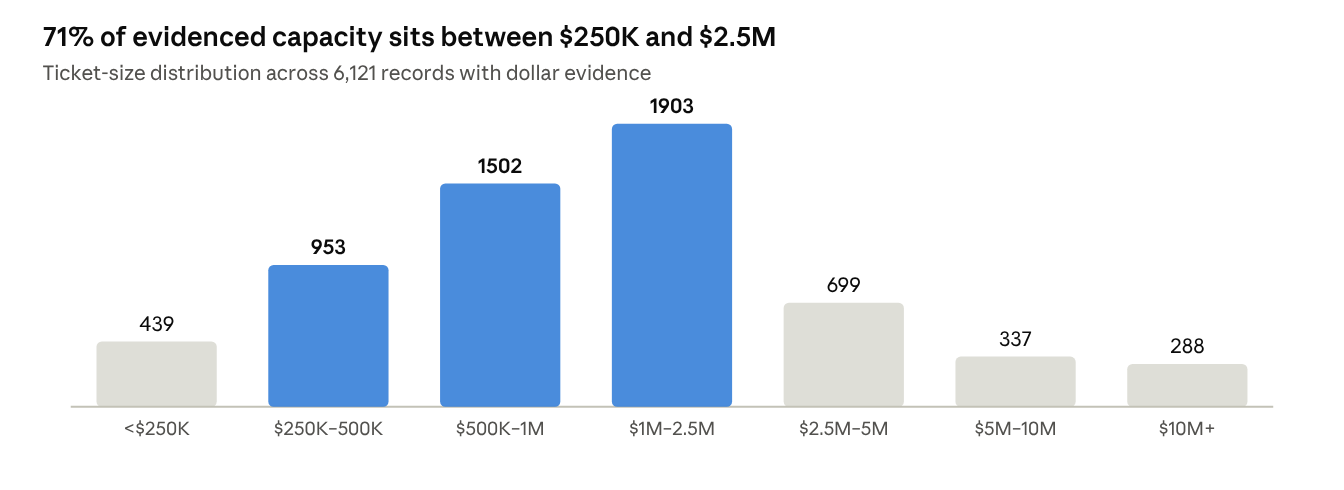
Buyer-ready analytics layer, UAE Investor Intelligence Database.
The practical math: a $10M raise at a $250K average check needs roughly 40 investors, and 2,455 qualified contacts sit in the $250K–$1M band alone. A $25M raise at a $500K average check needs about 50 investors, with 1,903 qualified contacts in the $1M–$2.5M band alone. A $50M raise at a $1M average check needs roughly 50 investors, and 1,324 qualified contacts clear $2.5M in verified or real-estate-adjusted capacity. In every case, the file is oversized relative to what a single raise needs — which is what lets a buyer filter down to a tight, sector-fit shortlist rather than working the whole database cold.
Who to Contact, Not Just Who’s on the List
Sector and seniority shape more than the qualify rate — they shape which structures land. The file is sliced by sector, so outreach can be built around who’s actually buying what you’re selling rather than a generic UHNW blast.
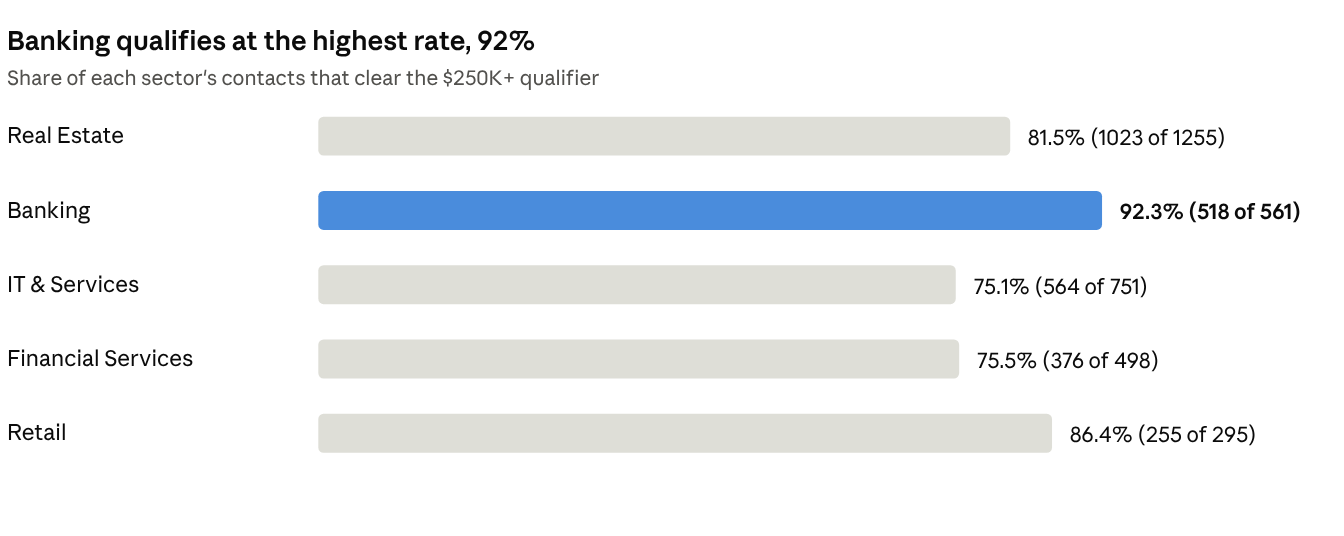
Buyer-ready analytics layer, UAE Investor Intelligence Database.
Real estate and asset managers (1,023 qualified) respond to direct real estate and co-investment structures — deals they already underwrite the way a sponsor does. Banking and financial services (894 qualified combined) respond better to structured, packaged vehicles: funds, notes, and private credit with a clear risk-adjusted return profile, where institutional-grade documentation matters more than a narrative pitch.
Seniority matters just as much as sector. A check-writing decision made by a Chairman or Founder closes in one conversation; the same decision routed through a Director often needs a committee.
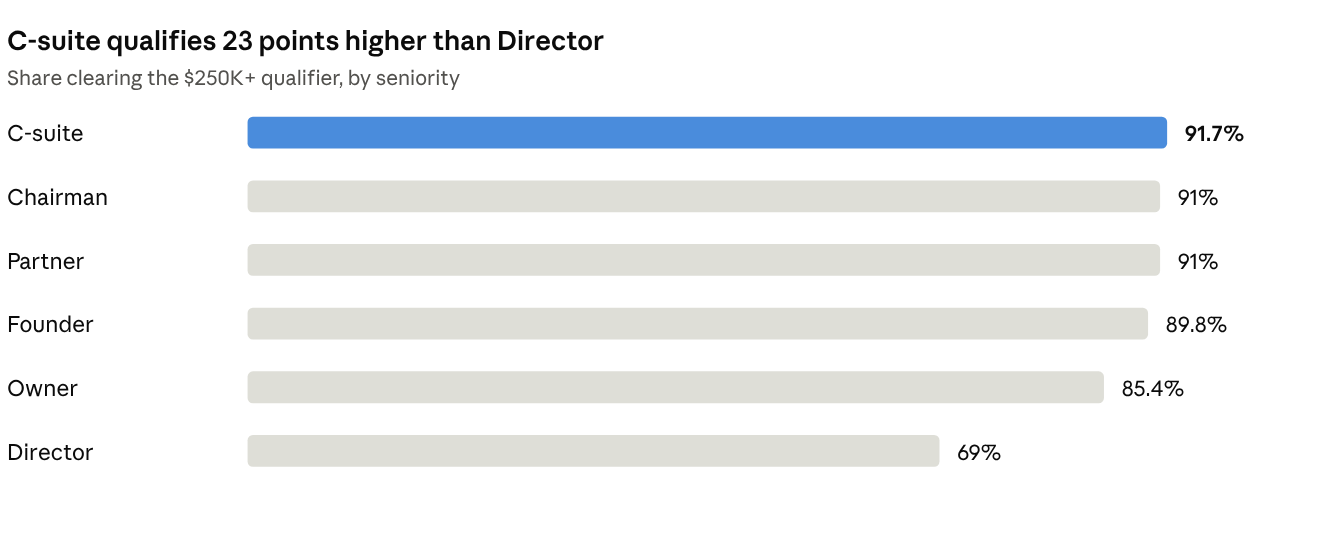
Buyer-ready analytics layer, UAE Investor Intelligence Database.
2,792 principal-level contacts — Chairman, Founder, Owner, Partner, or C-suite, the people who write the check themselves — qualify at a measurably higher rate than Director and below. That is a reason to lead outreach with them: the file is built to put you in front of the person who can say yes, not the person who has to ask someone else.
Currently Active, and Tested in the Field
Verification is only half the value — the file also skews toward investors who are still in the market. Measured against the register’s most recent dated record, 82% of the $250K+ qualified tier carries a dated property transaction on file, 70.4% of that dated group transacted within the most recent 12 months, and 90.5% transacted within the most recent 36 months. An investor who bought Dubai property eight months ago has liquid capital, understands multi-year illiquid holds, and is actively evaluating new opportunities — exactly who belongs on a contact list. Records with no transaction date — role-or-company-size basis, or current-holdings-only matches — stay in the file and are labeled as such; nothing is hidden or inflated to look more recent than it is.
That selectivity shows up in response rates, not just in the file’s construction. Run through live, blind outreach — no warm intro, no prior relationship — the response confirms what the methodology predicts:
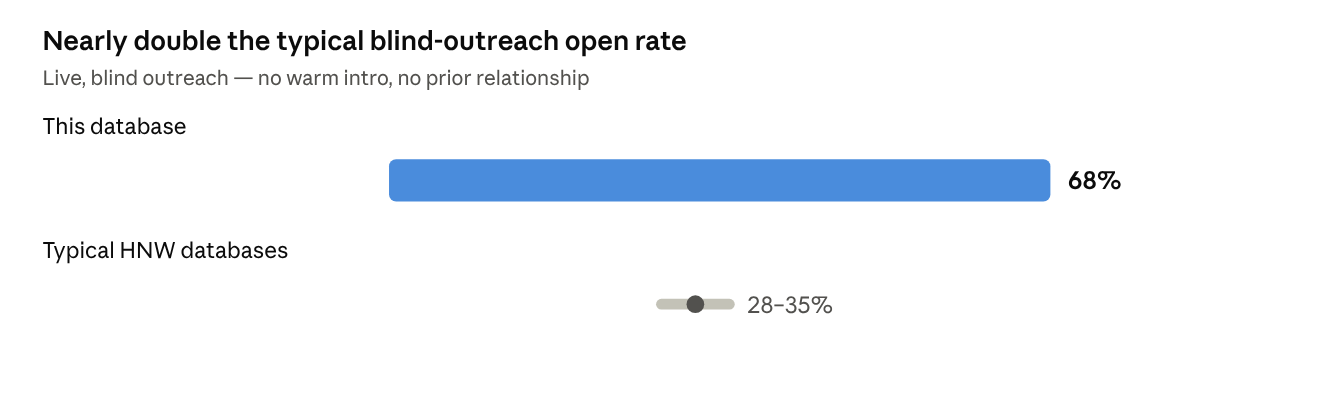
Internal campaign tracking vs. published cold-email benchmarks for financial-services and real-estate outreach.
Close to double the response of a typical HNW list, because this file isn’t guessing who might be interested. It already knows who has invested.
Why This Is Rare – Priced Against Every Alternative
No other database fuses four independent sources — executive seniority, company size, and a verified, person-level property transaction history — into one scored record. Every alternative on the market falls short in a specific, identifiable way:
| Option | Cost | What you actually get |
|---|---|---|
| Off-the-shelf contact lists | $200–$500, bulk, one-time | Bulk-scraped contacts. No property or wealth verification, no transaction match, no rating |
| Institutional-grade database subscriptions | $35,000–$60,000 per year | Licensed to PE firms, IBs, and placement agents raising $25M–$500M — still generic until refined to your sector |
| Build it yourself | $50,000–$120,000+, year one minimum | Property-data and contact-platform subscriptions, plus months of specialist fuzzy-matching and scoring labor |
| Placement agent / bank retainer | $150,000–$350,000 non-contingent retainer | 300–400 qualified introductions trickled over the engagement; weeks of onboarding before outreach even begins |
| UAE Investor Intelligence Database | $5,000, one-time institutional license | 9,043 verified profiles, 6,928 qualified at $250K+, ready same day — no subscription, no renewal |
The gap is starkest against the traditional placement-agent route: a non-contingent retainer of $150,000–$350,000 against a pool of roughly 150,000 institutional-grade relationships typically trickles down to just 300–400 qualified introductions over the life of the engagement, at a cost of $375–$1,167 per qualified name. This database delivers 6,928 qualified contacts on day one, at roughly $0.72 per qualified contact — before a single retainer invoice would have been paid. In live, blind outreach testing — no warm intro, no prior relationship — it produced a 68% open rate against 28–35% typical for generic HNW investment databases, because the file isn’t guessing who might be interested. It already knows who has invested.
What’s Actually in Every Row
Most of what gets sold as an “investor database” in Dubai is a single flat table — name, title, company, email — with nothing behind it to check. The file behind this license carries up to 40 fields per contact, organized into four layers: who someone is, how to reach them, how they’re scored, and the raw property evidence the score is built on. That fourth layer is the one nothing else on the market has. Instead of asking a buyer to trust a rating, every qualified record carries the actual transaction count, dirham value, dates, and project names behind it, so the rating can be checked against its own evidence rather than taken on faith.
Layer 1 — Identity. Every contact carries standard professional identity fields, plus two that are specific to how this file was assembled. Source Exec List and Matched Database are the audit trail: because one executive can legitimately turn up in more than one property register, the row-level file keeps every cross-reference hit separately before the “one person, one profile” consolidation described earlier collapses duplicates into the 9,043-row scoring sheet.
| Field | What it captures |
|---|---|
| Source Exec List | Elite or Standard — which of the two underlying executive pools the contact was drawn from before matching |
| Matched Database | Which of the three property registers produced this specific match — Dubai Transactions Master (6,688 of the 11,154 row-level matches), Dubai 2025 Buyer Contacts (3,159), or Abu Dhabi Owners (1,307) |
| First Name / Last Name | Contact’s name as recorded in the source executive directory |
| Job Title | Current role title |
| Company Name | Current employer |
| Seniority | Normalized seniority band (e.g. C-suite, Director, VP), feeding the role half of the scoring model |
| Departments | Functional department tags |
| Industry | Standardized industry classification |
| # Employees | Company headcount band, feeding the company-scale half of the scoring model |
| City / State / Country | Location as recorded in the source directory |
Layer 2 — Contact Channels. Up to eight independent ways to reach the same person, not one. A mobile number is present on roughly a third of qualified records and a corporate line on nearly four in five, which puts a working phone channel on about 85% of the file — a single-email list has one point of failure; this one doesn’t.
| Field | What it captures |
|---|---|
| Primary address, and the join key used to match every other field in the file | |
| Mobile Phone | Personal mobile, where available |
| Corporate Phone | Direct company line |
| Personal LinkedIn URL | The individual’s own LinkedIn profile |
| Website | Company website |
| Company LinkedIn URL | Company LinkedIn page |
Layer 3 — Qualification Signals. The scoring layer described earlier, broken out field by field at the row level.
| Field | What it captures |
|---|---|
| Investor Relevance | A relevance tag — Corporate Investor / Strategic, Active Investor – Direct, Active Investor – Indirect, Capital Introducer / Advisor, or Non-Relevant for Fundraising — describing a contact’s own professional relationship to a capital raise, independent of their property-transaction capacity |
| Investor Score | A numeric score computed from that same relevance signal |
| Potential Retail Investor ($250k+) | The row-level Yes/No capacity qualifier, applied before duplicate matches are consolidated into one profile |
| Possible VVIP | A flag on a small subset of contacts — 94 of 11,154 row-level matches — carrying additional signals of outsized wealth or profile, surfaced for manual review rather than asserted outright |
| Investment Capacity Tier | A supplementary institutional-style capacity band, Tier 1 (Institutional, $50M+) through Tier 4 (Retail, sub-$500K), populated where there’s enough evidence to estimate it |
| Confidence | The match-confidence grade behind the record — at the row level, 8,913 matches grade High (unique name match), 1,497 grade Medium (phone-only, flagged for manual review), and 744 grade Verified (name and phone both match) |
Layer 4 — Property Evidence. This is the layer that makes the file an investor database rather than a contact list. Two of its fields are worth explaining because they carry more than one value: Property Types (count) reads like “Villa (5); Building (2)” — a literal inventory of what a contact has bought, by type and count, not just a total. Procedure Types (count) reads like “Mortgage Registration (2); Sale (2); Delayed Sell (2)” — the UAE land department’s own deal-mechanics classification, which means a buyer can tell a straight cash sale apart from a mortgaged purchase or an off-plan pre-registration, deal by deal. Areas, Projects, and Projects / Buildings add geographic and project-level granularity down to the named development, so a buyer can see whether a contact has already bought near their own project. List Price Total is kept entirely separate from Total Value, so a closed, verified transaction is never blended with an unverified asking price.
| Field | What it captures |
|---|---|
| status | A data-quality flag carried from the matching pipeline (e.g. “deliverable”, marking a validated email), populated on a subset of records |
| # Transactions | Count of matched property transactions and holdings behind this record |
| Property Types (count) | Inventory of property types purchased, with a count of each |
| Procedure Types (count) | The UAE land department’s deal-mechanics classification — sale, mortgage registration, delayed sell, pre-registration — with a count of each |
| Total Value (AED) | Sum of verified transaction value across all matched records |
| First Transaction / Last Transaction | Dates of the earliest and most recent matched transaction — the raw fields the market-activity recency figures earlier in this article are computed from |
| Areas | Named district(s) where the matched transactions took place |
| Projects / Projects / Buildings | Named development(s) or building(s) involved |
| # Matched Records | Total count of distinct property records matched to this person |
| Property/Unit Types (count) | A secondary unit-type breakdown (e.g. apartment, office, hotel apartment), where recorded separately from Property Types |
| List Price Total (AED, unverified) | Current active-listing price exposure for contacts still holding or marketing property |
One row, read together. Figures from an anonymized, representative profile — reconstructed to match the file’s real field patterns, not an actual record — show how the four layers read as one narrative rather than four disconnected columns:
| Field | What it captures |
|---|---|
| Source Exec List / Matched Database | Elite / Dubai Transactions Master (2018–2024) |
| Job Title / Seniority | COO, a mid-size IT services firm / C-suite |
| Confidence | Medium — phone-only, unique number |
| Potential Retail Investor ($250k+) | Yes |
| # Transactions / Total Value (AED) | 7 / AED 7.98M |
| Property Types (count) | Villa (5); Building (2) |
| Procedure Types (count) | Mortgage Registration (2); Sale (2); Delayed Sell (2); Sell – Pre registration (1) |
| First Transaction / Last Transaction | Sep 2020 / May 2024 |
| Mobile Phone / Corporate Phone | Both present |
Read as a single row, that isn’t “a C-suite executive” and, separately, “a property owner.” It’s one verified person who has closed seven deals worth close to AED 8M across two property types and three deal structures over four years, reachable on two phone numbers, graded at Medium confidence pending exactly the kind of manual review that grade is built to flag. No off-the-shelf contact list carries that. No property-data provider carries the executive identity layer on top of it. This file is the only place the two live on the same row — which is the real answer to why nothing comparable exists at any price point below it.
What the $5,000 Institutional License Includes
The license is a single-enterprise, one-time purchase — no subscription, no renewal, no seat count. It includes:
The full verified file — 9,043 person-level investor profiles, each carrying executive identity (name, title, seniority, company, industry, contact details) alongside its property-transaction evidence and investment rating
The $250K+ qualifier on every record — 6,928 profiles flagged against a direct yes/no capacity check, each with its evidence basis recorded (a verified transaction, a real-estate-adjusted estimate, or role-and-company-scale alone)
Buyer-ready segmentation — the file pre-sliced by sector (real estate, banking, financial services, IT & services, retail), by ticket band ($250K–$500K through $10M+), by seniority and decision authority, and by market-activity recency
A same-day workflow, not a spreadsheet to study — filter by sector and ticket band, prioritize by evidence quality, sort by recency, export and contact; a ranked, qualified, sector-fit contact list is ready the day you receive the file
What it does not include: resale or redistribution rights, ongoing updates or refresh cycles, or outreach execution — this is the targeting asset, not a managed campaign. Firms that want the file run on their behalf, rather than worked in-house, should raise that separately before purchase.
For Qualified Firms Only
This is a one-time, $5,000 institutional license to a database that does not exist anywhere else in this form — built for private equity real estate funds and sponsors, investment banks and capital-introduction teams, real estate developers, and family offices and private banks running an active $10M–$50M raise or origination mandate. If that is your firm, the file is ready before your first call.
To license the UAE Investor Intelligence Database, contact me through the contact page on the homepage.

