
October 28, 2026
The Problem Isn’t a Lack of Investors — It’s Time
Ask most first-time founders how fundraising is going and you’ll usually get some version of the same answer: “I’m still figuring out who to even email.” Not what to say. Not how to pitch. Who to contact in the first place.
That’s not a strategy problem. It’s a research problem — and it’s a bigger one than most people expect. There are tens of thousands of active venture capital firms, angel groups, and individual angels writing checks into early-stage companies at any given time, scattered across websites, LinkedIn profiles, conference attendee lists, and databases that were never built with a seed-stage founder in mind. Finding the right fifty or hundred of them — with a real name and a working email, not just a firm’s generic “contact us” page — can easily eat two or three weeks a founder doesn’t have.
I spent five years on the other side of that problem, reviewing and refining pitch decks for more than three hundred founders before they went out to raise. The pattern that stood out wasn’t a weak pitch. It was founders burning their most valuable early momentum — the first few weeks after deciding to raise — on spreadsheet research instead of outreach.
So I built the resource I kept wishing existed: a single, deduplicated database of venture capital firms, angel groups, and individual angel investors, built specifically for pre-seed and seed-stage fundraising. The goal isn’t to sell you data for its own sake. It’s to remove the research bottleneck entirely, so the weeks you’d spend building a list become minutes, and the time you actually have goes into the conversations that move a raise forward.
That delay compounds in ways founders don’t always see coming. Fundraising runs on momentum — a few early “yeses” make the next conversation easier, investors talk to each other, and a round that’s visibly coming together attracts more interest than one that’s crawling. Spend your first three weeks building a spreadsheet instead of having conversations, and you’re not just losing time. You’re losing the compounding effect of momentum that makes the back half of a raise so much easier than the front half.
Most “Investor Databases” Aren’t Built for You
Search for “startup investor database” and most of what comes back is built for a completely different buyer. These lists skew toward private equity firms, institutional allocators, family offices, hedge funds, and buyout shops — the players writing seven- and eight-figure checks into mature, revenue-generating companies, not the angels and seed funds writing a first $25,000 to $250,000 check into a company with ten customers and a deck.
That mismatch isn’t an accident. Institutional and PE-focused data is where the money is: those lists sell to larger funds, investment banks, and advisory firms for hundreds or thousands of dollars a seat, because the buyers on the other end manage much larger pools of capital and can justify the spend. A founder raising a $500,000 pre-seed round ends up paying premium prices for a list where the vast majority of contacts would never consider a check that small — if they’d look at an early-stage startup at all.
It also means a founder working from one of those lists wastes outreach on exactly the wrong audience. A partner at a buyout fund managing a billion-dollar vehicle isn’t going to respond to a pre-seed pitch, no matter how good the deck is — it’s simply not what they’re mandated to invest in. That’s not rejection on the merits. It’s a mismatched list wasting a founder’s limited outreach capacity on people who were never going to say yes.
This database exists specifically to fix that mismatch. I pulled private equity, institutional allocators, hedge funds, and real estate funds out entirely. What’s left is the VC firms actually doing seed and early-stage investing, the angel groups and syndicates, and individual angels — plus a smaller set of startup-relevant contacts that didn’t arrive pre-labeled by investor type in the original source data, but were clearly still worth keeping rather than quietly dropped.
Think of it like the difference between a phone book for an entire city and a shortlist of the restaurants that are actually open for the cuisine you’re craving tonight. Both are technically “contact information.” Only one of them saves you any time.
Why Building This List Yourself Is Harder Than It Looks
If you decided to build this list yourself, here’s roughly what that would involve: scraping or manually copying firm names and partner contacts off dozens of individual VC and angel group websites; cross-referencing LinkedIn to find the actual person handling your sector and stage, not just whoever’s listed as “Managing Partner” on the homepage; tracking down emails that are rarely published anywhere public; and then doing it all again a few months later, because investor data doesn’t sit still.
That last part is the piece people underestimate most. The early-stage investing world is enormously active. In the third quarter of 2025 alone, U.S. startups raised roughly $965 million through SAFEs and convertible notes — across more than 5,660 separate instruments — and the first quarter of 2025 saw closer to $1.2 billion in pre-seed cash move through the market, the high point of the year so far, according to Carta’s deal data. That’s thousands of individual financing events every few months, and each one often comes with a reshuffle: an associate gets promoted to partner, a seed fund quietly stops writing new checks, a firm rebrands after closing a new fund. Any list that isn’t actively maintained starts going stale the moment it’s finished.
Angel investing adds its own layer of difficulty on top of that. Unlike institutional VC, a meaningful share of angel activity happens through informal syndicates, personal networks, and groups that don’t publish a member roster anywhere public. That’s precisely why angel data is harder to compile than firm-level VC data, and why a consolidated list of individual angels — not just angel groups — is unusually valuable; most founders never see one.
There’s also no single public registry that tracks any of this. Unlike public company filings, most early-stage investor information lives in scattered, half-maintained places — a firm’s own “team” page, a conference speaker list from two years ago, a LinkedIn profile nobody updated after a job change. Commercial platforms like Crunchbase and PitchBook aggregate a meaningful slice of it, but at subscription prices built for institutional research budgets, not a solo founder bootstrapping a seed round.
That’s the actual gap this database fills. Not because the underlying research is impossible to do yourself — because doing it properly costs the one resource every founder is shortest on during a raise: time.
All of this matters for more than just efficiency. A stale or mismatched list doesn’t just waste your time — it quietly damages your reputation before you’ve had a real conversation. Investors talk to each other, especially within a sector. A handful of obviously off-target, poorly targeted cold emails can be the first impression a firm forms of you, before your actual product or traction ever enters the picture. A smaller, well-matched list that you can personalize properly beats a huge, generic one almost every time.
There’s one more layer of churn worth knowing about if you’re new to this world: VC funds themselves have a lifecycle. A typical fund actively deploys new capital for roughly three to five years after it closes, then shifts into managing its existing portfolio and stops writing first checks into new companies entirely — even though the firm’s website, LinkedIn page, and old press coverage keep looking exactly as active as ever. A list built two or three years ago can be quietly pointing you at firms that simply aren’t investing anymore, and there’s no banner on their homepage that says so.
What’s Actually Inside
The database holds just under 49,500 investor records, split across three core types plus a fourth, smaller bucket of related contacts.
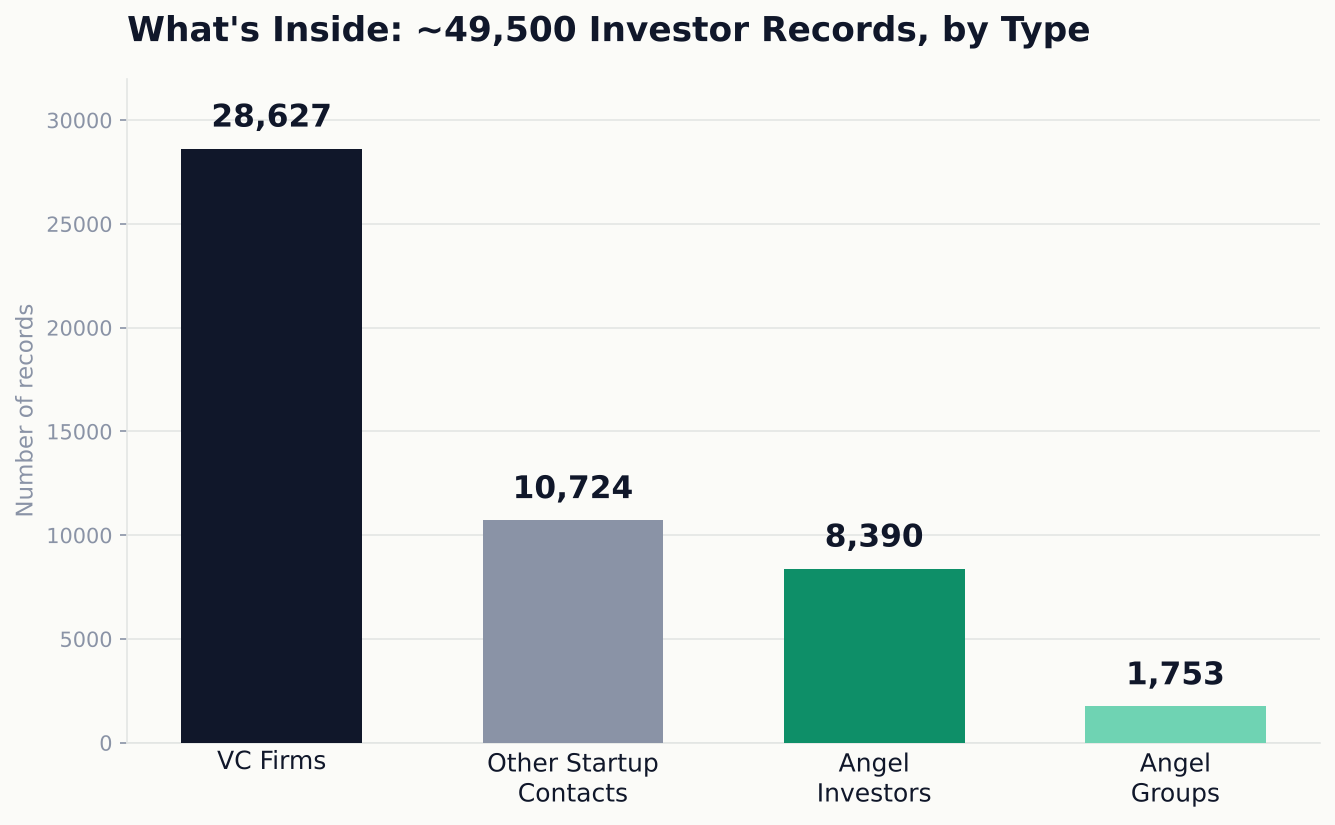
Venture capital firms make up the largest share by a wide margin, with individual angel investors and dedicated angel groups rounding out the core of the list. The fourth bucket — contacts that are clearly startup-relevant but weren’t pre-labeled by investor type in their original source — got kept rather than discarded, in case there’s a genuinely useful contact hiding in a column that just wasn’t filled in correctly. Altogether, that’s roughly 39,700 distinct firms and individuals once duplicates are removed, spread across 136 countries. This is not a U.S.-only list, even though the United States and United Kingdom lead by volume.
A name and a company aren’t enough to actually start outreach, so every record was also checked for how usable it actually is — not just how complete the spreadsheet looks.
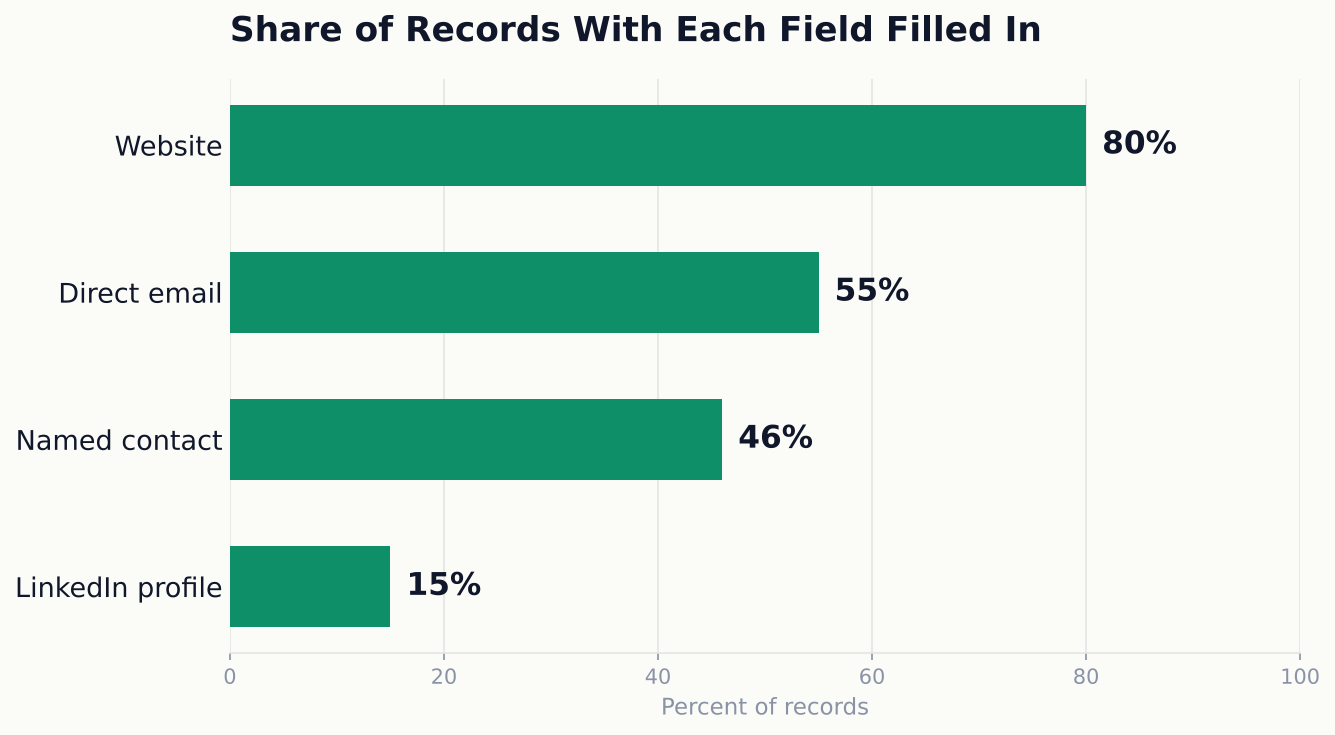
Most records come with a website, which is often the fastest way to confirm a firm is still active and find the right person to target. A smaller majority carry a direct email you can use today. Named contacts and LinkedIn profiles are rarer, simply because a lot of the original source data was captured at the firm level rather than the individual level — which is exactly why the “how to use it” section below treats the complete records and the partial ones differently, instead of blasting all 49,500 the same way.
The 136-country spread is worth pausing on too. It’s easy to assume a database like this would be dominated entirely by Silicon Valley, and the U.S. and U.K. do lead by volume — but the list also includes meaningful coverage across Western Europe, Southeast Asia, and other active startup hubs. If you’re raising outside North America, or raising a round with any international angle at all, that breadth is part of the point, not an afterthought.
How a List Like This Actually Gets Built
People sometimes assume a database like this comes from one clean source — a single vendor, a single export. It doesn’t. This one is a consolidation of VC, angel group, and angel investor lists I’ve separately sourced and relied on in my own work over five years — some built through direct research, some acquired from specialized data providers, some assembled from public fundraising and accelerator records. Each source arrived with its own column layout, its own naming conventions, and its own gaps.
Merging them is where the real work happens, and it’s genuinely easy to get wrong. The source files alone totaled over 64,500 raw rows before any cleanup. The obvious approach — merge any two rows with a matching company name — breaks almost immediately at that scale. A firm with a dozen different partners on staff, each a distinct, real contact, would collapse into a single row if you merge purely on company name, destroying exactly the specific, named contact that makes a database useful in the first place. Merge on email address instead, and you hit the opposite failure: shared inboxes, placeholder addresses, and reused “info@” emails chain completely unrelated companies into one false cluster — in early testing, that approach alone collapsed over two thousand genuinely distinct companies into a single false group of nearly nine thousand rows.
The fix was matching on company name and named contact together, so duplicate entries for the same firm and the same person get merged, while different people at the same firm stay separate. On top of the exact matches, a separate pass checked for near-duplicates — firms whose names were spelled slightly differently across source files, like an abbreviated “LLP” or a missing ampersand — and flagged those for review rather than guessing at a merge. That whole process brought the dataset down from 64,500-plus raw rows to just under 49,500 verified, deduplicated records.
It also surfaced a real defect buried in one source file, where a spreadsheet formatting quirk had “stuck” one well-known firm’s name onto a run of otherwise-unrelated contacts who had nothing to do with that company. Rather than guess at a fix, those specific rows were flagged for manual review instead of silently corrected — a wrong guess is worse than an honest gap, and it’s the kind of error that’s invisible unless you actually go looking for it.
This is the part most people don’t see when they buy a database like this. The raw data exists in fragments all over the internet, much of it free if you have the weeks to go find it. What you’re actually paying for is the hours spent reconciling it into something that doesn’t waste your time with duplicates, ghosts, or two different people accidentally merged into one contact.
None of this was a fully automated, hands-off process, either. AI did the heavy lifting on pattern-matching at scale — something no human could do cleanly across tens of thousands of rows — but anything the matching logic flagged as ambiguous got pulled out for a manual look rather than auto-resolved one way or the other. The goal the whole way through was the same: better to leave a handful of genuinely uncertain rows imperfect than to confidently merge or split something wrong and have you find out mid-outreach.
How to Actually Use It
A database this size is only useful if you work it methodically. Here’s how I’d actually approach it:
Segment before you send anything. Filter by sector focus and geography first, then by investor type. A climate-tech founder in Berlin gets far more out of 200 well-matched VC firms and angels than a mass email to all 49,500 records ever could. Most spreadsheet tools can filter the “Sector Focus” and “Country” columns in seconds. Say you’re raising a $750,000 pre-seed round for a fintech startup in Southeast Asia: filter Sector Focus for fintech and Country for the handful of markets you’re actually targeting, and you’ll likely end up with a few hundred records — a list you can realistically work through in a weekend, not a quarter.
Prioritize the complete records first. Rows with a named contact and a direct email are ready for personalized outreach today. Rows with just a firm name and a website are a starting point for ten minutes of research — find the right partner, skim their recent activity, then reach out.
Verify before you send, not after. People change firms, firms rebrand, and emails rotate — that’s normal in any investor database, not a defect in this one. A thirty-second LinkedIn check before a cold email saves you from pitching someone who left the firm eighteen months ago.
Personalize using what’s already in the row. The sector focus and description fields exist so you’re not sending the identical email to a climate fund and a fintech-focused angel group. Reference why this specific firm, not just “I saw you invest in startups.”
Track what you send. Add a column for outreach date, response, and follow-up. This database gives you the targets — a simple tracker turns it from a one-time blast into an actual campaign you can manage over weeks.
Watch the stage, not just the sector. A firm’s “Sector Focus” tells you what they fund; it doesn’t always tell you what stage they’re writing checks at right now. A fund that led Series A rounds two years ago may have since raised a larger follow-on fund and moved upmarket, or a seed fund may be in the final year of a close and selective about new positions. Use the website field to do a quick gut-check on recent deal activity before you assume a sector match is also a stage match.
Treat it as a starting line, not a finish line. This is the research already done for you, not the outreach already sent for you. The weeks it would have taken to build this list from scratch are gone. The actual fundraising conversations are still yours to have.
Watch the Full Walkthrough
Everything above is the short version. If you want to actually see where this data came from, watch how the deduplication worked without losing a single distinct contact, and get a real look at the finished spreadsheet — the columns, the sample rows, the whole thing — I walk through all of it on camera below.
▶ WATCH THE FULL WALKTHROUGH
If you’ve read this far, you’re probably exactly who this was built for: a founder who needs real investor contacts and doesn’t have weeks to spend finding them. The database is $10, one-time, delivered by email — usually within minutes, always within four hours. All sales are final, and I don’t offer samples — the video above walks through exactly what’s in the database and how it’s organized, so you can judge it there before you buy. But the reasoning behind that price hasn’t changed since the top of this post: if you’re trying to raise a pre-seed or seed round, money and time should never be what stands between you and the right investor.
Get the database: $10
Payment & Delivery
Payment accepted via PayPal or credit card.
Digital Delivery: Your database will be delivered in Excel spreadsheet format, typically within a few minutes to 4 hours of payment confirmation, depending on the time of purchase.
Refund Policy: All database sales are final. Due to the digital nature of these products, refunds are not available.

