A data-driven outlook from 427 verified investor mandates, built on Dubai Investors List ME Family Office Database
October 2026
Executive Summary
Every January, the Middle East private wealth industry produces a fresh round of outlook decks on where Gulf capital is headed next. Most are built the same way: a handful of headline interviews, a survey of a few hundred respondents answering in the abstract, and a set of conclusions that read the same whichever bank or consultancy wrote them — “diversification,” “alternatives,” “the region is open for business.”
This report is built differently. Rather than asking family offices what they say they plan to do, it is built bottom-up from 427 individually verified Middle East family office records — single- and multi-family offices across the UAE, Saudi Arabia, Oman, Israel, Kuwait, Bahrain, Qatar, Lebanon, Jordan and Iran — each profiled on its actual stated strategy preferences, geographic mandates, industry focus and current activity across private equity, real estate, infrastructure, natural resources, private debt and hedge funds. It is the underlying dataset behind The Dubai Investors List’s ME Family Office Database, maintained and refreshed on a rolling basis, with more than half of the 427 records updated within the twelve months to October 2026.
| The headline finding: real estate is the asset class carrying Gulf family capital to the West, private equity and venture capital are where diversification away from oil is happening fastest, and infrastructure and natural resources remain almost entirely domestic — a mirror of the giga-project and energy-transition spending driving the region’s own economies. |
Layered on top is a live geopolitical variable: a family office community that, per UBS’s 2026 Global Family Office Report, is more likely than any other region to overhaul its strategic asset allocation in the next year, against a backdrop of oil-price scenarios that range from the $60s to above $120 a barrel depending on how the Gulf’s own 2026 security environment resolves.
This report sets out what the data shows sector by sector, what publicly available research adds to the picture, and what both together suggest for family office capital deployment through 2027.
1. The Shape of the Universe
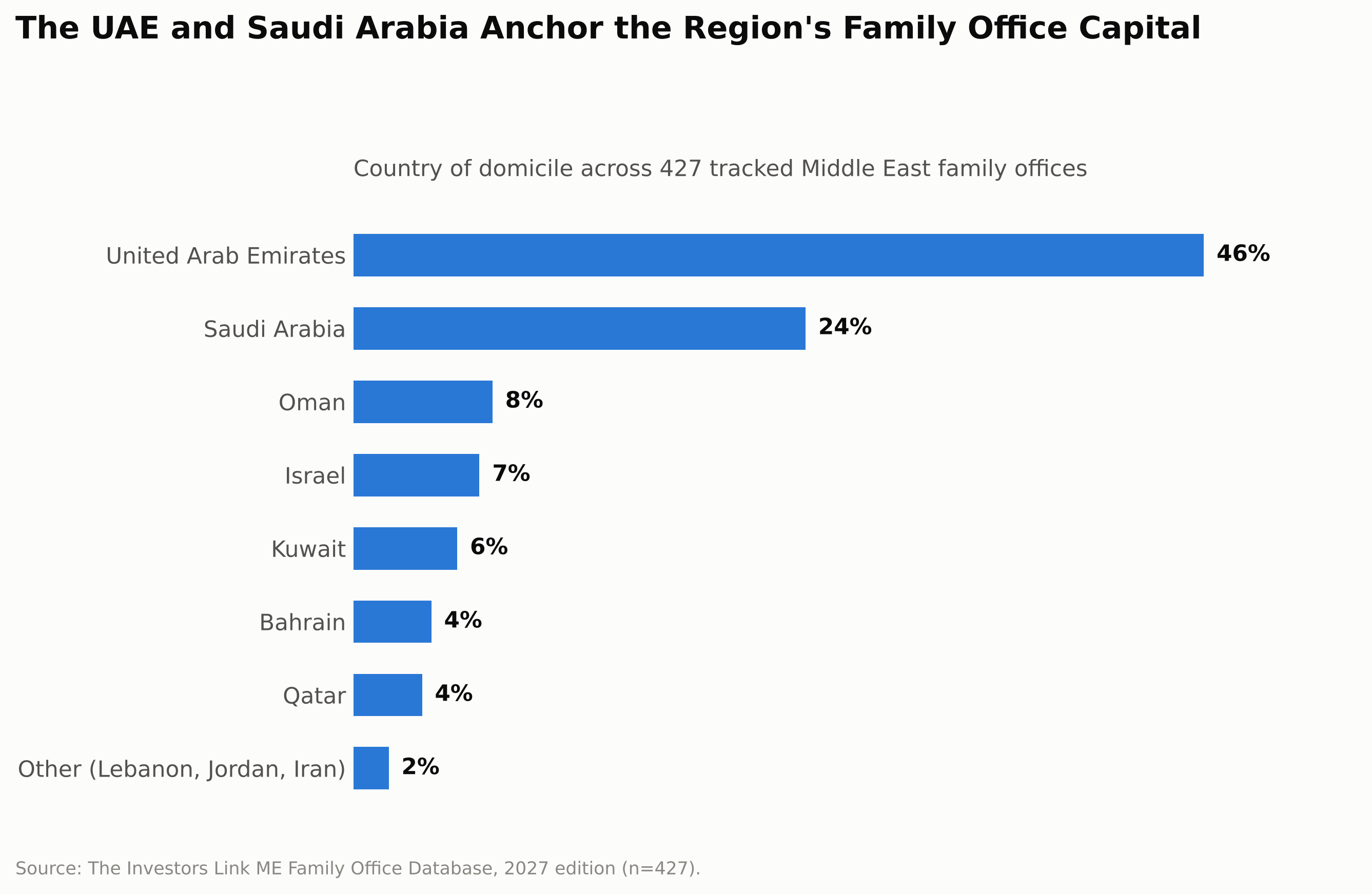
Figure 1. Country of domicile across the 427 family offices tracked in the database.
The 427 family offices in the dataset are concentrated where the region’s private wealth is concentrated. The UAE accounts for 46% of tracked entities, Saudi Arabia 24%, and a further six jurisdictions — Oman, Israel, Kuwait, Bahrain, Qatar, and a small Levantine group spanning Lebanon, Jordan and Iran — make up the balance. Single-family offices (368 records) outnumber multi-family offices (59) by roughly six to one, consistent with a region where family wealth has historically stayed inside the family rather than being pooled into third-party platforms, though that is now changing: Dubai’s DIFC introduced new Family Arrangements Regulations in 2024 that removed the requirement for single-family offices to register as designated non-financial businesses, a change widely credited with the subsequent jump in SFO formation across the emirate.
The dataset also captures a generational spread that matters for 2027 planning. A meaningful share of the region’s family offices were established before 1980 — several, like Bahrain’s Kanoo Group (1890) and Saudi Arabia’s El Seif Group (1951), predate the Gulf oil era entirely — while the single largest cohort by formation decade is the 2010s, reflecting the post-2014 oil-price adjustment that pushed many trading and merchant families to formalize investment arms. That split matters because it shows up directly in allocation behaviour: older, multi-generational conglomerates tend to run diversified direct holding structures across energy, logistics, real estate and industrials, while newer single-family offices skew toward narrower, higher-conviction private equity and venture mandates.
Asset bases vary enormously and are known for only a minority of entries — a reminder that even a well-maintained private database cannot fully substitute for voluntary disclosure in a region where financial privacy is both a cultural and regulatory norm. Where AUM is disclosed, it ranges from under $50 million to $10 billion-plus single-family offices such as Abu Dhabi and Dubai’s A1 Group, with a cluster of $1–7 billion entities including Binghatti, Kanoo Group, Rawabi Holding Group, Ghobash Group and El Seif Group. External estimates put the regional total considerably higher: Agreus Group has placed aggregate Middle East family office assets under management above $500 billion, against a backdrop of roughly 18,800 ultra-high-net-worth individuals in the region as of 2023 — a population Knight Frank projects will grow nearly 30% by 2028, with an estimated $1 trillion in regional wealth due to pass to the next generation by 2030.
2. Where the Capital Already Sits
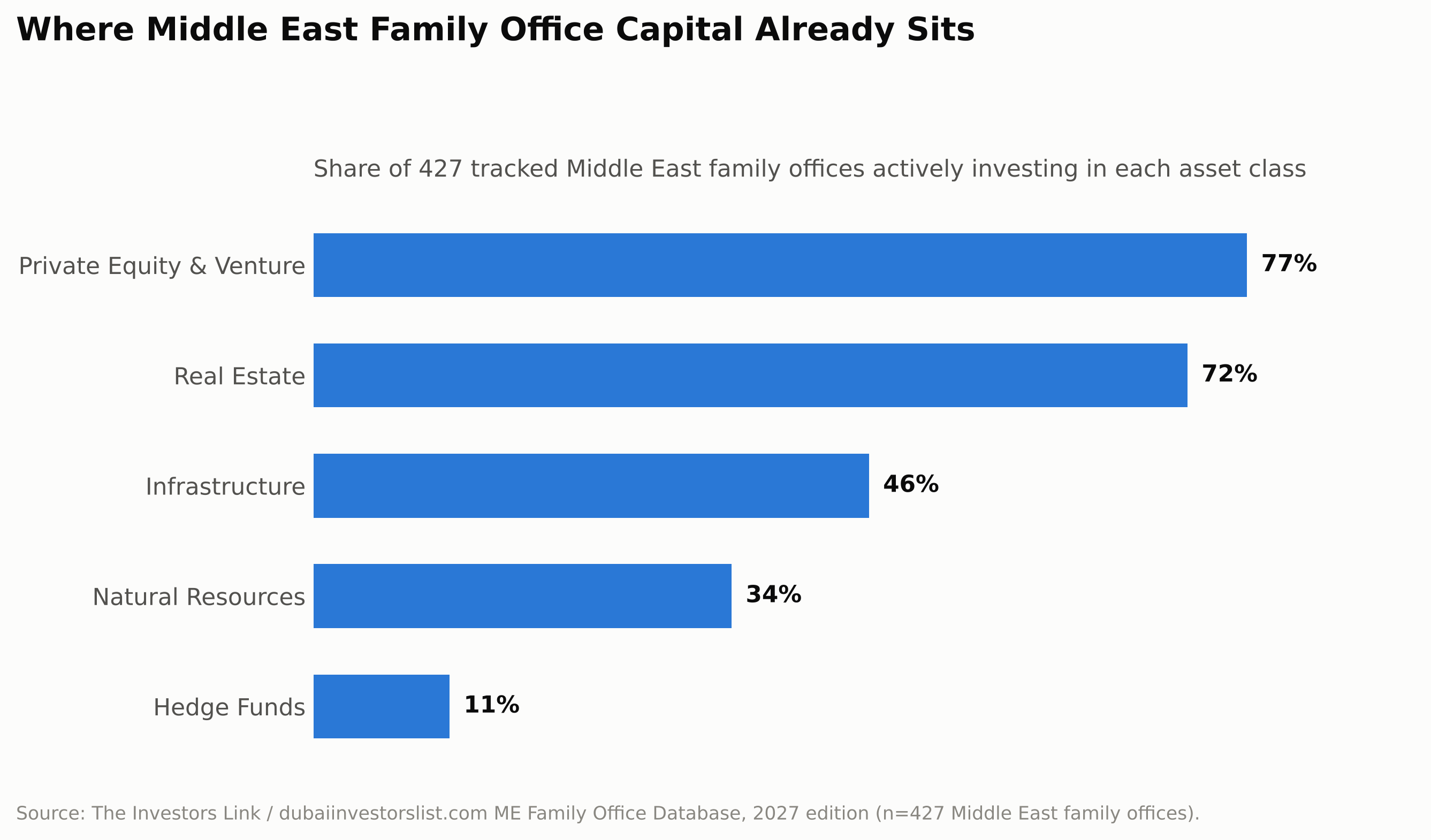
Figure 2. Share of the 427-firm universe with an active mandate in each asset class.
Strip away the asset classes with thin coverage and a clear hierarchy emerges. Private equity and venture capital is the most widely held alternative asset class in the dataset — 77% of the 427 tracked family offices are active investors — narrowly ahead of real estate at 72%. Infrastructure trails at 46%, natural resources at 34%, and hedge funds, consistent with the region’s broader preference for direct and private exposure over liquid alternatives, bring up the rear at just 11%.
That ordering is itself informative. It means the “big three” this report focuses on — real estate, private equity and infrastructure — collectively cover the overwhelming majority of active Middle East family office mandates, while natural resources functions less as a standalone allocation and more as a continuation of the operating businesses many of these families were built on in the first place: oil and gas services, petrochemicals, and now increasingly renewables.
A useful cross-check: firms with an infrastructure mandate, natural resources appetite and real estate activity overlap heavily with private equity participation, suggesting that for most of these institutions the asset-class label matters less than the underlying deal. A family office backing a logistics platform, a renewables developer or a branded residential tower will often record that single transaction across two or three of the database’s asset-class fields simultaneously — which is exactly the kind of cross-referencing a static industry survey cannot do, but a transaction-level database can.
3. Real Estate: Still Home, Increasingly Global
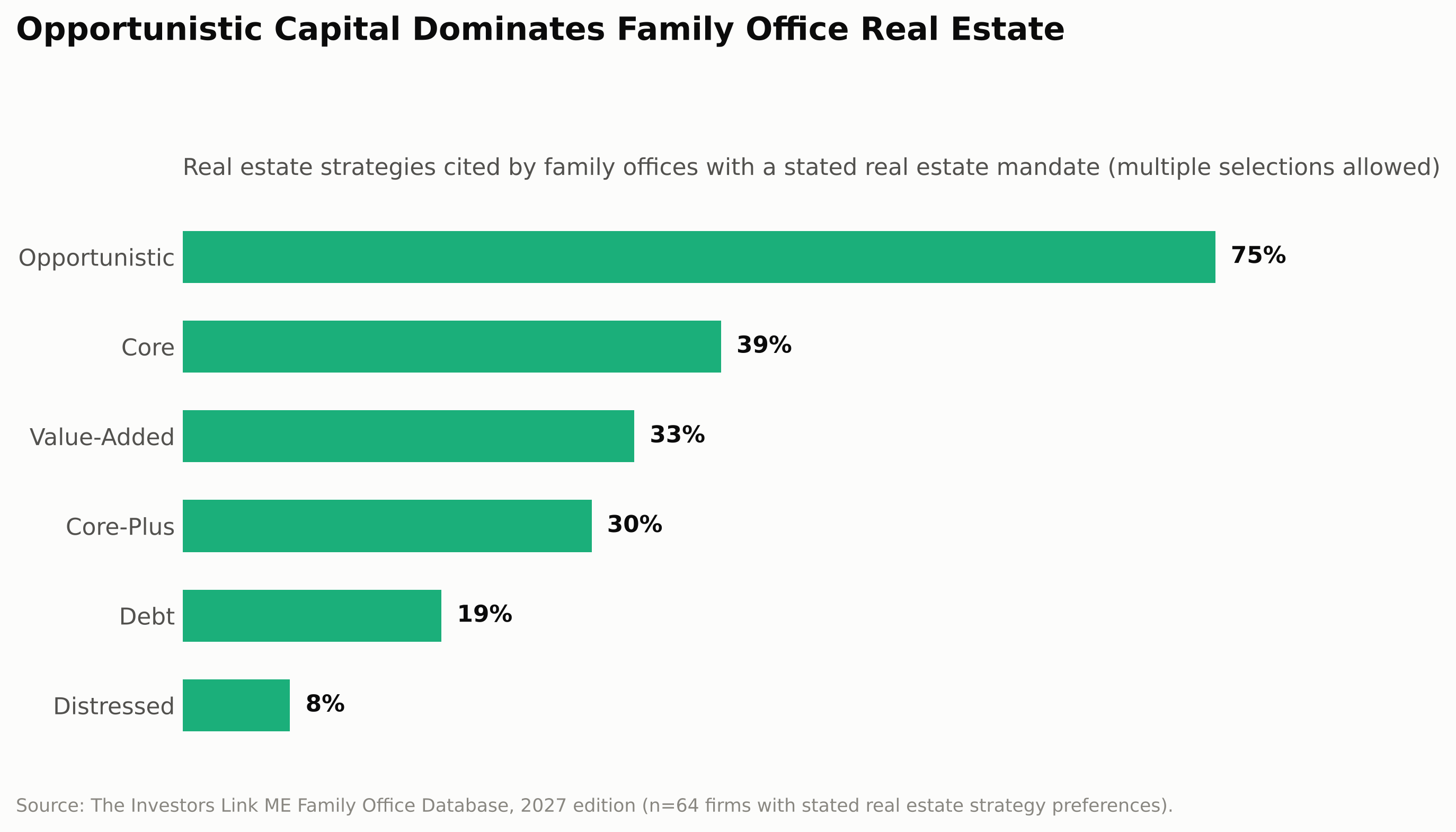
Figure 3. Real estate strategies cited by family offices with a stated real estate mandate.
Real estate is the single most tactically aggressive asset class in the dataset. Among the 64 family offices with a stated real estate strategy preference, 75% cite opportunistic strategies — by far the largest share of any approach — ahead of core (39%), value-added (33%), core-plus (30%), debt (19%) and distressed (8%). That skew toward higher-risk, higher-return positioning is consistent with what regional real estate advisors are reporting independently: family offices are moving away from passive limited-partner roles in blind-pool funds and building in-house teams to source, underwrite and manage direct deals themselves, a shift driven in large part by a new generation of internationally educated principals.
Three pieces of regulation have accelerated that shift specifically in 2024–2025, and all three remain live tailwinds heading into 2027. The DIFC’s 2024 Family Arrangements Regulations, noted above, reduced the compliance burden on single-family offices. In September 2025, the UAE clarified that Family Foundations are “fiscally transparent” for tax purposes, meaning real estate income flows through to the beneficiary level rather than being taxed at the entity level. And Saudi Arabia’s new Investment Law, effective February 2025, equalised treatment between domestic and foreign investors and streamlined licensing — a structural signal to the Kingdom’s own family conglomerates that direct real estate investment, at home and abroad, now carries materially less friction than it did three years ago.
The product preference inside that opportunistic tilt is consistent across the dataset and across public reporting: hospitality, branded residences and mixed-use development. Dubai’s Binghatti — a single-family office with an estimated $7 billion asset base — is the clearest illustration. Since its 2022 launch of the Burj Binghatti Jacob & Co Residences, the firm has layered branded partnerships (Bugatti Residences, Mercedes-Benz Places) onto its development pipeline and, in February 2024, raised over $621 million through its first USD-denominated sukuk — nearly double its original target, and a clear signal of how comfortably Gulf real estate families are now tapping global capital markets to fund opportunistic domestic development.
| The most consequential finding in this report: among family offices with a stated real estate geographic preference, 70% cite North America or Europe, essentially matching the 68% that cite the Middle East, GCC or MENA region. No other asset class in the dataset comes close to that balance. |
Real estate is the one place where Gulf family capital is genuinely bimodal: half the activity is building Dubai, Riyadh and the GCC’s own skylines, and the other half is quietly accumulating trophy and income-producing assets in London, New York, Manchester and continental European gateway cities. AIMS Investment’s 2024 sale of a Manchester residential portfolio is one visible example of the latter; most of this capital, by its nature, does not make headlines.
For 2027 specifically, expect that bimodal pattern to persist rather than resolve in either direction. Domestically, the opportunistic, branded, mixed-use model that Binghatti and peers have proven out shows no signs of slowing, helped by continued population and tourism growth across the UAE and Saudi Arabia. Internationally, family offices citing North America and Europe are doing so for income, diversification and generational wealth-preservation reasons that are structurally separate from — and will likely be reinforced rather than reversed by — the dollar-diversification conversation described in Section 6. Real estate, unlike a portfolio allocation to US equities or dollar cash, is a hard asset the family can see, control and pass down; that is precisely why it remains the easiest asset class for a historically home-biased investor base to take abroad.
4. Private Equity and Venture: Where the Diversification Is Happening
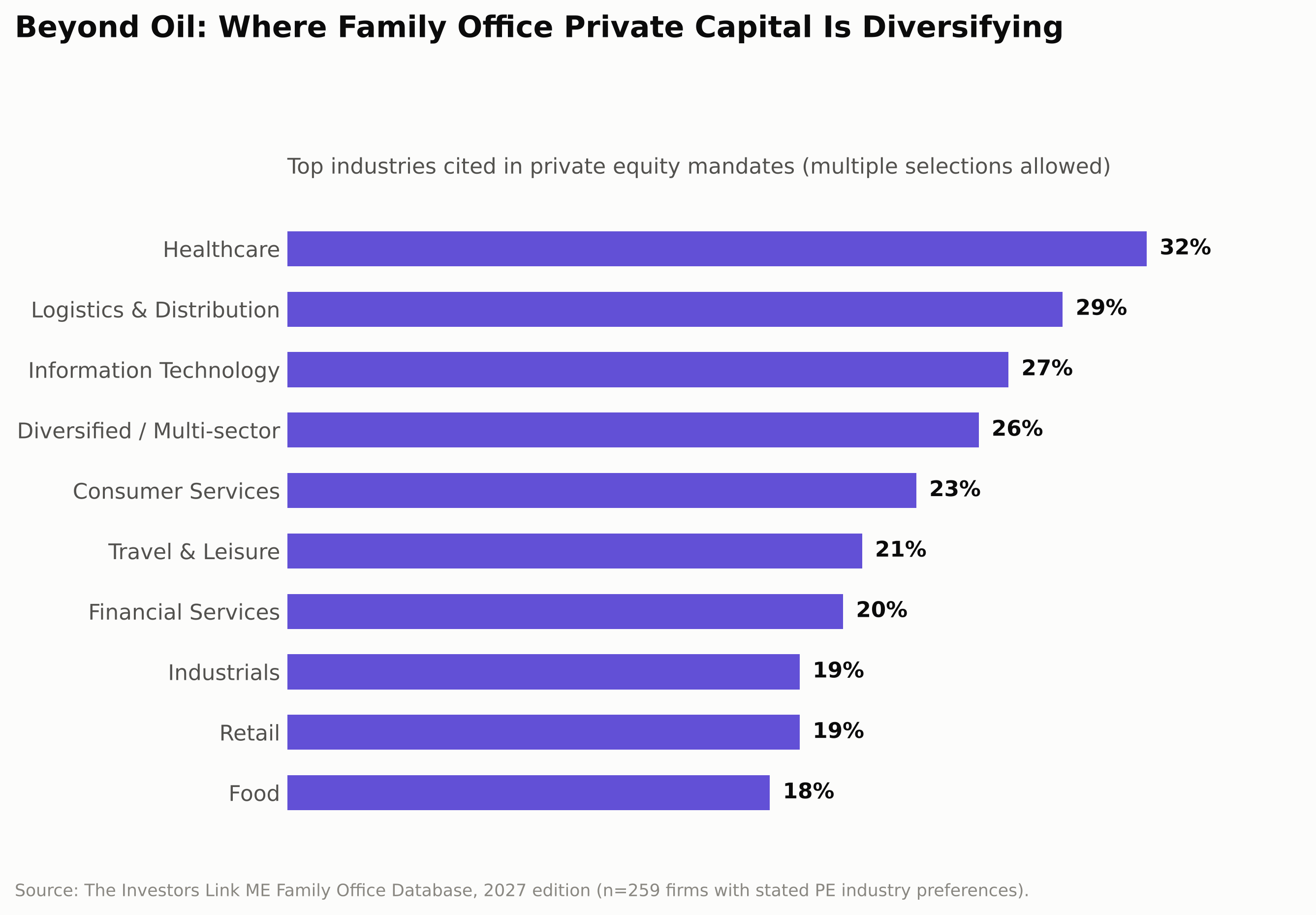
Figure 4. Top industries cited in private equity mandates (multiple selections allowed).
Private equity is both the largest and the most strategically varied asset class in the database. Among the 132 family offices with a stated PE strategy preference, venture capital (69.7%) is the single most cited approach — ahead of buyout (41.7%) and growth (37.9%) — with early-stage mandates, seed and start-up stage alike, each cited by well over a quarter of respondents. That is a striking result for a region still associated, in much outside commentary, with passive LP capital: a majority of the Middle East family offices in this database with an active PE mandate are backing venture-stage companies, not simply writing checks into established buyout funds.
The industry breakdown tells the diversification story in more granular terms. Healthcare (32%), logistics and distribution (29%), information technology (27%) and a broad diversified/multi-sector bucket (26%) lead the list of 259 family offices with stated PE industry preferences — ahead of consumer services, travel and leisure, financial services, industrials, retail and food, each in the high teens to low twenties. Oil and gas, by contrast, registers at just 9% as a stated PE industry preference — a reminder that even as natural resources and infrastructure mandates remain tied to the region’s hydrocarbon base, the private equity capital sitting alongside it is overwhelmingly being pointed at healthcare systems, supply chains, software and consumer businesses instead.
Bahrain’s Kanoo Group — one of the region’s oldest multi-family office platforms, tracing to an 1890 shipping business — illustrates how far that diversification now extends internationally. Its Kanoo Capital division, formed in 2016, now spans more than 40 active investments across 17 countries in fixed income, equities, private capital and joint ventures, targeting roughly 8% annual returns, with stated PE geographic interest spanning the GCC, Europe, North America and Greater China simultaneously. Abu Dhabi and Dubai’s A1 Group shows a similar pattern at the single-family-office level: direct holdings across education, healthcare, oil and gas and petrochemicals domestically, alongside direct investments in the US, Europe and Asia.
That said, caution is still the dominant posture toward unproven managers. Among family offices with a stated position, more than three times as many say no to first-time fund managers as say yes (21 versus 6), and co-investment alongside an established GP — rather than a blind commitment — is the clear preference where a position is recorded. For 2027, the practical implication for anyone raising from this community is straightforward: a strong track record, a willingness to structure co-investment or direct deal access, and a credible healthcare, logistics, technology or diversified thesis will open far more doors than a first-time fund pitch on venture or buyout strategy alone — however compelling the strategy itself.
5. Infrastructure and Natural Resources: Nation-Building Stays Home
Infrastructure is the second-largest of the five alternative asset classes by participation (46% of the 427-firm universe) and, among the 184 family offices with a stated infrastructure geographic preference, the most geographically concentrated of all: 90% cite the Middle East, GCC or MENA region, versus just 18% citing North America or Europe. Natural resources shows an almost identical pattern — 93% home-region versus 13% for North America and Europe, among 129 respondents with a stated preference.
That concentration is not a gap in family office sophistication; it is a rational response to where the deal flow and the national mandate both sit. Saudi Arabia and the UAE are in the middle of the largest sustained infrastructure build-out in the region’s history, and family-controlled construction and engineering groups are direct beneficiaries and participants. Saudi Arabia’s El Seif Group — a Riyadh-based conglomerate founded in 1951 and listed among PIF’s own Vision 2030 construction partners — illustrates the scale involved: in July 2024, its joint venture with China State Construction Engineering Corporation won a SAR 7.8 billion (over $2 billion) contract for Diriyah Company’s Northern District, the largest single award in Diriyah Company’s history, following an earlier $1.8 billion joint venture with the same Chinese partner in 2021. That Saudi–Chinese construction pairing is also a small but telling data point in the broader pivot-to-Asia narrative discussed in Section 6: even as Gulf capital explores Asian financial markets, Chinese state contractors are becoming embedded delivery partners inside the Kingdom’s own giga-projects.
The energy transition is visible inside the natural resources numbers without yet displacing oil and gas as the core allocation. Among 92 family offices with a stated natural resources industry preference, oil (70%) and natural gas (65%) remain dominant, but renewables already register at 27% — a meaningful share for a category that barely existed in most of these portfolios a decade ago. Rawabi Holding Group, an Al Khobar-based oilfield-services conglomerate founded in 1980, is a representative case: alongside its core oil and gas services business and a majority stake in Canada’s United Safety, the group’s leadership has publicly flagged diversification into renewables, hydrogen and floating wind, alongside conversion to a closed joint-stock company and consideration of a partial IPO — a sequence several family-run energy services groups in the database appear to be following in parallel.
For 2027, infrastructure and natural resources are the two asset classes in this report least likely to see any meaningful geographic rebalancing, geopolitics notwithstanding. The scale of Gulf state capital commitment to domestic giga-projects — Gulf funds already control roughly 40% of global sovereign wealth fund assets, a pool Deloitte expects to grow from about $12 trillion today to $18 trillion globally by 2030 — means family-run infrastructure and energy businesses will continue to find more opportunity, and more favourable financing and co-investment terms, at home than abroad. The open question for 2027 is less about geography and more about energy mix: whether the renewables, hydrogen and grid-infrastructure share of that domestic spending — and of family office capital following it — grows from the current high-20s percentage into something closer to parity with oil and gas.
6. The Pull to the West — and the Geopolitics That Could Slow It
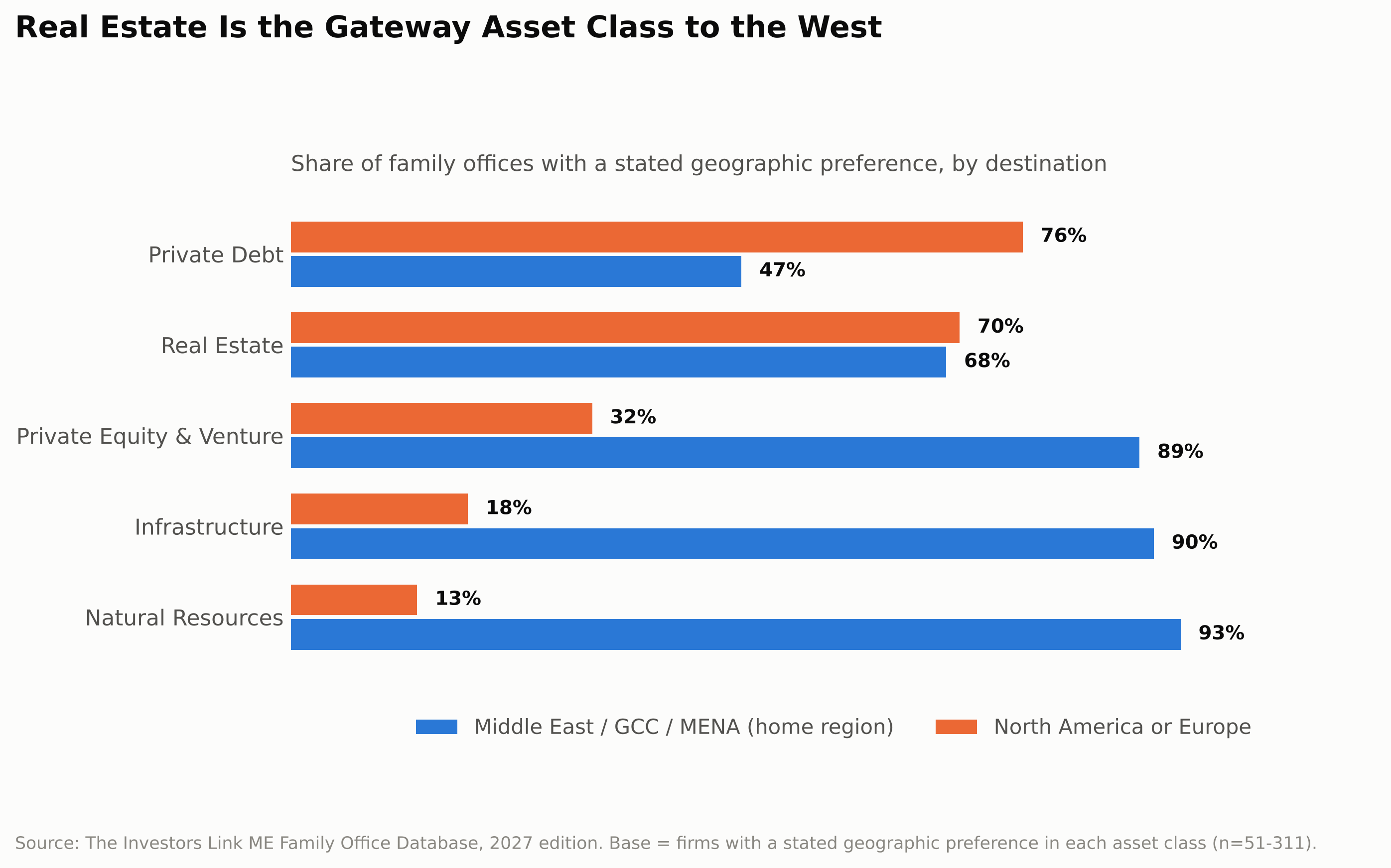
Figure 5. Share of family offices with a stated geographic preference citing the home region versus North America or Europe, by asset class.
Put the five asset classes side by side and the pattern is unambiguous: real estate and, to a lesser extent, private debt are where Gulf family capital crosses into North America and Europe; private equity does so selectively; infrastructure and natural resources barely do so at all. That pattern lines up closely with the only large independent survey of the region’s family offices published in 2026. UBS’s Global Family Office Report, covering 307 family offices across more than 30 markets with an average net worth of $2.7 billion, found that Middle East family offices already hold roughly half their total portfolios in North America — the largest regional concentration anywhere in the survey — with meaningful secondary exposure to Western Europe and the home region.
The same UBS survey, however, points to the most significant swing factor for 2027: Middle East family offices reported the highest intention to overhaul strategic asset allocation of any region surveyed — 82%, against a 60% global average that was itself a survey record. More than half said they consider themselves overexposed to the US dollar, roughly a third are planning multi-currency diversification (one of the highest rates of any region, with the Swiss franc and euro cited as preferred alternative stores of value), and UBS’s Benjamin Cavalli specifically flagged plans to raise Asia-Pacific allocations from roughly 2% to 10% of portfolios. None of that amounts to an exit from the West — North America, Cavalli noted, “clearly continues to represent the greatest share of allocations” even as the shift unfolds — but it does describe a family office community actively reweighting at the margin for the first time in years.
Geopolitics is the proximate cause. UBS respondents ranked geopolitical conflict as the top portfolio risk over both short and long time horizons, and Middle East-specific commentary through 2026 has been dominated by the aftermath of the February 2026 US and Israeli strikes on Iran, which triggered a broad regional risk-asset selloff and prompted explicit commentary from Chinese strategists and Citigroup analysts about Gulf capital reassessing its concentration in Western, dollar-denominated assets in favour of perceived alternative safe havens such as Hong Kong and Singapore. That is not a new instinct for Gulf sovereign capital specifically — the Qatar Investment Authority has had a Beijing office since 2014, the Kuwait Investment Authority opened in Shanghai in 2018, and Saudi Arabia’s Public Investment Fund opened its first Asian office in Hong Kong in 2022, followed by a 2024 memorandum of understanding with the Hong Kong Monetary Authority to launch a $1 billion joint investment fund — but 2026 is the first year the family office segment specifically has told surveyors, in meaningful numbers, that it intends to follow.
Set against that is a countervailing, state-level force pulling in the opposite direction. During President Trump’s May 2025 Gulf tour, the UAE pledged $1.4 trillion of investment into the US economy over ten years, alongside more than $200 billion in specific business deals including a $60 billion ADNOC partnership and a $14.5 billion Etihad Airways Boeing order; Saudi Arabia committed $600 billion, including nearly $142 billion in weapons purchases that the White House described as the largest-ever arms deal, with subsequent reporting suggesting the Kingdom’s committed figure has since moved higher. Pledges of that size are made at the sovereign and state-enterprise level, not by individual family offices, but they set the diplomatic and commercial tone that family capital typically follows with a lag — and they are a structural reason to expect the “overexposed to the dollar” sentiment captured in the UBS survey to translate into gradual rebalancing at the margin through 2027, rather than any rapid rotation out of US and European assets.
The oil price is the variable most likely to determine how much room Gulf family offices actually have to diversify internationally in 2027, because it sets the pace of the primary liquidity event — government and SWF spending — that ultimately funds private wealth formation across the region. Goldman Sachs’s base case for 2027 Brent crude is $80 a barrel, embedding roughly $20 a barrel of geopolitical risk premium on top of fundamentals; the bank’s downside scenario, in the $60s, assumes Gulf output runs about one million barrels a day above February 2026 levels, while its upside scenario, around $125, assumes Gulf output instead stays some five million barrels a day below that same baseline. A lower-for-longer oil price would tighten the fiscal and giga-project spending that is currently the engine of family-office wealth creation in infrastructure, construction and energy services; a higher, geopolitically driven price would do the opposite for government coffers while simultaneously validating the very risk perception now pushing some of that same capital toward diversification. Either way, 2027 is shaping up to be a year in which the asset classes most exposed to home-region risk — infrastructure, natural resources, and the sovereign-adjacent construction economy around them — are also the ones most directly exposed to how that number moves.
7. What This Means for 2027
Pulling the sector analysis, the regulatory tailwinds and the geopolitical backdrop together, five reasonably confident calls emerge for how Middle East family office capital behaves through 2027:
- Real estate stays opportunistic and stays the primary bridge to the West. Expect continued branded-residence, hospitality and mixed-use activity at home, continued direct (not fund-intermediated) acquisition of income and trophy assets in US and European gateway cities, and continued use of sukuk and other Islamic capital-markets instruments to fund domestic development pipelines.
- Private equity keeps diversifying away from oil — but stays selective on managers. Healthcare, logistics, technology and diversified operating businesses will keep attracting the largest share of PE capital; venture and early-stage activity will remain more prevalent than outside perception suggests; and GPs without a track record or without co-investment flexibility will continue to find this investor base hard to access.
- Infrastructure and natural resources stay almost entirely domestic. The scale of Gulf giga-project and energy-transition spending gives family-run construction, engineering and energy-services groups more opportunity at home than abroad, and that is unlikely to change regardless of how the broader allocation-diversification conversation evolves. Watch the renewables, hydrogen and grid share of natural resources activity specifically — it is the fastest-growing sub-segment inside an otherwise stable, home-biased asset class.
- Dollar and currency diversification continues, but gradually, and does not mean an exit from the US. The UBS findings and the scale of 2025’s state-level US investment pledges point in the same direction: North America remains the largest single destination for Middle East family wealth, even as family offices add Swiss franc, euro and selective Asia-Pacific exposure at the margin.
- Oil price volatility is the swing factor to watch all year. A Brent price anchored near Goldman’s $80 base case through 2027 would support continued giga-project spending and a steady, orderly pace of diversification; a sharp move to either the downside ($60s) or upside (above $120) would accelerate change in different directions — the former by tightening the fiscal spigot funding domestic infrastructure wealth, the latter by reinforcing the geopolitical risk narrative already pushing some capital toward Asia.
None of these calls required guessing. They come from cross-referencing 427 individually verified family office mandates against the small set of credible, publicly available research on this investor base — which is, ultimately, the case for treating a maintained, transaction-level database as a more reliable guide to where this capital is actually going than another round of generic survey headlines.
About This Research
This report draws on The DubaiInvestorsList.com ME Family Office Database, a proprietary dataset of 427 Middle East family offices — single- and multi-family offices across the UAE, Saudi Arabia, Oman, Israel, Kuwait, Bahrain, Qatar, Lebanon, Jordan and Iran — each profiled on firm background, notable investments, recent activity, assets under management (where disclosed), year established, and detailed strategy, geographic and industry preferences across private equity, real estate, infrastructure, natural resources, private debt and hedge funds. Records are individually researched and refreshed on a rolling basis; more than half of the current dataset was updated within the twelve months to October 2026.
Percentages in this report are calculated against the subset of family offices with a stated position in the relevant field, as noted beneath each chart; “stated” means the preference is present in the underlying record, not that every tracked family office was contacted or surveyed for this report. Where multiple strategies, sectors or geographies are cited for a single family office, that record is counted once in each applicable category, so individual category percentages do not sum to 100%.
The full database — including verified contact-level detail and firm-by-firm profiles — is available through dubaiinvestorslist.com, alongside the companion UAE Capital Database, UAE C-Suite Database and related Middle East institutional investor datasets.
Get the database: $249
Payment & Delivery
Payment accepted via PayPal or credit card.
Digital Delivery: Your database will be delivered in Excel spreadsheet format, typically within a few minutes to 4 hours of payment confirmation, depending on the time of purchase.
Refund Policy: All database sales are final. Due to the digital nature of these products, refunds are not available.
Watch the Detailed Video before purchase
Sources
1. The Dubai Investors List ME Family Office Database, 2027 edition (proprietary, n=427)
2. UBS, Global Family Office Report 2026, as reported by Khaleej Times, “Middle East war: Family offices taking medium-term approach, reducing exposure to dollar,” 2026
3. AGBI, “Gulf family offices cut exposure to the dollar,” June 2026
4. WealthBriefing, “UBS Family Office Report Highlights Move Towards Emerging Markets, Europe, AI,” 2026
5. Deloitte Middle East, “Gulf sovereign wealth funds lead global growth as assets forecast to reach US$18tn by 2030,” March 2025
6. Caixin Global, “Middle East conflict may redirect Gulf capital toward Asia,” March 2026
7. Goldman Sachs 2027 Brent crude forecast, as reported by Devdiscourse, “Brent crude may fall to USD 60s in 2027 if Gulf oil output recovers faster: Goldman Sachs,” 2026
8. GRI Institute, “GCC Family Office Real Estate Allocation: How Gulf Capital Is Shifting to Direct Investment,” 2026
9. IQ-EQ, “Why the Middle East is Seeing a Boom in Family Offices,” 2026, citing Knight Frank Wealth Report 2024 and Agreus Group estimates
10. Al-Monitor, “Trump caps Gulf tour in Abu Dhabi with dizzying investment pledges,” May 2025

