A data-led outlook from the Dubai Investors List research desk, covering every Saudi, UAE, Bahraini, Kuwaiti, Qatari and Omani-domiciled private-market fund in our 2022–2024 vintage database, and the people who run them.
Key Takeaways
- The Gulf grew while the world shrank. Between the 2023 and 2024 vintages, new fund launches worldwide fell by about a third. Over the same period, GCC-domiciled fund launches doubled, from 77 to 157. The region’s share of global fund formation tripled, from 0.8% to 2.5%.
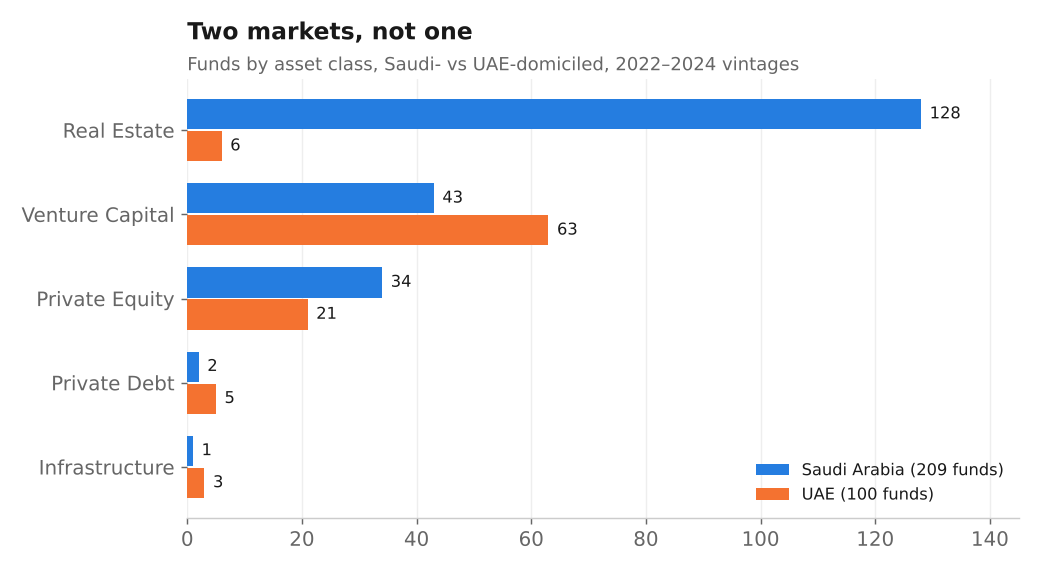
- Saudi Arabia and the UAE are two different markets. Saudi Arabia accounts for 209 of the 338 GCC funds, and 61% of them are real estate, mostly denominated in riyals. The UAE accounts for 100, and 63% of them are venture capital, mostly in US dollars.
- Two-thirds of GCC funds are still raising. 228 of 338 GCC funds (67%) are still open, a higher share than the global average of 56%. Among the 2024 vintage, 93% are still in market. That pipeline will define the 2027 regional fundraising calendar.
- The UAE is a launchpad for new managers. 46% of UAE-domiciled funds with known fund numbers are first-time funds, more than double the global rate of around 20%.
- Gulf funds are increasingly looking outward. 81 GCC-domiciled funds (24%) focus primarily outside the Middle East, led by North America (29) and Asia (17). Nearly half of all UAE-domiciled funds invest mainly abroad.
- Gulf funds are short-dated. The median GCC fund has a five-year life, against eight years globally. Saudi real estate funds have a median life under four years. Short lives mean frequent re-raises.
- The people are concentrated in two cities. Our database holds 3,740 fund-manager contacts based in the GCC. More than 60% of them sit in Riyadh (1,162) or Dubai (1,108). Around a third of the firms with Gulf-based staff are headquartered outside the region, led by US and UK firms.
- Fintech, not AI, leads Gulf venture. Globally, artificial intelligence is the most-cited venture vertical. Among GCC funds, fintech leads by a wide margin, followed by blockchain, e-commerce and clean technology.
Introduction: Why the Gulf Deserves Its Own Map
Most outlooks on private markets treat the Middle East as a footnote: a source of sovereign wealth that occasionally writes very large cheques into funds managed in New York, London or Singapore. That picture is incomplete, and for anyone planning a fundraise, a deal or a business-development push in 2027, it is increasingly misleading.
Our database of private-market funds from the 2022, 2023 and 2024 vintages contains 24,035 funds worldwide. Of those, 338 are domiciled in a Gulf Cooperation Council country: 209 in Saudi Arabia, 100 in the United Arab Emirates, 23 in Bahrain, 3 in Kuwait, 2 in Qatar and 1 in Oman. In global terms that is a small number. But it is the direction of travel, not the absolute size, that makes the Gulf the most interesting regional story in private markets going into 2027.
While global fund formation fell sharply in the 2024 vintage, GCC fund formation surged. While the global market became more concentrated around large, established managers, the UAE became one of the most active places in the world to launch a first-time fund. While most of the world’s managers looked to the Gulf as a source of capital, a growing number of Gulf managers began deploying capital abroad.
This report takes a closer look at those funds and the people behind them. It is the regional companion to our broader report, The 2027 Capital Crunch, which examined all 24,000 funds in the dataset. Here, we focus on four questions:
- How is GCC fund formation changing, and how does it compare with the rest of the world?
- How do the Gulf’s two main markets, Saudi Arabia and the UAE, differ, and why does that matter?
- Who are the people making decisions in Gulf private markets, and where are they?
- What could 2027 look like for managers raising in the Gulf, for international managers raising from the Gulf, and for dealmakers bringing opportunities to Gulf investors?
As with all of our research, this report uses aggregate figures only. We do not name individual funds or individuals.
Section 1: The Surge — Gulf Fund Formation Against the Global Tide
The headline numbers
GCC-domiciled fund launches by vintage year:
| Vintage | GCC funds | All funds worldwide | GCC share of global |
|---|---|---|---|
| 2022 | 104 | 8,476 | 1.2% |
| 2023 | 77 | 9,347 | 0.8% |
| 2024 | 157 | 6,212 | 2.5% |
| Total | 338 | 24,035 | 1.4% |
The pattern is the reverse of the global one. Worldwide, 2023 was the peak vintage and 2024 saw a sharp drop. In the Gulf, 2023 was the trough and 2024 was the peak, with more than double the number of funds launched the year before.
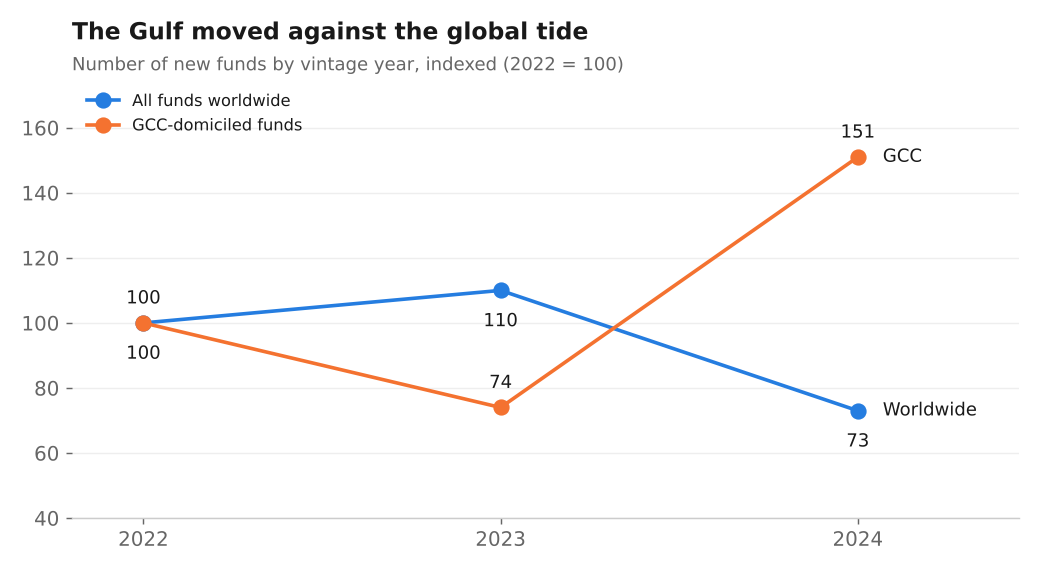
Indexing both series to 2022 makes the divergence clear. By the 2024 vintage, global fund formation stood at 73% of its 2022 level. GCC fund formation stood at 151%.
Some caution is warranted. The GCC sample is small, so a handful of large managers launching several vehicles at once can move the numbers. And, as with the global dataset, data on the most recent vintages fills in over time. But reporting lag should, if anything, cause recent vintages to be under-counted. That makes the 2024 surge more striking, not less.
Country by country
| Country | 2022 | 2023 | 2024 | Total |
|---|---|---|---|---|
| Saudi Arabia | 69 | 42 | 98 | 209 |
| United Arab Emirates | 25 | 26 | 49 | 100 |
| Bahrain | 8 | 8 | 7 | 23 |
| Kuwait | 1 | 1 | 1 | 3 |
| Qatar | 0 | 0 | 2 | 2 |
| Oman | 1 | 0 | 0 | 1 |
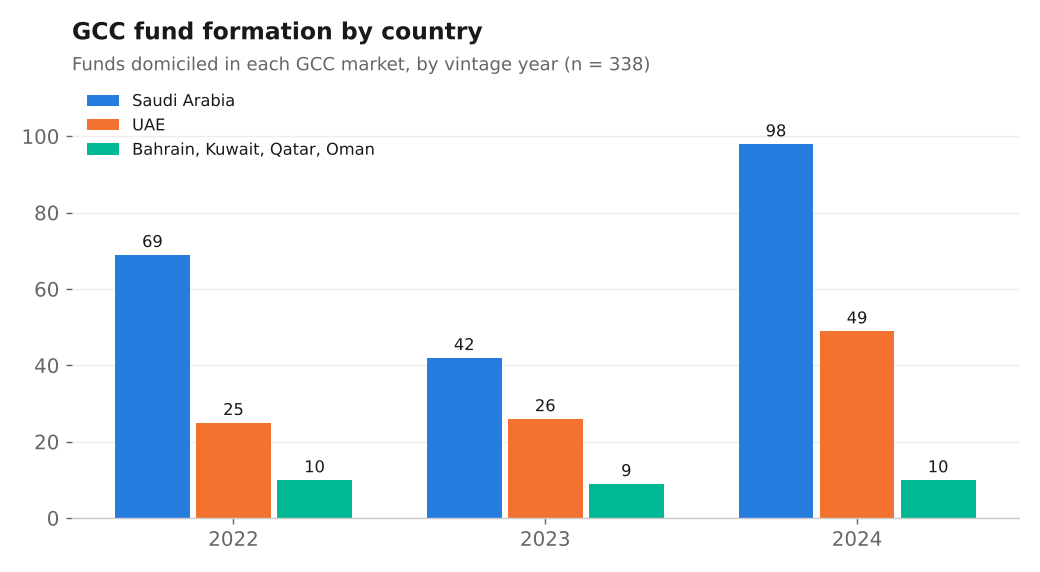
Saudi Arabia and the UAE together account for 91% of all GCC funds in the dataset, and both roughly doubled their output between the 2023 and 2024 vintages. Bahrain held steady at seven or eight funds a year, and is notable mainly for the international orientation of its managers (see Section 5). Kuwait, Qatar and Oman each record only a handful of domiciled funds, although they host significant investor communities, as Section 6 shows.
By city, Riyadh is the region’s leading fund hub, with around 160 funds managed from the Saudi capital. Dubai follows with 58, then Abu Dhabi with 40, Manama with 23 and Jeddah with 21. The Eastern Province cities of Al Khobar and Dhahran together account for more than 20.
The pipeline: 228 open funds
Of the 338 GCC funds, 228 (67%) are still open: raising, at an interim close, or announced. That is a higher share than the global average of 56%, which is largely explained by how recent the Gulf’s surge has been:
| Vintage | GCC funds | Still open | Share still open |
|---|---|---|---|
| 2022 | 104 | 37 | 36% |
| 2023 | 77 | 45 | 58% |
| 2024 | 157 | 146 | 93% |
Almost the entire 2024 GCC vintage, 146 of 157 funds, is still in market. Those funds will be the core of the Gulf fundraising calendar in 2026 and 2027.
Of the GCC funds that disclose a target size (138 of 338), combined targets add up to around US$72 billion. That headline figure needs careful reading. A handful of very large vehicles, including two infrastructure funds and one venture vehicle with multi-billion-dollar targets, account for around US$40 billion of the total. Excluding funds targeting US$5 billion or more, the remaining GCC funds are seeking around US$32 billion.
Against those targets, GCC funds that have reached a final close report a combined US$8.4 billion raised, with a median final close of US$100 million.
Fast closes when they close
One striking feature of the GCC data is how quickly funds close when they do. The median closed GCC fund spent just six months in market, faster than any asset class globally, where median times range from 9 months for venture capital to 21 months for infrastructure. Among the small number of closed GCC funds that report both a target and a final close (16 funds), most met or exceeded their target.
The likely explanation is structural. Many Saudi real estate funds are raised from a known base of domestic institutional and high-net-worth investors, often with an anchor commitment arranged before launch. They are, in effect, pre-sold. That model works well for the funds that use it. It also means that for a manager without those pre-existing relationships, the market can look closed even when it is growing.
By contrast, the median open GCC fund has been in market for around 20 months, almost identical to the global figure. The Gulf, in other words, has two kinds of fund: those that close quickly because the capital was lined up in advance, and those that face the same long, uncertain raise as everyone else.
Section 2: Two Markets, Not One — Saudi Arabia and the UAE
The single most important insight in the GCC data is that “the Gulf” is not one market. Saudi Arabia and the UAE, which together host more than nine in ten GCC funds, look strikingly different on almost every measure.
| Measure | Saudi Arabia | United Arab Emirates |
|---|---|---|
| Funds (2022–2024 vintages) | 209 | 100 |
| Fund managers | 56 | 65 |
| Largest asset class | Real estate (128 funds, 61%) | Venture capital (63 funds, 63%) |
| Second asset class | Venture capital (43) | Private equity (21) |
| Main fund currency | Saudi riyal (151 funds) | US dollar (76 funds) |
| Main legal domicile | Onshore Saudi Arabia | Mix of UAE, Cayman, Delaware, Luxembourg |
| Primary focus Middle East | 94% | 51% |
| Median fund life | 4 years | 5.5 years |
| First-time funds | 15% | 46% |
| Still open | 67% | 73% |
Saudi Arabia: a domestic, real-estate-led market
Saudi Arabia’s private fund market is overwhelmingly domestic. Of 209 Saudi-domiciled funds, 196 have a primary focus on the Middle East, 151 are denominated in riyals, and 138 are legally domiciled onshore in the Kingdom. Real estate dominates, with 128 funds, followed by venture capital (43) and private equity (34).
The market is also relatively concentrated. Just 56 managers account for all 209 Saudi funds, an average of almost four funds each. A number of Saudi managers run a series of vehicles side by side, often one per project or strategy, rather than a single large commingled fund.
Saudi private equity is the fastest-growing segment. Saudi-domiciled private equity funds rose from 6 in the 2022 vintage to 11 in 2023 and 17 in 2024, with buyout funds rising from 3 to 6 to 8. That is consistent with a maturing market in which more privately held Saudi businesses are being professionalised, recapitalised and prepared for eventual exit.
The UAE: an international, venture-led hub
The UAE’s fund market looks far more like an international financial centre than a domestic market. Of its 100 funds, 76 are denominated in US dollars and just over half (51) have a primary focus on the Middle East; the rest target North America, multi-regional strategies, Asia and Africa. UAE funds are domiciled in a mix of onshore UAE structures, financial-free-zone vehicles and offshore jurisdictions including the Cayman Islands, Delaware and Luxembourg.
Venture capital is the dominant asset class, with 63 funds, rising from 14 in the 2022 vintage to 22 in 2023 and 27 in 2024. Private equity follows with 21 funds. Real estate, which dominates in Saudi Arabia, accounts for only six UAE-domiciled funds. That does not mean the UAE lacks real estate capital; Dubai’s property market is among the most active in the world. It means UAE real estate capital is largely deployed through direct ownership, developers, family holding companies and private vehicles, rather than through formally recorded commingled funds.
The UAE is also where new managers go to launch. Forty-six percent of UAE-domiciled funds with known fund numbers are first-time funds, compared with around 20% across the global dataset and 15% in Saudi Arabia. 65 different managers account for the 100 UAE funds, and the median manager has just one.
Why the difference matters for 2027
For anyone working in Gulf capital markets, the Saudi–UAE split has practical consequences:
- Different investor bases. Saudi funds are raised largely from domestic institutions, government-linked entities and Saudi high-net-worth families. UAE funds draw on a more international mix of regional family offices, expatriate wealth, sovereign-linked investors and global LPs.
- Different products. If you are selling real estate exposure, Saudi Arabia is where the fund market is. If you are selling venture or growth exposure, or looking for co-investors in international deals, the UAE is more likely to be the right starting point.
- Different currencies and structures. A riyal-denominated, onshore Saudi fund and a US dollar, Cayman-domiciled UAE fund appeal to different investors, are regulated differently and are marketed differently.
- Different competition. In Saudi Arabia, a new manager competes with a smaller group of established local managers with deep domestic relationships. In the UAE, a new manager competes with dozens of other first-time funds, many of them run by international professionals who have relocated to Dubai or Abu Dhabi.
Treating the Gulf as a single block, with one investor list and one pitch, is one of the most common mistakes international managers make. The 2027 data suggests it will become more costly, not less.
Section 3: Gulf Real Estate Funds — Core and Opportunistic, Little in Between
Real estate is the largest asset class among GCC-domiciled funds, with 143 funds across the three vintages. 128 of them are Saudi.
A barbell of strategies
Globally, value-add is the most common real estate fund strategy. In the Gulf, it is almost absent. GCC real estate funds split into two camps:
| Strategy | 2022 | 2023 | 2024 | Total |
|---|---|---|---|---|
| Core | 20 | 14 | 38 | 72 |
| Opportunistic | 27 | 9 | 23 | 59 |
| Value-add | 2 | 1 | 9 | 12 |
Core funds, which buy or hold stabilised, income-producing assets, are the largest group and grew fastest in the 2024 vintage. Opportunistic funds, which in the Gulf context typically means development, land and higher-risk repositioning, are the second-largest group. Value-add, the middle ground that dominates in the US and Europe, accounts for fewer than one in ten Gulf real estate funds, although it did rise from 1 fund in 2023 to 9 in 2024.
This barbell reflects the Gulf’s real estate market. In fast-growing cities with large development pipelines, investors tend to choose either the stability of completed, income-producing assets or the higher returns of development. There is less of the ageing building stock that value-add strategies elsewhere depend on.
Diversified and residential lead
By main property type, Gulf real estate funds are dominated by diversified strategies (76 funds), followed by residential (24). Industrial and land each account for 6 funds, office for 5 and hotels for 3. Saudi funds show the same pattern: 65 diversified, 22 residential, 6 land and 5 office.
Very short fund lives
The most distinctive feature of Gulf real estate funds is their life. The median GCC real estate fund has a life of just 3.75 years, compared with a median of eight years across all funds globally. Many Saudi real estate funds are structured around a single development or a defined pool of assets, with capital returned once the project is completed and sold.
Short fund lives have two consequences that matter for 2027:
- Frequent capital recycling. Investors in Gulf real estate funds receive capital back relatively quickly, then need somewhere to put it. That creates a regular cycle of re-investment demand, and a natural opening for managers offering new products.
- Frequent fundraising. Managers running short-dated funds are raising almost continuously. That means a steady flow of new Gulf real estate funds coming to market, each of which needs investors, and many of which also need debt, development partners and service providers.
What could happen in 2027
- More core and income funds. If the 2024 trend continues, core strategies will make up a growing share of new Gulf real estate funds, aimed at investors who want income rather than development risk.
- A growing value-add segment. The rise from one value-add fund in 2023 to nine in 2024 is small in absolute terms but could signal the start of a more mature market, as early-2010s stock in Riyadh, Jeddah and Dubai ages.
- Cross-border real estate flows. Gulf real estate capital increasingly also looks abroad. Thirteen GCC-domiciled real estate funds have a primary focus outside the Middle East, mainly North America and Europe. International developers and real estate managers raising in the Gulf should expect sophisticated questions and strong competition from regional managers already investing in their markets.
Section 4: Gulf Venture Capital and Private Equity
Venture: a UAE-led, fintech-first market
The GCC has 110 venture capital funds in our dataset across the three vintages, making venture the second-largest asset class after real estate. Sixty-three are UAE-domiciled, 43 are Saudi, and the remaining four are spread across Bahrain, Kuwait, Qatar and Oman.
The sector mix is distinctive. Among the industry verticals listed by GCC funds:
| Vertical | GCC funds citing it |
|---|---|
| Fintech | 44 |
| Blockchain | 17 |
| E-commerce | 15 |
| Clean technology | 14 |
| Artificial intelligence | 13 |
| SaaS | 12 |
| Healthtech | 9 |
| Edtech | 7 |
| Infrastructure | 7 |
Fintech dominates, cited by more than three times as many funds as artificial intelligence. That contrasts sharply with the global picture, where AI is the most-cited vertical across all funds. The Gulf venture market is still largely focused on digitising financial services, payments, commerce and logistics, where there remains significant opportunity in markets that have only recently opened up to digital competitors.
There are also clear differences between the two main venture markets:
- UAE venture funds lean toward fintech (24 funds), blockchain (16), clean technology (10), e-commerce (9), healthtech (7) and AI (7). The UAE’s prominence in blockchain and digital assets is a direct result of its efforts to build a regulated environment for that sector.
- Saudi venture funds lean toward fintech (17), e-commerce (6), SaaS (5), AI (4) and proptech (3). They are more focused on domestic consumer and enterprise digitisation.
What could happen in Gulf venture in 2027
- AI catches up. With large government programmes investing in AI infrastructure and capabilities across the region, it would be surprising if AI-focused venture funds did not grow sharply in the 2025–2027 vintages.
- A first-time manager shakeout in the UAE. The UAE’s high proportion of first-time funds is a sign of a vibrant ecosystem, but it also means many of those managers have no track record. As global LP capital tightens, some first-time UAE managers will struggle to close, while those with strong anchor investors and differentiated strategies will stand out.
- More venture debt and growth capital. Five UAE venture funds are already dedicated to venture debt. As regional startups mature, the demand for growth-stage equity and non-dilutive debt is likely to rise.
Private equity: Saudi buyouts on the rise
The GCC has 68 private equity funds in the dataset. Saudi Arabia accounts for 34, the UAE for 21 and Bahrain for 10, with the remainder elsewhere in the region.
The clearest trend is in Saudi Arabia, where private equity fund formation nearly tripled from 6 funds in the 2022 vintage to 17 in 2024. Buyout funds rose from 3 to 8 over the same period, with growth equity making up much of the rest.
For 2027, this matters for two groups:
- Business owners and advisers in Saudi Arabia will find a growing number of domestic private equity buyers for mid-market companies, alongside the international funds that have historically dominated larger deals.
- International PE managers looking for Saudi co-investors or joint-venture partners will find a larger and more professional local private equity community than existed just a few years ago.
Section 5: The Gulf as Capital Exporter
Most commentary on Gulf capital focuses on money flowing in: international managers raising from Gulf LPs. The data shows a growing flow in the other direction, with Gulf-based managers raising funds specifically to invest abroad.
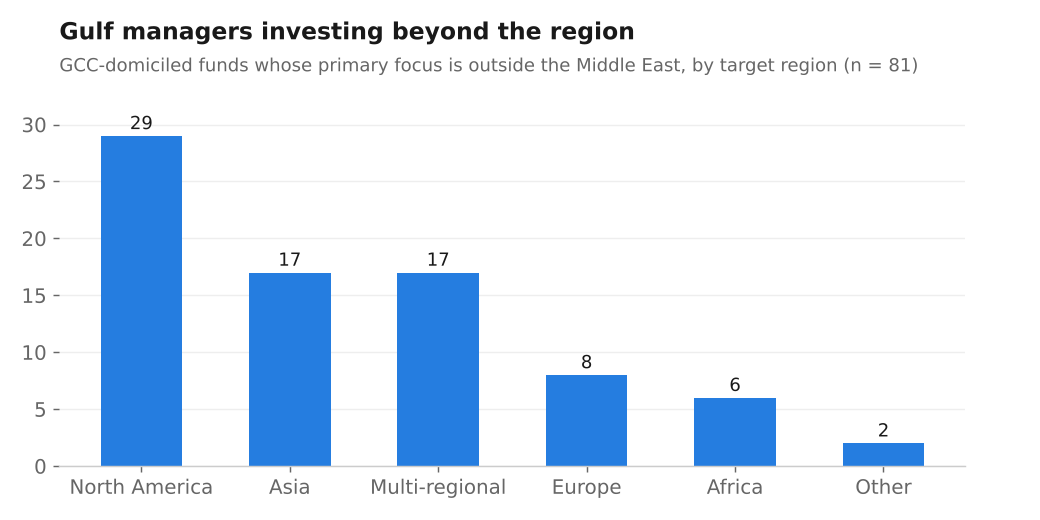
81 GCC-domiciled funds (24%) have a primary investment focus outside the Middle East. By target region:
- North America: 29 funds
- Asia: 17 funds
- Diversified multi-regional: 17 funds
- Europe: 8 funds
- Africa: 6 funds
- Other: 2 funds
By asset class, these outbound funds are led by venture capital (35), private equity (21) and real estate (13), with smaller numbers in private debt (6) and infrastructure (4).
The outbound trend is concentrated in two places:
- The UAE. 49 of the UAE’s 100 funds focus primarily outside the Middle East. That makes the UAE, in effect, as much a hub for managing international portfolios as a market for regional investment.
- Bahrain. 17 of Bahrain’s 23 funds focus outside the Middle East, mostly on North America (9) and Asia (5). Bahrain has a long history as a base for Gulf managers investing in US and European private equity and real estate on behalf of regional clients.
Saudi Arabia is much more inward-looking, with only 13 of its 209 funds focused outside the region.
Outbound fund formation held at around two dozen funds in each of the 2022 and 2023 vintages, then rose to 34 in 2024.
Why the outbound trend matters for 2027
- Gulf managers are co-investors, not just LPs. International managers should recognise that many Gulf firms are not only potential limited partners but also active deal sponsors and co-investors in North America, Europe and Asia. A Gulf-based fund manager may be a competitor for deals, a partner on them, or both.
- Deal flow to the Gulf. Developers, operating companies and sponsors in the US, UK and Asia looking for equity partners should be talking to Gulf-based managers who run outbound funds. These funds exist specifically to find opportunities like theirs.
- A two-way relationship. The most successful relationships between international managers and Gulf investors in 2027 are likely to be two-way: co-investment, joint ventures, and reciprocal deal sharing, rather than a simple request for an LP commitment.
Who is coming the other way?
Our data also shows foreign-domiciled funds targeting the region. 45 funds domiciled outside both the GCC and Israel have a primary focus on the Middle East, led by US-domiciled funds (28) and Singapore-domiciled funds (7). Many international managers investing in the region also use Gulf-domiciled vehicles, particularly in the UAE’s financial free zones, which is part of why UAE fund formation is so internationally oriented.
Section 6: The People — Who Makes Decisions in Gulf Private Markets
Funds are only half of the picture. For anyone trying to raise capital, partner with a Gulf manager or bring a deal to the region, what matters is the people.
3,740 professionals at 348 firms
Our database holds 3,740 fund-manager contacts based in GCC countries, at 348 firms. By country:
| Country | Contacts |
|---|---|
| Saudi Arabia | 1,575 |
| United Arab Emirates | 1,567 |
| Bahrain | 285 |
| Kuwait | 239 |
| Oman | 43 |
| Qatar | 31 |
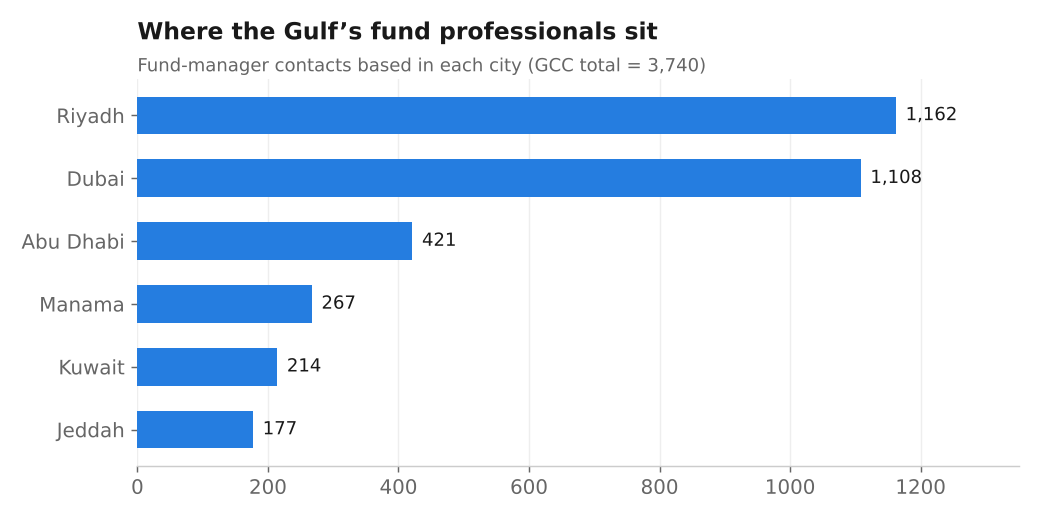
Two cities dominate. Riyadh (1,162 contacts, including Al-Riyadh records) and Dubai (1,108) together account for more than 60% of all Gulf-based fund professionals in the database. Abu Dhabi follows with 421, then Manama with 267, Kuwait (Kuwait City and Safat combined) with 214 and Jeddah with 177.
Notably, Kuwait has more fund professionals in the database than its three domiciled funds would suggest. Kuwait’s investment companies have long invested through vehicles domiciled elsewhere, and many of its professionals manage international portfolios.
Seniority: the decision-makers are reachable
Among the 3,740 Gulf contacts, titles include:
- 417 chief executives
- 452 managing directors
- 396 partners
- 688 heads of a function or team
- 118 chief financial officers
- 89 chief investment officers
By firm type, 2,423 work at firms classified as fund managers, 887 at private equity firms, 245 at real estate firms, 91 at infrastructure firms and 60 at private equity fund-of-funds managers. By asset-class coverage, the largest groups cover private equity (2,402), real estate (1,440), venture capital (1,359) and private debt (726).
One detail stands out. Only 55 Gulf-based contacts carry an investor relations title, compared with more than 10,000 across the global database. Gulf firms rarely have dedicated investor relations teams. Relationships with investors, and with anyone seeking capital, are usually held by the chief executive, a managing director or a founding partner. For anyone approaching Gulf managers in 2027, this means outreach needs to go to the senior decision-maker, not to a generic “IR” inbox, because in most cases that inbox does not exist.
International firms on the ground
Of the 348 firms with Gulf-based professionals in our database, 112 (around a third) are headquartered outside the GCC. The largest groups are US firms (40), UK firms (18), Indian firms (9) and French and Swiss firms (6 each).
This is the clearest sign of how seriously international managers now take the region. These are firms that have moved people to Riyadh, Dubai and Abu Dhabi rather than relying on fly-in fundraising trips. For managers still raising from the Gulf by flying in, 2027 will mean competing with peers who are permanently on the ground.
Relationships over email
Email addresses are available for 57% of the Gulf contacts in our database, compared with telephone numbers for 85%. That gap is a useful reminder of how business is done in the region: by phone, through introductions and in person, far more than through cold email. A short, accurate list of the right people, combined with a credible introduction, will outperform a large email campaign.
Section 7: How Gulf Funds Are Built
Small and mid-sized funds dominate
Among the 138 GCC funds that disclose a target size, the median target is US$100 million. More than half (71 funds) target US$100 million or less, and only 18 target more than US$500 million.
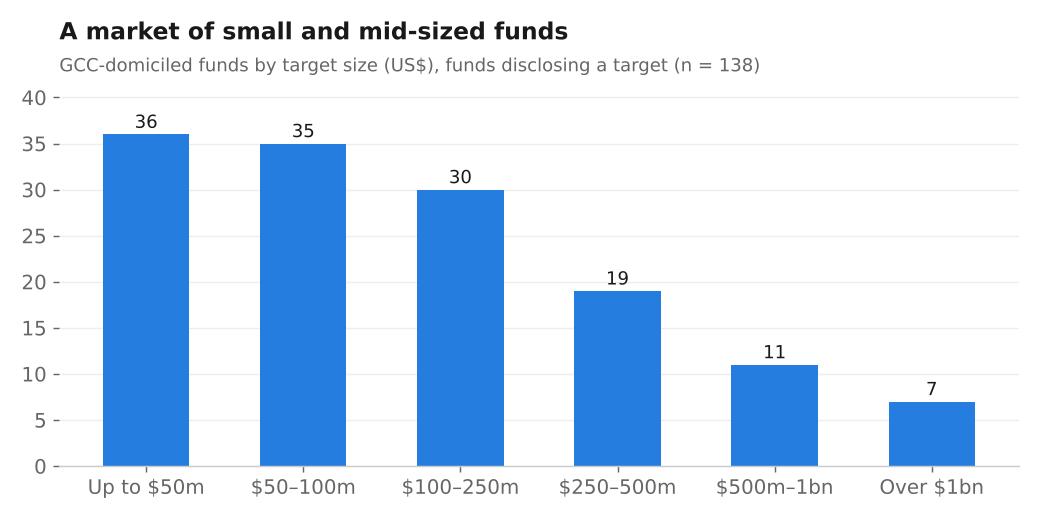
| Target size | Funds |
|---|---|
| Up to US$50m | 36 |
| US$50–100m | 35 |
| US$100–250m | 30 |
| US$250–500m | 19 |
| US$500m–1bn | 11 |
| Over US$1bn | 7 |
This is a market of small and mid-sized vehicles, punctuated by a few very large government-linked or strategic funds. For international service providers, placement teams and co-investors, the practical implication is that most Gulf fund managers are running relatively lean operations, often with small teams and limited back-office capacity.
A relatively concentrated manager base
The 338 GCC funds are run by 131 fund managers. The median manager has one fund in the dataset, but a small number run many: the ten most active managers account for 35% of all GCC funds, and the single most active manager has 16 funds across the three vintages. Concentration is highest in Saudi Arabia, where serial real estate fund managers launch multiple project-specific vehicles.
For 2027, this concentration cuts two ways. For investors, it means the Gulf fund market is relatively easy to map: a few dozen managers account for a large share of activity. For new managers, it means competing against incumbents with deep domestic relationships and well-oiled fundraising machines.
Distribution: still largely self-raised
Among GCC funds where placement-agent information is recorded (46 funds), 21 used a placement agent and 25 did not. The funds that did use agents are mostly larger, internationally marketed vehicles. Most Gulf funds, particularly in Saudi real estate, are raised directly by the manager through its own relationships.
This matters for 2027 because the Gulf’s growth is being driven by smaller managers who cannot easily afford, or attract, a global placement bank. They need to find investors themselves, and increasingly they need to look beyond their existing networks, both within the GCC and internationally.
Terms and disclosure
Gulf funds disclose relatively little about their terms. Only a handful report management fees, carry or hurdles, which is itself a useful finding: international LPs used to detailed term disclosure should expect a different, more relationship-based diligence process in the Gulf.
Where return targets are disclosed, they are ambitious. The median minimum target net IRR among the 11 GCC funds that report one is 16%, and the median minimum target gross IRR among the 7 that report one is 20%. Middle East–focused funds globally carry a median minimum target net IRR of 19%. These are small samples, but they point in the same direction: Gulf managers are promising returns at or above global private equity levels.
On governance, the Big Four are well represented among GCC fund auditors, with KPMG, Deloitte and EY the most frequently named. Co-investment is common where it is reported: 22 of the 31 GCC funds that answer the question say they offer co-investment opportunities to their LPs.
Section 8: Three Gulf Scenarios for 2027
As in our global report, these scenarios are illustrations rather than predictions. They are designed to help managers and investors think about the range of plausible outcomes.
Scenario A: Continued Acceleration
What happens: Government-led economic programmes continue at pace, regional capital markets deepen, and global managers keep expanding their Gulf presence. Gulf fund formation in the 2025–2027 vintages continues to grow from the 2024 level.
What it means: More Saudi private equity and venture funds, a growing UAE venture ecosystem, and continued growth in outbound funds. The 146 open 2024 GCC funds mostly reach final close in 2026–2027. International managers deepen their local teams.
Who wins: Established Saudi managers, UAE managers with strong anchor investors, international firms with people on the ground, and service providers and data owners who can map the region’s growing investor community.
Scenario B: Consolidation
What happens: Lower energy revenues or a slowdown in government spending leads regional investors to become more selective. Domestic LPs concentrate on their most trusted managers.
What it means: Fund formation stabilises or dips. Many first-time UAE funds struggle to close. Saudi real estate continues, but with fewer new managers. Fund terms become more investor-friendly.
Who wins: Large, established managers, core real estate, private credit, and LPs with capital to deploy who can negotiate terms.
Who struggles: First-time managers, generalist venture funds and international managers without established Gulf relationships.
Scenario C: The Two-Way Hub
What happens: Global LP capital remains constrained, so more international managers turn to the Gulf for capital, while Gulf managers continue to expand their international investing.
What it means: The Gulf becomes a genuine two-way hub. Outbound funds grow further, international managers set up more local vehicles, and co-investment and joint-venture structures between Gulf and international managers become standard.
Who wins: International managers who build reciprocal relationships, Gulf managers with global deal access, and dealmakers outside the region who can bring opportunities to Gulf investors.
The likely reality
The most likely 2027 outcome is a mix of Scenarios A and C, with pockets of B. The 2024 data shows a region expanding both its domestic fund market and its international reach at the same time. In all three scenarios, the advantage goes to those who know exactly which Gulf investors and managers to approach, and how.
Section 9: A 2027 Gulf Playbook
For international managers raising from the Gulf
- Choose your market. Decide whether your product fits Saudi Arabia, the UAE or both. A US dollar growth equity fund and a riyal-denominated core real estate fund are not sold to the same people.
- Map the right people, not just the right firms. With few dedicated investor relations teams in the region, your list needs to reach chief executives, managing directors, partners and chief investment officers.
- Go beyond sovereigns. Sovereign wealth funds are the best-known Gulf investors and the most heavily courted. Family offices, regional investment companies, Gulf-based fund managers with outbound mandates, and senior executives who invest privately are often more accessible and more open to new relationships.
- Offer something reciprocal. Co-investment rights, joint ventures, local deal flow or a Gulf-domiciled feeder vehicle all signal long-term commitment.
- Plan for presence. A third of the firms with Gulf-based staff in our data are international. If you are competing with them, regular in-person time in Riyadh, Dubai and Abu Dhabi is not optional.
For Gulf managers raising in 2027
- Look beyond your home market. If you are a UAE first-time manager, you are competing with dozens of peers for the same local LPs. Saudi, Kuwaiti and Bahraini investors, and international LPs with Middle East allocations, are all potential sources of capital.
- Build your own distribution. Most Gulf funds are raised without a placement agent. Treat investor targeting as a core capability: a clean, segmented investor list, a disciplined outreach plan and good records.
- Disclose more than your peers. In a market where few funds publish detailed terms, clear disclosure on fees, returns and governance is a competitive advantage with international LPs.
For dealmakers and companies seeking Gulf capital
- Target the outbound funds. 81 GCC funds exist specifically to invest outside the Middle East. If you are a US real estate developer, a European growth company or an Asian infrastructure sponsor, these are your most natural Gulf counterparties.
- Approach Saudi private equity for regional deals. The near-tripling of Saudi PE funds since 2022 means more domestic buyers and partners for mid-market regional companies.
- Speak to the decision-maker. In the Gulf, the person who can say yes is usually the founder, CEO or managing director. Find them, and find a credible way to be introduced.
Conclusion: The Gulf Is No Longer a Footnote
In a year when global fund formation fell by a third, the GCC doubled its output. The region now hosts two distinct private fund markets: a domestic, real-estate-led Saudi market and an international, venture-led UAE hub. A quarter of Gulf funds now invest primarily outside the Middle East, and a third of the firms with professionals in the region are headquartered abroad.
For 2027, that combination makes the Gulf both a source of capital and a source of competition. International managers will compete for Gulf LPs with local managers and with peers who are already on the ground. Gulf managers will compete with each other, and increasingly with international firms, for both capital and deals.
In every scenario, the winners will be those who understand the region’s two markets, map its decision-makers accurately and approach them in the way the region prefers: directly, personally and with something of value to offer.
Methodology and Data Notes
Source. This analysis uses the Dubai Investors List institutional funds database. The fund universe is all funds from the 2022, 2023 and 2024 vintages whose manager is located in a GCC country (Saudi Arabia, the United Arab Emirates, Bahrain, Kuwait, Qatar and Oman): 338 funds run by 131 managers. The contact analysis covers 3,740 fund-manager contacts based in GCC countries, across 348 firms. Global comparisons use the full dataset of 24,035 funds.
“GCC-domiciled.” Throughout, we classify a fund as GCC-domiciled based on the country of its fund manager’s location in the data. Some of these funds are legally domiciled offshore (for example in the Cayman Islands, Delaware or Luxembourg), which we discuss in Section 2.
“Still open.” Funds with a status of Raising, First Close, Second Close or later interim closes, or Announced.
Small samples. The GCC universe is much smaller than the global dataset, and many fields, particularly fund terms, are disclosed by only a handful of funds. Percentages based on small samples are flagged in the text and should be treated as indicative.
Reporting lag. Data on recent vintages fills in over time. The 2024 surge in GCC fund formation is, if anything, more likely to be understated than overstated.
Scenarios. The 2027 scenarios are illustrative and are not forecasts. Nothing in this report is investment advice or an offer to buy or sell any security or fund interest.
About Dubai Investors List
Dubai Investors List builds proprietary investor intelligence for capital raisers, fund managers, placement teams and dealmakers, with particular depth in the UAE and wider Gulf. Our databases cover UAE and GCC family offices, Gulf-based private equity, venture and real estate managers, senior UAE executives and verified Dubai property investors, alongside global institutional fund and fund-manager data.
If you are planning to raise capital from the Gulf in 2027, raise a Gulf-based fund, or bring a deal to Gulf investors, the same data behind this report can help you identify the right firms, the right decision-makers and the right approach.
This database is available for purchase exclusively by institutional-grade clients.
Gulf Money Is Looking for Deals Abroad: Inside the 79 Gulf Funds Investing Outside the Middle East
November 2026
A data-led report from the Dubai Investors List research desk for developers, founders, fund managers and sponsors in North America, Europe, Asia and Africa who want to understand Gulf capital and where it is going.
Key Takeaways
- Almost a quarter of Gulf funds invest mainly abroad. Of 338 private-market funds run from GCC countries in the 2022–2024 vintages, 79 (23%) have a primary investment focus outside the Middle East.
- North America is the number one destination, and growing fast. 29 outbound Gulf funds focus on North America. Their number jumped from 6 in the 2023 vintage to 15 in 2024.
- India is the hidden second story. 17 outbound funds focus on Asia, and 12 of them target India, making the Gulf–India corridor one of the most active routes for Gulf fund capital.
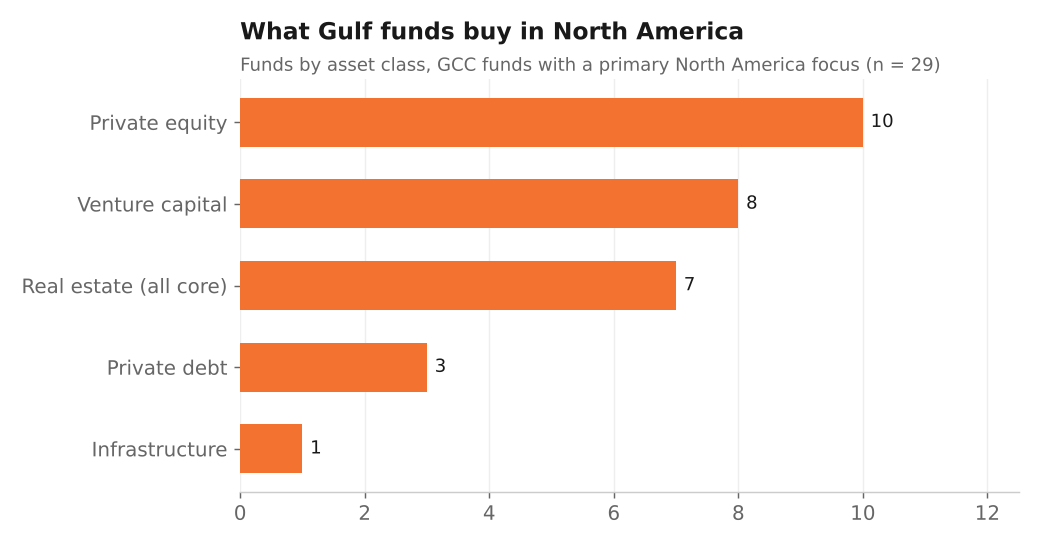
- In North America, Gulf funds buy private equity, venture and stabilised real estate. The 29 North America funds include 10 private equity, 8 venture capital and 7 real estate funds. Every one of the real estate funds is a core strategy, buying completed, income-producing assets.
- The UAE sends the most, and Bahrain punches above its weight. 49 outbound funds are UAE-based and 16 are in Bahrain, where nine focus on North America.
- These funds are built to look international. 55 of the 59 that report a currency are in US dollars. The most common legal homes are the Cayman Islands and Delaware. Their median life is seven years, against four for home-focused Gulf funds.
- Their people are not only in the Gulf. The 38 managers behind these funds have 1,040 professionals in our database, including 167 in the United States and 65 in the United Kingdom.
- Most are still raising. 54 of the 79 are still open, including 29 of the 33 launched in 2024.
Introduction: The Other Direction of Gulf Capital
Most conversations about Gulf money go in one direction: international managers flying to Riyadh, Dubai and Abu Dhabi to ask for capital. That is a real and important flow. But it is only half the picture.
In our earlier report, The Gulf Capital Map 2027, we analysed 338 private-market funds run from the six GCC countries and found that a significant share of them invest primarily outside the Middle East. This report goes inside that group.
It is written for people who are on the receiving end of that capital, or would like to be:
- Real estate developers and owners in the US, UK and Europe looking for equity partners;
- Founders and growth companies in North America, India, Europe and Africa raising venture or growth capital;
- Fund managers and sponsors looking for co-investors or limited partners with a Gulf connection;
- Advisers and capital raisers who help any of the above find investors.
We answer five questions. How many Gulf funds invest abroad, and is that number growing? Where do they invest? What do they buy? Who runs them, and where are their people? And what does all of this mean for anyone outside the Gulf looking for capital in 2027?
As in all our research, we report aggregate figures only and do not name individual funds or people.
Section 1: How Big Is Gulf Outbound Fund Capital?
79 funds, and growing
Of the 338 GCC-based funds in our 2022–2024 vintage database, 79 have a primary investment focus outside the Middle East. That is 23% of all Gulf funds, almost one in four.
The number rose sharply in the most recent vintage:
| Vintage | Outbound Gulf funds | All Gulf funds | Outbound share |
|---|---|---|---|
| 2022 | 23 | 104 | 22% |
| 2023 | 23 | 77 | 30% |
| 2024 | 33 | 157 | 21% |
| Total | 79 | 338 | 23% |
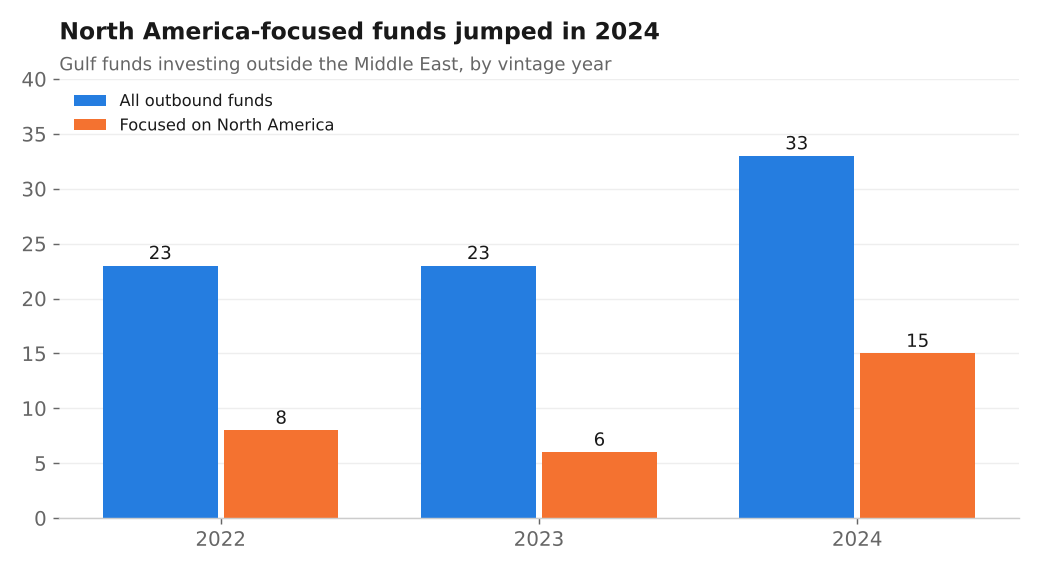
Outbound fund launches rose 43% between the 2023 and 2024 vintages, from 23 to 33. The outbound share of all Gulf funds dipped in 2024 only because home-focused Gulf funds grew even faster, particularly in Saudi real estate.
Most of them are still raising
54 of the 79 outbound funds (68%) are still open: raising, at an interim close, or announced. Among the 2024 vintage, 29 of 33 are still in market. These funds will be actively raising, and in many cases actively looking for deals, through 2026 and 2027.
How much money?
Thirty-six outbound funds disclose a target size, with a combined total of around US$37.9 billion. As with the wider Gulf market, that figure needs careful reading. Two very large UAE-based infrastructure vehicles, one focused on North America and one on Asia, account for about US$30 billion of it. Excluding those two, the remaining 34 funds are seeking around US$7.9 billion, with a median target of US$100 million.
Of the funds that have already reached a final close, 14 report a combined US$3.1 billion raised, with a median final close of US$195 million.
By target size, most outbound funds are small to mid-sized:
| Target size | Funds |
|---|---|
| Up to US$50m | 8 |
| US$50–100m | 10 |
| US$100–250m | 6 |
| US$250–500m | 7 |
| US$500m–1bn | 2 |
| Over US$1bn | 3 |
For a developer, founder or sponsor, the practical implication is that most Gulf outbound funds are writing cheques sized for the mid-market, not just mega-deals.
Section 2: Where the Money Goes
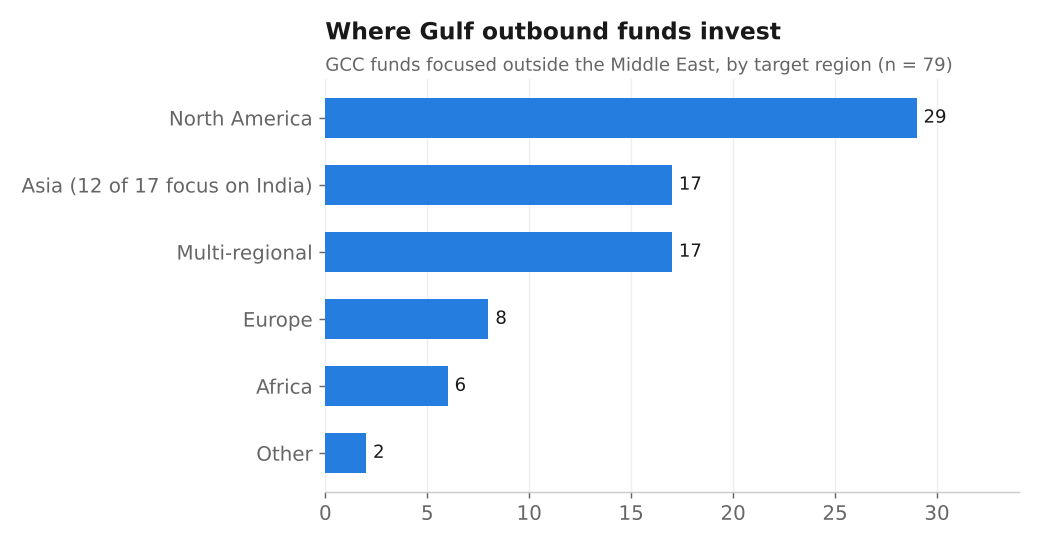
| Target region | Funds | Main asset classes |
|---|---|---|
| North America | 29 | Private equity (10), venture (8), real estate (7) |
| Asia | 17 | Private equity (8), venture (6), real estate (2) |
| Diversified multi-regional | 17 | Venture (14), private equity (2) |
| Europe | 8 | Real estate, venture and private debt (2 each) |
| Africa | 6 | Venture (5), private debt (1) |
| Other | 2 | Infrastructure, multi-asset |
North America: the top destination
North America is the single largest target region, with 29 funds, and the fastest-growing. North America-focused Gulf funds rose from 8 in the 2022 vintage and 6 in 2023 to 15 in 2024, more than doubling in a year. 22 of the 29 are still open. Section 3 looks at them in detail.
Asia: really an India story
Seventeen outbound funds focus on Asia, but the region label hides a much more specific pattern. Twelve of those 17 funds name India as their geographic focus. Two focus on China and the rest on broader Asian strategies.
The Gulf–India corridor is built on deep trade, family and business ties, and it shows in the fund data. Asia-focused Gulf funds lean toward private equity (8 funds) and venture capital (6), and they are overwhelmingly UAE-based (11) and Bahrain-based (5).
For Indian founders, growth companies and fund managers, this is one of the most important and least discussed sources of foreign capital.
Multi-regional: a venture story
Seventeen outbound funds describe themselves as diversified multi-regional, and 14 of these are venture capital funds, including three dedicated to venture debt. These are typically UAE-based managers backing technology companies across several markets, often combining the Gulf, India, Europe and North America in one portfolio.
Europe and Africa: smaller but specific
Europe attracts eight outbound funds, spread across real estate, venture, private debt, private equity and natural resources, with the UK the most-named single country. Africa attracts six, five of them venture capital funds, with a focus on North Africa and Egypt. Every Africa-focused outbound fund in the dataset is UAE-based.
Section 3: Inside the 29 North America Funds
For US and Canadian readers, this is the most important section of the report.
What they buy
| Asset class | Funds | Strategies |
|---|---|---|
| Private equity | 10 | Buyout (3), growth (3), co-investment (3), fund of funds (1) |
| Venture capital | 8 | Generalist venture (6), early stage and start-up (2) |
| Real estate | 7 | All core: diversified (5), office (2) |
| Private debt | 3 | Direct lending (2), special situations (1) |
| Infrastructure | 1 | Core infrastructure |
Three findings stand out.
First, Gulf real estate money in North America is core money. All seven North America real estate funds follow a core strategy: buying completed, stabilised, income-producing property. Five are diversified across property types and two focus on office. This is very different from the Gulf’s home market, where opportunistic and development strategies are common. For US developers, the implication is clear: Gulf funds are most likely to be buyers or long-term equity holders of finished, leased assets, rather than providers of ground-up development equity.
Second, co-investment is part of the model. Three of the ten North America private equity funds are dedicated co-investment vehicles, and every outbound Gulf fund that answers the question (11 funds) says it offers co-investment to its own investors. Gulf managers often invest alongside US sponsors rather than simply handing money to them.
Third, there is a venture and growth appetite. Eight venture funds and three growth equity funds focus on North America. Combined with the multi-regional venture funds, that is a meaningful pool of Gulf capital looking at North American technology companies.
Who sends it
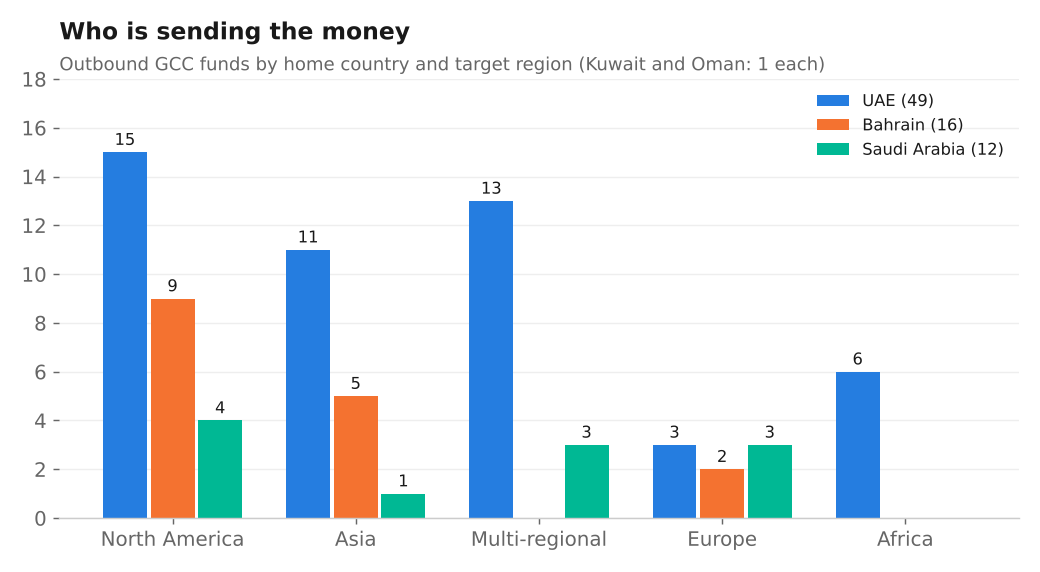
The 29 North America funds come from four countries: the UAE (15), Bahrain (9), Saudi Arabia (4) and Kuwait (1). Bahrain stands out. More than half of all Bahraini outbound funds focus on North America, reflecting a long history of Bahrain-based firms buying US private companies and US real estate on behalf of Gulf investors.
Section 4: Who Runs Gulf Outbound Funds
By country
| Home country | Outbound funds | Main asset classes | Main target regions |
|---|---|---|---|
| United Arab Emirates | 49 | Venture (31), private equity (11) | North America (15), multi-regional (13), Asia (11) |
| Bahrain | 16 | Real estate (7), private equity (6), private debt (3) | North America (9), Asia (5) |
| Saudi Arabia | 12 | Spread across asset classes | North America (4), Europe (3), multi-regional (3) |
| Kuwait | 1 | Private equity | North America |
| Oman | 1 | Venture | Multi-regional |
The UAE dominates, with 49 of the 79 outbound funds, and its outbound funds are heavily venture-focused. Nearly half of all UAE-based funds (49 of 100) invest mainly outside the Middle East, which makes the UAE as much a hub for managing international portfolios as a market in its own right.
Bahrain’s outbound funds look quite different: real estate, private equity and private debt, aimed mainly at North America and Asia. Sixteen of Bahrain’s 23 funds focus abroad.
Saudi Arabia, by contrast, is overwhelmingly domestic. Only 12 of its 209 funds focus outside the Middle East.
By city
By the city of the managing firm, outbound funds are run from Dubai (26), Abu Dhabi (23), Manama (16), Riyadh (9), Dhahran (2) and one each from Muscat, Kuwait and Jeddah.
A concentrated group of managers
The 79 outbound funds are run by just 38 managers. The two most active managers run 24 funds between them, almost a third of the total. For anyone trying to reach Gulf outbound capital, that concentration is good news: a relatively small number of firms account for a large share of the activity.
Section 5: Built to Look International
Outbound Gulf funds are structured very differently from the Gulf funds that invest at home. They are built to look and operate like international private funds.
| Measure | Outbound Gulf funds | Home-focused Gulf funds |
|---|---|---|
| Main currency | US dollar (55 of 59 reporting) | Saudi riyal (148), then US dollar (79) |
| Most common legal homes | Cayman Islands (13), Delaware (8) | Onshore Saudi Arabia and UAE |
| Median fund life | 7 years | 4 years |
| First-time funds | 31% | 22% |
| Use a placement agent (where known) | 13 of 22 | 8 of 24 |
| Offer co-investment (where answered) | 11 of 11 | 11 of 20 |
What this tells us:
- They speak the language of international deals. US dollar funds domiciled in Cayman and Delaware fit naturally alongside US and European co-investors, lenders and sponsors.
- They are longer-term investors. A seven-year median fund life is close to the global norm and much longer than the short, project-based funds common in Saudi real estate.
- They are more likely to be new. Almost a third are first-time funds. Many are run by experienced professionals who have relocated to Dubai or Abu Dhabi to launch international strategies.
- They use professional distribution more often. More of them use placement agents than home-focused Gulf funds, which suggests they raise from a wider, more international investor base.
Section 6: The People Behind the Money
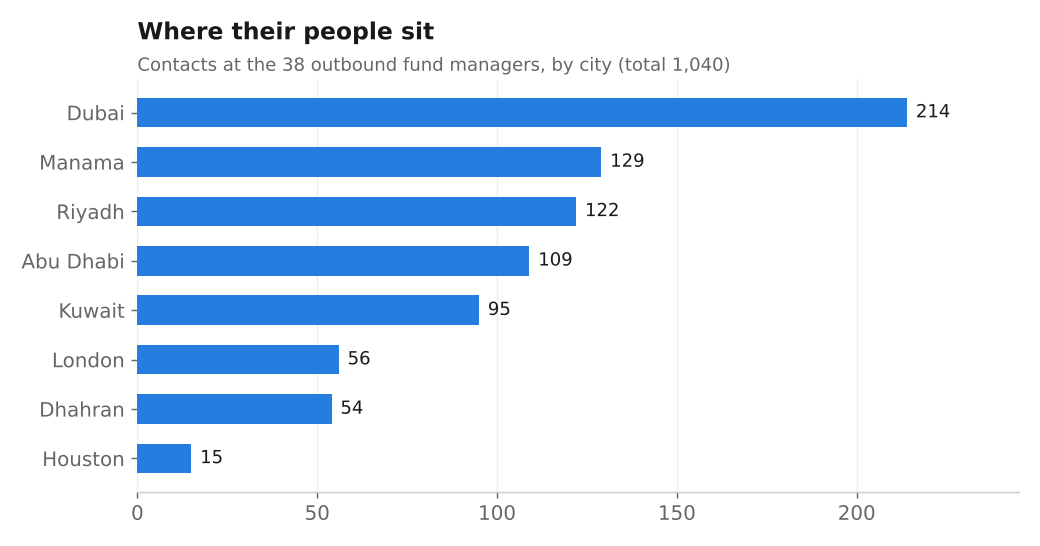
For anyone looking for capital, the most important question is who to talk to. Our database holds 1,040 professionals at 37 of the 38 outbound Gulf fund managers.
They are not all in the Gulf
| Country | Contacts |
|---|---|
| United Arab Emirates | 323 |
| Saudi Arabia | 188 |
| United States | 167 |
| Bahrain | 129 |
| Kuwait | 110 |
| United Kingdom | 65 |
| India | 16 |
This is one of the most practical findings in the report. 167 professionals at these Gulf managers are based in the United States and 65 in the United Kingdom. By city, London (56) and Houston (15) appear alongside Dubai (214), Manama (129), Riyadh (122), Abu Dhabi (109) and Kuwait (95).
In other words, many Gulf outbound managers have deal teams in the markets they invest in. A US developer or founder looking for Gulf capital may find that the right first conversation is with a Gulf firm’s office in New York, Houston or London, not in Dubai.
Seniority
Among the 1,040 contacts:
- 146 partners
- 169 heads of a function or team
- 77 managing directors
- 71 chief executives
- 40 chief investment officers
- 34 chief financial officers
- 17 investor relations professionals
As with the wider Gulf market, investor relations teams are thin. Relationships, and investment decisions, sit with partners, managing directors and senior investment staff. Phone numbers are available for 89% of these contacts and email addresses for 62%.
Section 7: What Could Happen in 2027
The data points to several plausible trends. As always, these are illustrations, not predictions.
- More North America funds. The jump from 6 to 15 North America-focused Gulf funds between the 2023 and 2024 vintages, with 22 of the 29 still open, suggests that Gulf managers will be active buyers of US private equity, venture and core real estate through 2026 and 2027.
- A deepening Gulf–India corridor. With 12 India-focused funds already in the data, India is likely to remain the second-largest destination for Gulf outbound fund capital.
- More co-investment and joint ventures. Gulf outbound managers already lean on co-investment. Sponsors in the US and Europe who can offer co-investment alongside a fund commitment, or a joint-venture structure, are likely to find the warmest reception.
- Core over development. In real estate, expect Gulf outbound capital to keep favouring completed, income-producing assets. Developers seeking construction-stage equity will likely need to look elsewhere, or bring a clear path to stabilisation.
- More local presence. With 167 US-based and 65 UK-based professionals already at these managers, expect Gulf firms to keep building teams in the cities where they invest.
Section 8: A Playbook for Capital Seekers Outside the Gulf
1. Match your deal to what they buy
- Real estate: lead with stabilised, income-producing assets or a clear route to stabilisation. All of the Gulf real estate funds focused on North America in our data are core.
- Private equity: buyouts, growth equity and co-investment opportunities are all represented. Co-investment is a natural entry point.
- Venture and growth: generalist venture funds and multi-regional funds are the main pools. Fintech, e-commerce and clean technology are the most-cited sectors among outbound funds.
2. Look for their local teams
Before booking a flight to Dubai, check whether the Gulf firm you want to reach has people in New York, Houston, London or Mumbai. Many do.
3. Speak to the right person
Go to the partner, managing director or chief investment officer who covers your region and asset class. Investor relations teams are small or absent.
4. Offer something reciprocal
Co-investment rights, joint-venture structures, deal flow in your market, or a role for the Gulf firm in future transactions all signal a long-term relationship rather than a one-off ask.
5. Understand the two routes to Gulf capital
The 79 funds in this report are one route. They are professionally managed vehicles that invest on behalf of Gulf investors. The other route is to go directly to the family offices and private investment companies whose capital often sits behind those funds, and who increasingly invest directly in international deals themselves.
Two Routes to Gulf Capital
For a developer, founder or fund manager outside the region, Gulf capital typically arrives in one of two ways:
- Through Gulf-based fund managers investing abroad, the 79 funds analysed in this report. They are professional, structured and often already present in your market.
- Directly from Gulf family offices, which back many of those funds as investors and also invest directly in private companies, real estate and co-investments around the world.
The first route is visible in fund data like ours. The second is far harder to map: family offices are private by design, rarely publish their mandates and often do not appear in standard fund databases at all.
That is why we maintain a dedicated Middle East Family Office Database, covering 425 family offices across the region, built and verified separately from the fund data in this report. For capital seekers who want to reach Gulf capital at its source, rather than only through intermediaries, it is the natural next step.
Methodology and Data Notes
Source. This analysis uses the Dubai Investors List institutional funds database. The universe is all funds from the 2022, 2023 and 2024 vintages whose manager is based in a GCC country (338 funds), filtered to those whose recorded primary region focus is outside the Middle East (79 funds). Two further GCC funds have no recorded region focus and are excluded.
Regions. Regions follow the primary region focus recorded for each fund. “Other” covers one Americas-wide fund and one Australasia fund. Country-level focus within Asia, Europe and Africa uses each fund’s recorded geographic focus.
Contacts. The people analysis covers 1,040 contacts at 37 of the 38 managers behind the outbound funds. Contacts are counted by their own recorded location, which may differ from the manager’s head office.
Small samples. The outbound universe is small, and many fields are disclosed by only some funds. Figures based on small samples should be treated as indicative.
This database is available for purchase exclusively by institutional-grade clients.

